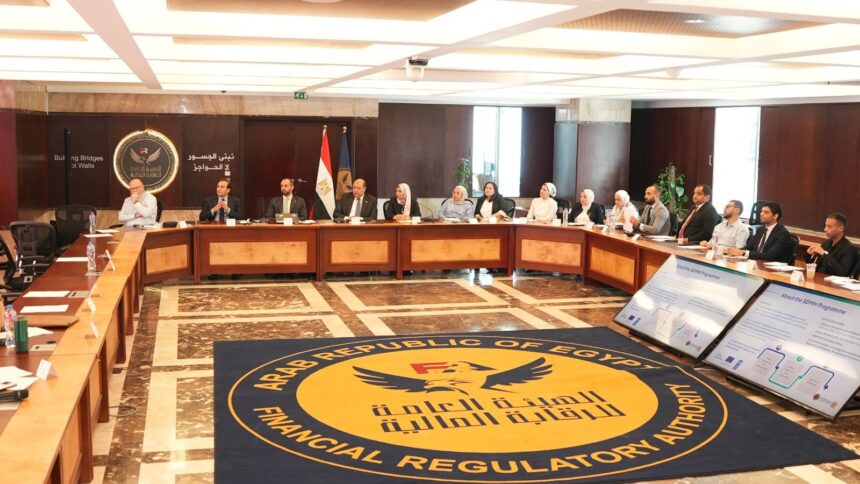
The Financial Regulatory Authority (FRA) held a workshop in cooperation with the European Union and the United Nations Development Programme (UNDP) in Egypt to discuss a draft roadmap for implementing the sustainability disclosure standards issued by the IFRS Foundation.
The workshop was held as part of the Sustainability Disclosure and Management Hub programme, implemented by UNDP under the EU-led Sustainable Finance Advisory Hub. The programme aims to support the development of national sustainability management and disclosure frameworks, strengthen cooperation between government and regulatory authorities and market participants, and help create an investment environment better able to attract capital flows while keeping pace with climate commitments and the Sustainable Development Goals.
The draft roadmap is based on a phased implementation of disclosure requirements, beginning with simplified climate disclosures, followed by initial implementation of the IFRS Sustainability Disclosure Standards and ultimately their full implementation. The approach takes into account varying levels of readiness in terms of governance, data availability and quality, internal systems, technical skills, and audit and assurance requirements.
The first phase focuses on simplified climate disclosures, while the second moves to the initial implementation of the IFRS Sustainability Disclosure Standards. The third phase targets full implementation of the standards. The roadmap also includes a subsequent phase for introducing disclosures aligned with the Global Reporting Initiative (GRI) Standards, supporting the development of a broader disclosure framework covering impact-related reporting and double materiality.
Islam Azzam, Chairperson of the FRA, said developing the sustainability disclosure framework aims to provide more reliable and comparable information on sustainability-related risks and opportunities, helping investors and other users of reports make more efficient decisions, while supporting capital allocation and enhancing the competitiveness of Egyptian markets.
He said the FRA recognises the growing importance of sustainability-related disclosures and the rapid international developments in this area. In its capacity as the regulator of Egypt’s non-banking financial markets, the FRA has already taken significant regulatory steps in line with environmental, social and governance (ESG) standards and the Task Force on Climate-related Financial Disclosures (TCFD) recommendations.
Azzam said the draft roadmap remains under discussion and review before the procedures for its approval are completed. He added that it is based on a phased implementation of sustainability disclosure standards that takes into account varying levels of readiness among regulated entities and builds on existing requirements, allowing those entities to gradually develop their data systems, governance frameworks, capabilities and internal controls.
The workshop was attended by Mahmoud Gibril, Assistant Chairperson of the FRA; Aya Ali, Director-General of the FRA’s Sustainable Development Department; Giacomo Poggio, Coordinator for Investment, Sustainable Finance and Digital Transition at the Delegation of the European Union to Egypt; and Gimar Deeb, Deputy Resident Representative of UNDP in Egypt, alongside representatives of a number of relevant entities and stakeholders.
Participants reviewed the results of an assessment of current disclosures, which identified several challenges related to the quality and depth of disclosures, institutional structures responsible for sustainability, and the availability of expertise and resources. The assessment also highlighted the need to strengthen links between sustainability objectives, data, performance and measurable outcomes, and to further integrate sustainability considerations into strategy and risk management.
Against this backdrop, the draft roadmap includes measures to build capacity, develop technical guidance, support digital transformation and provide data tools, helping entities address readiness gaps before mandatory implementation of each phase begins.
Gibril said the transition to sustainability disclosure standards requires the development of the institutional and technical infrastructure necessary for implementation, including enhancing staff capabilities, improving data quality, developing governance systems and internal controls, and strengthening the participation of companies, investors, auditors and assurance service providers throughout the development and implementation of the framework.
He added that the roadmap builds on Egypt’s existing disclosure framework rather than creating a separate system by developing current ESG and climate disclosure requirements and gradually transitioning to the IFRS Sustainability Disclosure Standards as an international reference that provides a more consistent and comparable basis for disclosing information on sustainability-related risks and opportunities with financial implications. This would enhance reporting quality and support investor decision-making and capital allocation.
The roadmap aims to provide a disclosure framework that is more closely aligned with international standards while remaining appropriate to the Egyptian context, ensuring improved quality of sustainability information and strengthening the ability of Egyptian companies and markets to capitalise on sustainability-related opportunities.