

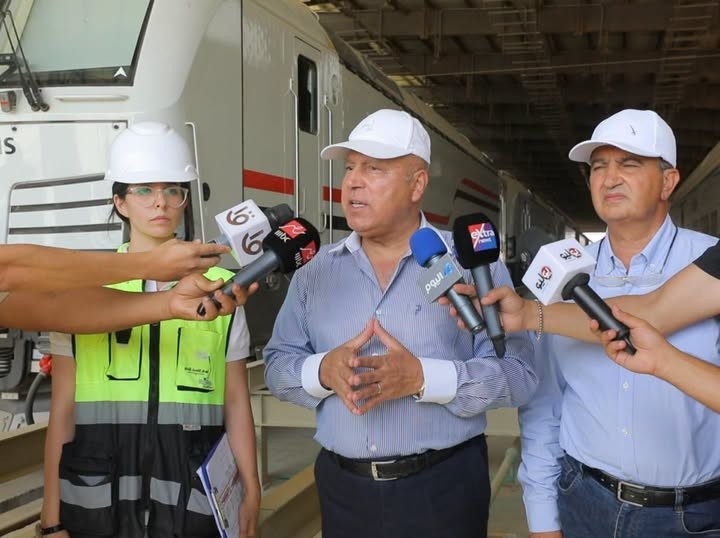
Egypt is developing a 2,250km high-speed electric rail network, upgrading its 10,000km conventional railway system and targeting a combined capacity of around 4 million daily passengers on railways and high-speed trains by 2030, Transport Minister Kamel Al-Wazir said.
Speaking during an inspection tour of the first line of the high-speed electric rail network linking Ain Sokhna, Alamein and Marsa Matrouh, Al-Wazir outlined Egypt’s comprehensive plan to establish an integrated, safe and sustainable mass transit system.
The first three high-speed rail lines, spanning a combined 2,000km, are currently under construction as part of the wider 2,250km network. They include the Ain Sokhna–Marsa Matrouh line via Cairo and Alexandria, the 6th of October–Abu Simbel line serving Upper Egypt, and a line connecting Qena with Safaga and Hurghada. A fourth 250km line linking Port Said and Alexandria is planned in partnership with the private sector.
Al-Wazir said trial operations without passengers on a section of the first line are scheduled to begin in early October, followed by phased testing of the full line before passenger services commence upon completion of technical and safety requirements.
Once the first three high-speed rail lines become operational, they are expected to carry around 2.5 million passengers daily, while Egypt’s conventional railway network is targeted to transport 1.5 million passengers per day by 2030, bringing total rail capacity to approximately 4 million daily passengers.
Egypt’s existing railway network, extending over 10,000km, is undergoing comprehensive upgrading, including signalling modernisation and the addition of around 400km of new lines serving major industrial zones in 10th of Ramadan, 6th of October, Sadat City and Borg El Arab.
Around 900 trains currently operate daily using approximately 1,000 locomotives and 4,000 railcars, transporting between 1.1 million and 1.2 million passengers each day.
The minister added that the wider mass transit strategy is based on three pillars: intercity transport through railways, high-speed trains and buses; urban transport systems in major cities; and feeder networks connecting residential communities to major transport hubs.
In Greater Cairo, the metro network currently carries between 2 million and 2.5 million passengers daily. The first phase of Metro Line 4, connecting 6th of October with Fustat via the Giza Plateau and central Cairo, is expected to begin trial operations in mid-2027. The line is projected to eventually carry between 1 million and 1.25 million passengers per day.
Meanwhile, Egypt’s Bus Rapid Transit network on the Ring Road is expanding, with 320 locally manufactured electric buses contracted. Of these, 100 are already operating, while additional deliveries are scheduled through January 2027.
The country is also developing a 100.3km monorail network, comprising 43.8km west of the Nile and 56.5km east of the Nile, linking the New Administrative Capital with Greater Cairo through integration with Metro Line 3.
In Alexandria, the government is implementing a 108km metro project to replace the existing Abu Qir railway, while the first phase of the Raml Tram upgrade extends 13km.
Al-Wazir noted that Egypt’s transport strategy aims to connect all modes into one integrated network, supported by feeder services and private-sector participation.
He concluded that development loans are limited to rolling stock and major electric transport projects, account for no more than 30% of project costs, and have repayment periods of up to 40 years.


