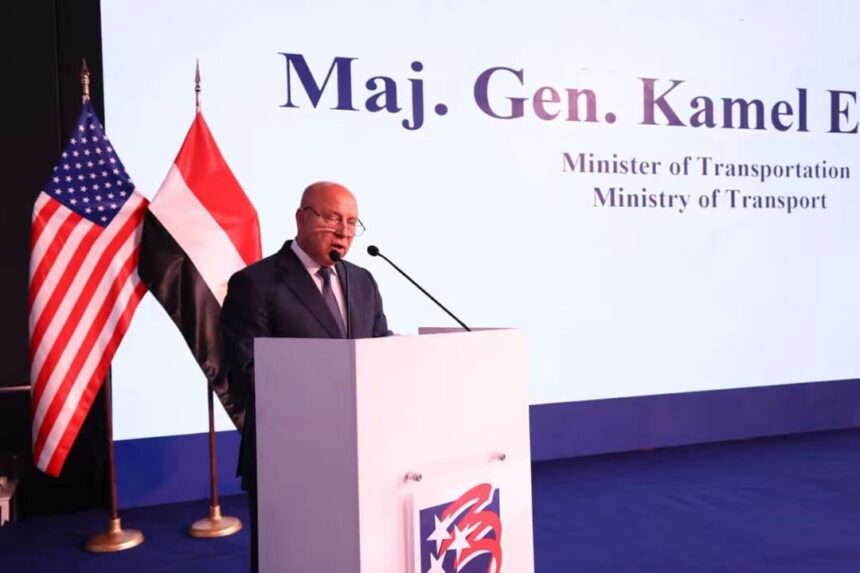
Transport Minister Kamel Al-Wazir said Egypt has successfully forged strategic partnerships with major global port operators, shipping lines and international operators, strengthening the ability of Egyptian ports to attract transshipment trade and enhance their global competitiveness. He also expressed his aspiration to expand cooperation with US companies in the sector.
The Minister made the remarks during his participation in the “Port Infrastructure and Maritime Innovation” conference, organised by the Commercial Office of the US Embassy in Cairo. The event was attended by Robert Silverman, Chargé d’Affaires of the US Embassy in Cairo; Mark Mitchell, US Deputy Assistant Secretary of Commerce; and several senior officials, decision-makers and representatives of the maritime transport and business sectors from both countries.
In his speech, Al-Wazir said the conference reflects the depth of Egyptian-US relations, which extend beyond trade and investment cooperation to an established strategic partnership that has demonstrated its ability to support growth, stability and development. He noted that cooperation in vital sectors is a key driver of the two countries’ shared interests.
He explained that maritime transport is central to this partnership, given Egypt’s strategic geographical location, the Suez Canal, its developed ports and logistics zones.
Furthermore, Al-Wazir noted that Egypt has made significant progress in the transport sector by expanding infrastructure, shifting towards smart and sustainable modes of transport, and strengthening regional and international connectivity. He added that the state has also adopted an integrated vision to support the blue economy by developing maritime transport, ports and logistics services and improving supply chains, while adhering to international environmental standards and supporting industrial, agricultural and urban development targets, increasing exports and attracting investment.
He added that the state is currently implementing eight integrated international development and logistics corridors linking Red Sea and Mediterranean ports and the Suez Canal corridor with dry ports and industrial, agricultural and mining zones through railway networks, high-speed electric trains and highways. These corridors will help reduce the time and cost of transporting goods and strengthen Egypt’s position as a regional transport and logistics hub and a centre for transshipment trade, he noted.
The Transport Minister said the key corridors include Al Arish-Taba, Sokhna-Alexandria, Safaga-Qena-Abu Tartour, Cairo-Alexandria, Tanta-Mansoura-Damietta, Gargoub-Salloum, Cairo-Aswan-Abu Simbel, and Bernice-Aswan-East Oweinat-Al Kufra-N’Djamena.
These corridors offer extensive opportunities for cooperation, investment and partnerships with the US in transport, logistics, mining, industry and infrastructure, he said. He also highlighted the importance of the Al Arish-Taba and Sokhna-Alexandria corridors in supporting Egypt’s potential integration into the India-Middle East-Europe-America Economic Corridor (IMEC), stressing Egypt’s readiness, backed by its advanced infrastructure, ports and industrial and economic zones.
Al-Wazir stressed that Egypt’s unique geographical location, together with the security and stability it enjoys, strengthens its role as a key hub for global trade. He explained that Egypt’s logistics corridors support the Northern Arab Trade Corridor linking Europe with the Levant, as well as the Southern Arab Trade Corridor linking Europe with the Gulf states through Egypt. This, he said, would help facilitate global trade flows and open new avenues for cooperation with the US.
He noted that the strategy for developing Egypt’s maritime transport industry aims to transform Egyptian ports into integrated logistics hubs connected to various transport networks. This will reduce clearance and handling times, cut costs and improve the efficiency of exports and imports.
The plan also includes developing ports on the Red Sea and Mediterranean coasts and establishing five new ports, bringing the total number of commercial ports to 19. It also expands their total area to around 100 million square metres, adds 70 kilometres of berths, and develops navigation breakwaters and fleets of marine tugboats.
Al-Wazir also said the state is working to develop Egypt’s merchant fleet to reach 40 vessels by 2030, with an annual transport capacity of 30 million tonnes. This will be accompanied by the implementation of green maritime transport projects, greater use of clean energy, reductions in carbon emissions and the application of international environmental standards at ports.
Concluding his remarks, the Transport Minister affirmed the Egyptian government’s readiness to provide support and assistance to serious investors, particularly US investors, across the transport sector. He stressed that the future of the sector rests on partnership, integration and the exchange of expertise, while expressing his aspiration to broaden the horizons of Egyptian-US cooperation in a manner that promotes shared prosperity and strengthens the sustainability of global trade.