

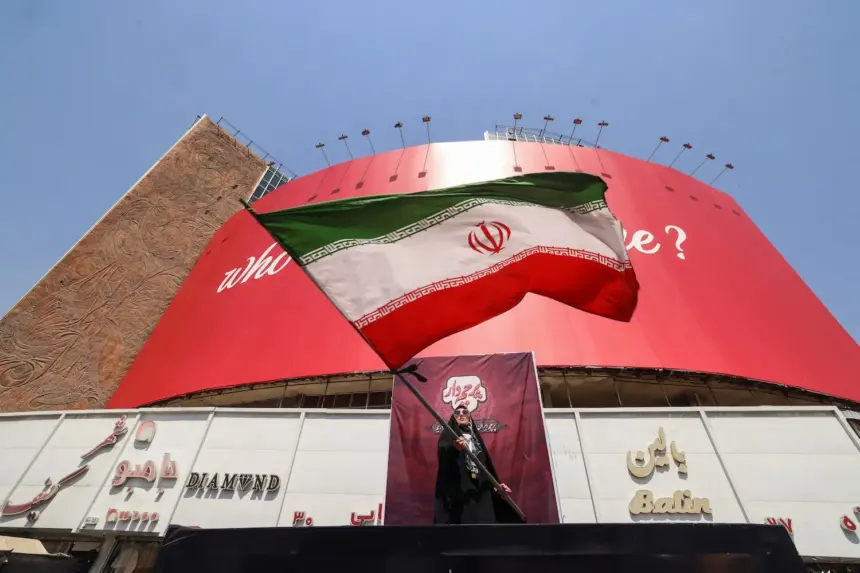
The United States and Iran have escalated their rhetoric ahead of expected new American economic sanctions, which Washington describes as the “harshest in history”, amid persistent military threats and ongoing traffic disruptions in the Strait of Hormuz.
US Treasury Secretary Scott Bessent is scheduled to hold a news conference at noon on Monday in Washington (1800 GMT) to unveil the measures, following warnings from US President Donald Trump of economic consequences for any country offering vital support to Tehran. Speaking to CNBC on Thursday, Bessent stated that the administration would detail its specific actions regarding Iran, adding that the goal is to bring down the regime.
Trump told reporters on Friday that while Iran desires an agreement, it is not ready to make the right deal. He insisted that relying on economic pressure does not mean US military options are limited, adding that the US is monitoring developments. Trump also asserted that the US exercises complete control over the entire area surrounding the Strait of Hormuz, extending to inland land areas.
However, shipping tracking data indicates continued disruption in the strategic waterway, which handled approximately one-fifth of global crude oil and liquefied natural gas (LNG) shipments prior to the conflict. Data from tracking firm Kpler showed that only seven commercial vessels crossed the strait on Thursday, down from 14 the previous day, with zero Very Large Crude Carriers (VLCCs) or LNG tankers making the passage.
Meanwhile, US Central Command (CENTCOM) confirmed that its forces had diverted 68 commercial vessels, disrupted three, and boarded three others as of Friday to enforce a naval blockade on Iranian ports. In contrast, US Energy Secretary Chris Wright stated on social media platform X that the US military helped facilitate the transit of over 15 million barrels of oil through the strait on Tuesday, bringing total exports leaving the region that day via pipelines and shipping to roughly 20 million barrels.
In response to Washington’s planned measures, Iranian Foreign Minister Abbas Araghchi posted a history of US sanctions on X on Friday, stating that Tehran had seen this movie before. Foreign Ministry spokesman Esmaeil Baghaei described the upcoming announcement as an assertion of extraterritorial sovereignty over independent UN member states, arguing that secondary sanctions have no basis in international law.
Iranian Parliament Speaker and chief negotiator Mohammad Bagher Ghalibaf stated on Tuesday that the Strait of Hormuz would remain closed until Washington fulfils the terms of the memorandum of understanding (MoU) signed in June. Ghalibaf outlined these conditions as lifting the US blockade on Iranian ports, removing sanctions on Iranian oil exports, unfreezing Iranian assets, and ending military threats and operations on all fronts.
The June MoU had established a maximum 60-day window for both sides to negotiate a final agreement, extendable by mutual consent, before talks stalled over the strait. Trump declared the agreement over on July 7, after which the Iranian Foreign Ministry announced the MoU’s suspension.
Coinciding with Washington’s statements, Major General Ali Abdollahi, Chief of Staff of the Iranian Armed Forces, warned on Friday of a broad and decisive response to any new US threats, confirming that Iranian land, sea, air, air defence, and cyber forces stand ready to act. Conversely, Iranian President Masoud Pezeshkian called for a diplomatic outcome, telling state news agency ISNA that it is better to end the war while Iran remains in a position of strength and dignity. Pezeshkian asserted that the world recognises Iran’s victory and acknowledges that the US attacked schools, hospitals, and infrastructure contrary to international law.
