
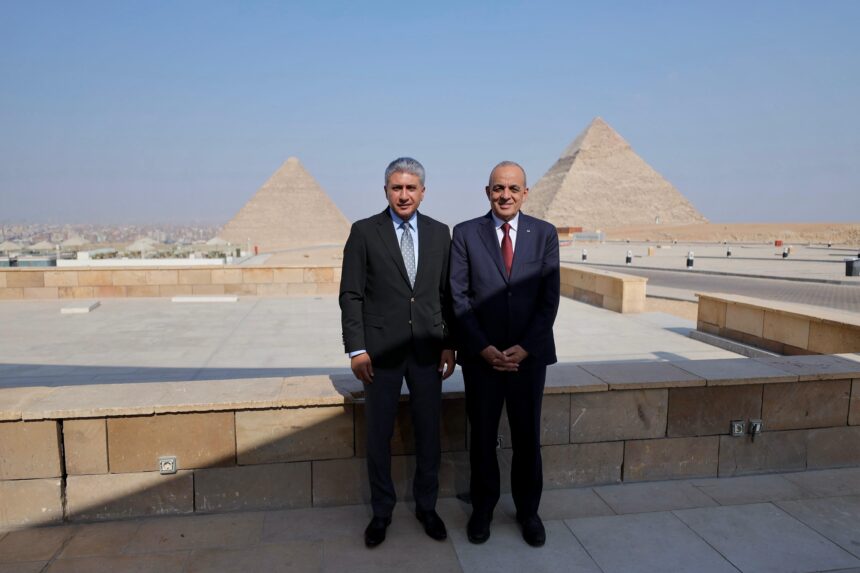
Egypt’s Minister of Tourism and Antiquities Sherif Fathy met with his Jordanian counterpart, Imad Al-Hajazin, and the accompanying delegation at the Grand Egyptian Museum during the Jordanian minister’s current visit to Egypt to discuss ways to strengthen cooperation and exchange expertise in tourism and antiquities.
The meeting focused on proposals to develop and launch joint tourism products and programmes and promote them in international markets, as well as opportunities to enhance archaeological cooperation and knowledge exchange between the two countries.
Fathy welcomed his Jordanian counterpart and the delegation to their “second homeland”, Egypt, emphasising the depth of the historic and fraternal relations between Egypt and Jordan and the close cooperation between the two countries across various fields.
He said the tourism and antiquities ministries of both countries are keen to build on these strong relations by implementing practical programmes and projects that enhance tourism and archaeological cooperation and serve their shared interests.
Joint tourism product linking Egypt and Jordan
The two ministers discussed a proposal to develop a joint Egyptian-Jordanian tourism product combining destinations and tourism experiences in both countries within a single trip.
The initiative aims to attract more international tourists, particularly from long-haul markets such as Latin America, by leveraging the air connectivity provided by EgyptAir and Royal Jordanian to facilitate tourist movement and support joint promotion.
They also discussed opportunities to link tourism and archaeological sites and routes in Egypt and Jordan, providing visitors with a richer and more diverse experience.
Joint religious tourism product
The meeting also addressed a proposal to launch a joint religious tourism product linking religious and spiritual sites in Egypt and Jordan, taking advantage of Jordan’s 2030 commemoration of the Baptism of Jesus Christ to promote the product.
Fathy stressed that the proposed product should not be limited to a particular occasion, but should provide an integrated, sustainable, year-round tourism experience based on the unique religious and archaeological assets of both countries.
The ministers agreed to establish a joint working group to develop implementation mechanisms and tourism programmes, prepare integrated tourism packages and promote them internationally. They also agreed to strengthen cooperation between the private tourism sectors of both countries in designing and marketing these programmes.
Archaeological cooperation and capacity building
The meeting also addressed cooperation and knowledge exchange in archaeological research, excavation, restoration, museum display, training and capacity building.
Fathy affirmed the ministry’s readiness to share its accumulated expertise and support areas of cooperation identified by the Jordanian side.
Al-Hajazin praised Egypt’s achievements in Egyptology and highlighted the expertise of Egyptian archaeological professionals in archaeological management, excavation and restoration, as well as Egypt’s continued cooperation with foreign missions, universities and scientific institutions.
Private sector role in heritage sites
The ministers also discussed Egypt’s experience in engaging the private sector in providing and operating services at archaeological sites and museums.
Al-Hajazin praised what he witnessed during his visits to the Giza Pyramids and the Grand Egyptian Museum, particularly the balance between preserving their archaeological and cultural value and enhancing tourism activity and visitor services.
Fathy emphasised that preserving and protecting archaeological sites remains a top priority, alongside enhancing the tourism experience and maximising their economic value.
He explained that the ministry establishes the vision and regulatory framework, while the private sector’s expertise is leveraged to implement and operate certain services within this framework.
He added that revenues generated from archaeological sites help support the Supreme Council of Antiquities’ preservation and development efforts, as well as maintenance, restoration and conservation work at other archaeological sites across Egypt, contributing to the sustainable management of the country’s cultural heritage.
Following the meeting, the Jordanian minister and delegation toured the Grand Egyptian Museum and visited the Giza Pyramids area, accompanied by Minister Fathy.