

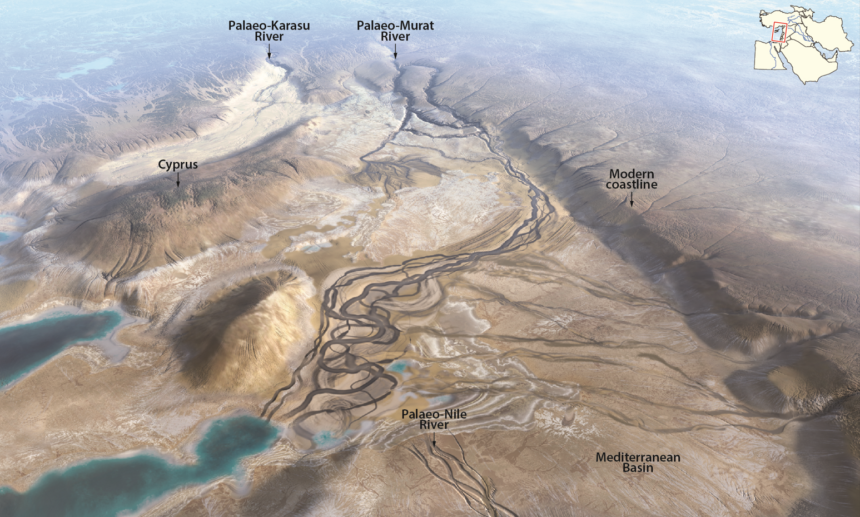
Millions of years before the first cities emerged in Mesopotamia, the Euphrates River followed a very different path from the one known today. Rather than flowing southeast through present-day Turkey, Syria, and Iraq toward the Persian Gulf, the river system may once have consisted of two separate waterways that drained into the eastern Mediterranean Sea.
That is the conclusion of a new study published in the journal Nature Geoscience, which reconstructs the deep geological history of one of the world’s most significant rivers and sheds new light on the tectonic forces that gradually transformed its course over millions of years.
The findings could also help explain the geological origins of the vast sedimentary plains of the Fertile Crescent, a region that would later become the cradle of agriculture and some of humanity’s earliest urban civilizations.
For decades, scientists have debated the ancient course of the Euphrates. Competing theories suggested that the river may have terminated in inland lakes in Anatolia, flowed toward the Arabian Peninsula, or emptied directly into the Mediterranean.
To investigate the question, researchers combined high-resolution marine seismic data, topographic reconstructions, and advanced computer modelling. Their analysis focused on extensive sediment deposits buried beneath the eastern Mediterranean seabed.
These deposits accumulated during the Messinian Salinity Crisis, a dramatic geological event that occurred between 5.97 million and 5.33 million years ago. During this period, the Mediterranean Sea became partially isolated from the Atlantic Ocean, causing sea levels to fall sharply and vast quantities of salt to accumulate across the basin.
Instead of the expansive sea visible today, much of the Mediterranean transformed into a deeply incised landscape with reduced water coverage, receiving sediment and freshwater from surrounding river systems.
By examining the buried deposits, researchers identified evidence of two major ancient river systems, which they named Paleo-Karasu and Paleo-Murat. Both originated in Anatolia and flowed southwest toward the eastern Mediterranean basin.
“The most surprising finding for us was that the ancestral Euphrates system drained into the Mediterranean rather than the Persian Gulf,” said Abdullah Zeki, a co-author of the study and a postdoctoral researcher in Earth sciences at the University of Texas at Austin.
According to the researchers, tectonic activity in eastern Anatolia gradually altered the region’s topography. Uplift and fault movements reshaped drainage patterns, forcing the rivers to change course over time.
One river was diverted eastward during the early Pliocene epoch, followed by the second system several million years later. Eventually, the two merged, forming the foundation of the modern Euphrates River.
The study suggests that the Euphrates did not settle into a course resembling its present-day path until approximately 1.6 million years ago, a relatively recent development on a geological timescale.
The implications extend far beyond the history of a single river. As these ancient waterways shifted eastward, they carried enormous quantities of sediment that helped create the fertile lowland plains of the Fertile Crescent. These landscapes would later support agriculture, permanent settlements, and the emergence of some of the world’s earliest cities.
Researchers also found evidence that the ancient river systems transported remarkably large volumes of water despite the widespread drying that characterised the Mediterranean region during the Messinian Salinity Crisis.
Their models indicate that the combined discharge of the Paleo-Karasu and Paleo-Murat rivers may have exceeded the modern flows of the Nile, Euphrates, and Tigris rivers combined. The finding suggests that parts of Anatolia were likely wetter and more mountainous than previously believed, receiving greater rainfall or experiencing more intense flood events.
Another unexpected discovery concerns the relationship between the ancestral Euphrates system and the ancient Nile.
At one stage during the Messinian Salinity Crisis, the two river systems may have approached to within just 25 kilometres of each other, the closest known distance between them in Earth’s history.
The researchers emphasise that this does not imply the rivers were directly connected. Rather, it illustrates how dramatically different the geography of the eastern Mediterranean and Middle East was during that period, when changing sea levels and tectonic processes repeatedly reshaped major drainage basins.
The study also suggests that the sharp decline in Mediterranean sea levels accelerated erosion throughout the region, carving deeper valleys and transporting enormous volumes of sediment into lower basins. Some of these deposits may have resulted from catastrophic flooding events triggered by the collapse of elevated lakes in Anatolia.
Despite the significance of the findings, the researchers acknowledge several limitations. Because the ancient river systems disappeared millions of years ago, their reconstruction relies heavily on modern topography, seismic imaging, and computer simulations rather than direct geological evidence from every segment of the rivers.
Estimates of water discharge and the timing of tectonic shifts also depend on modelling assumptions that carry a degree of uncertainty.
The authors note that future research involving additional sediment records, mineral analyses, and palaeodrainage studies will be necessary to test and refine the proposed reconstruction.
If confirmed, the findings would not only reshape scientific understanding of the Euphrates River’s geological history but also provide new insights into the tectonic and climatic processes that helped create the landscapes where some of the world’s earliest civilizations eventually emerged.


