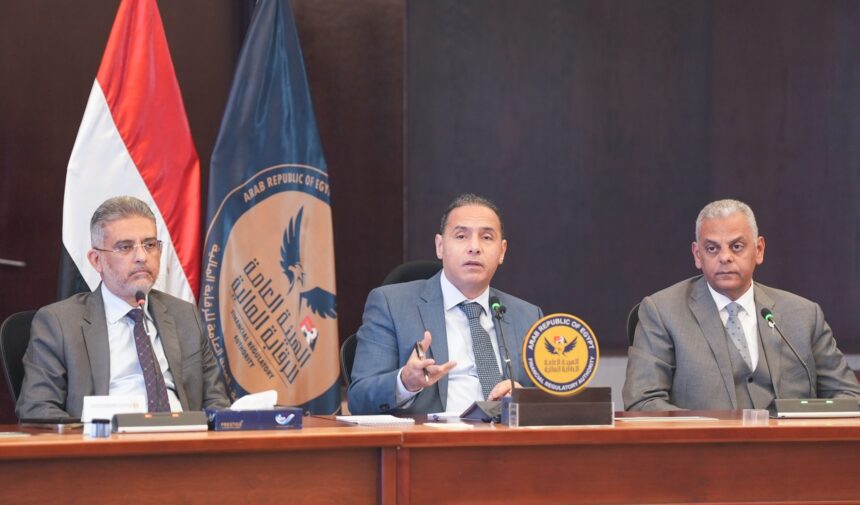
Islam Azzam, Chairperson of the Financial Regulatory Authority (FRA), said the authority places special priority on the insurance sector, given its vital role in achieving financial stability and providing protection for individuals and institutions.
He stressed the importance of continued coordination and cooperation with the Egyptian Insurance Federation and all relevant stakeholders to enhance confidence among market participants and support the sector’s development.
Azzam noted that the FRA will continue its efforts to address regulatory and operational challenges, while working to develop supervisory frameworks and issue regulations that enhance market efficiency and increase insurance penetration, in line with international best practices.
He also underscored the importance of institutionalising a consultative dialogue approach as an effective tool for strengthening direct communication with all relevant parties, contributing to market development and creating a business environment conducive to growth and investment.
These remarks came during an expanded meeting held by the FRA Chairperson with representatives of insurance companies that are members of the Egyptian Insurance Federation, as part of a broader series of consultations he is conducting with stakeholders across non-banking financial activities. These meetings aim to support market efficiency and strengthen the sector’s role in the national economy, in line with the authority’s strategy to drive a qualitative shift in the performance and growth of non-banking financial markets.
At the outset of the meeting, Azzam reiterated the FRA’s commitment to fostering a consultative dialogue as a mechanism for strengthening communication channels with all stakeholders in non-banking financial activities, supporting efforts to develop and expand markets and create an attractive, growth-oriented business environment.
He added that he is keen to listen to the various perspectives and challenges facing the insurance sector, and to explore ways to develop it and expand its market size in a manner that supports greater insurance, financial and investment inclusion, while increasing the sector’s contribution to gross domestic product.
The FRA Chairperson explained that the meeting focused on three main pillars: addressing current challenges, listening to practical proposals from market participants, and reaching realistic solutions that enhance the sector’s ability to play its vital role in mobilising savings and directing them towards development projects. This, he noted, also contributes to reducing financial burdens on citizens through insurance coverage in the event of unforeseen losses, ensuring business continuity and protecting assets.
The meeting discussed a number of key issues, foremost among them the executive decisions issued under the Unified Insurance Law No. 155 of 2024 and mechanisms for their implementation, in a way that balances regulatory oversight with market growth.

Discussions also covered the expansion of InsurTech and financial technology applications as key drivers of sector development, supporting innovation and improving customer experience. This comes alongside activating the FRA’s Regulatory Sandbox, which allows digital solutions and business models to be tested in a safe and supervised environment. The sandbox helps balance support for innovation with market stability and the protection of stakeholders’ rights, while enabling companies to refine their solutions prior to wider deployment and enhance readiness for digital transformation.
In this context, a number of insurance company representatives expressed interest in expanding the issuance of policies through InsurTech solutions, reflecting a growing trend towards adopting modern digital models. This shift is expected to simplify underwriting, pricing and policy management processes, accelerate service delivery, and expand access to broader customer segments.
The discussions also addressed documentation procedures for approving insurance policies at the FRA, which were described as efficient and flexible, supporting faster processing and strengthening the investment climate. It was emphasised that each insurance policy has specific technical conditions that require individual assessment rather than standardised templates, ensuring a balance between risk management and policyholder protection.
The dialogue further explored proposals submitted by insurance companies to enhance the retention of insurance premiums within the domestic market, within the framework of developing and improving the efficiency of the reinsurance sector. This aims to reduce the outflow of premiums abroad and maximise the use of local risk management capacities.
Some companies presented research papers outlining practical proposals, including tools to increase retention rates, develop local reinsurance mechanisms, and improve risk management and distribution, thereby strengthening the sector’s resilience and stability.
The application of corporate governance rules issued by the FRA was also reviewed, with emphasis on activating the role of company boards and their subcommittees. This includes ensuring regular board meetings and the effective functioning of specialised committees such as audit, risk, investment, and nominations and remuneration committees.
The discussion also addressed companies’ perspectives on complying with new governance requirements and ways to enhance board performance through more frequent committee meetings and stronger roles in supporting management decisions, transparency, and internal oversight. This follows governance rules issued by the FRA under Board Decision No. 200 of 2025 dated 27 October 2025, reflecting a broader move towards embedding sound governance principles within the insurance sector.
Challenges facing insurance companies formed a significant part of the discussion, particularly in relation to expanding the insured base, increasing coverage levels, strengthening policyholder protection, and ensuring the sector’s long-term sustainability.
Representatives of insurance companies expressed appreciation for the FRA’s efforts to maintain open channels of dialogue, affirming their support for all initiatives aimed at developing the sector and enhancing its ability to meet the needs of different segments of society.
According to the FRA, total insurance premiums reached approximately EGP 10.9bn in January 2026, including around EGP 7.3bn in property insurance premiums, while total claims paid by insurance companies amounted to approximately EGP 3.8bn.