

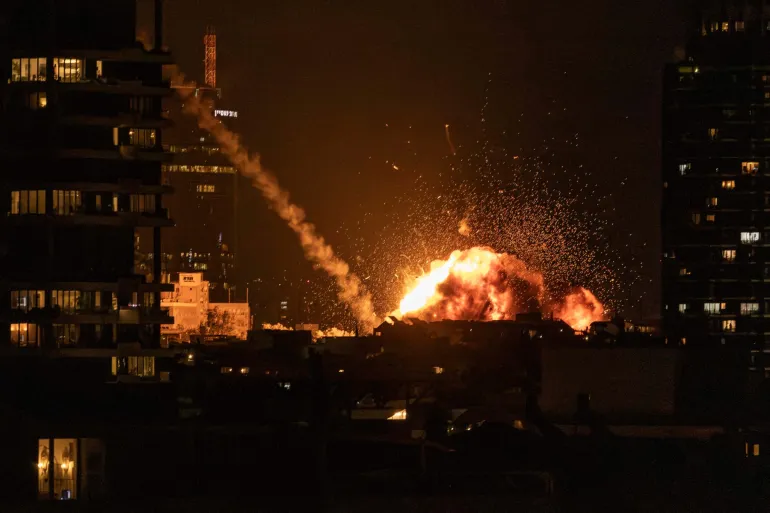
Military operations intensified between the United States and Israel on one side and Iran on the other, with renewed strikes on key facilities and continued missile exchanges, despite a U.S. announcement of a temporary pause targeting Iran’s energy sector.
Iran’s Fars News Agency reported that U.S.-Israeli strikes hit gas facilities in the cities of Isfahan and Khorramshahr. Iranian media later said a second strike targeted a gas administration building in Isfahan, with no casualties reported, as air defences attempted to intercept incoming attacks.
Iran, meanwhile, continued launching missiles towards Israel and nearby areas, triggering sirens in Tel Aviv, Dimona and Eilat in the south, as well as Haifa, Nahariya and Hadera in the north. Explosions were reported in areas including Nesher and Nahariya, attributed to falling warheads.
The developments came despite U.S. President Donald Trump announcing on Truth Social a five-day delay in strikes on Iran’s energy infrastructure, contingent on the outcome of what he described as “constructive” talks with Tehran.
However, U.S. officials said the pause applies only to energy-related sites and does not include military, naval, ballistic missile or defence industrial targets, indicating that broader operations would continue.
Iran has denied holding any negotiations with Washington in recent weeks, with both its foreign ministry and parliament speaker Mohammad Bagher Ghalibaf rejecting such claims. Pakistan also denied hosting talks, while expressing readiness to facilitate dialogue.
In the Gulf, the UAE Ministry of Defence said a Moroccan civilian contractor was killed and five personnel were injured in an Iranian missile attack targeting Bahrain, describing it as a “serious escalation.” Bahrain’s defence forces reported additional injuries, most of them minor to moderate.
The UAE said its air defences intercepted five ballistic missiles and 17 drones in the latest wave of attacks, bringing the total since the escalation began to 357 ballistic missiles, 15 cruise missiles and 1,806 drones.
Bahrain said it had intercepted and destroyed 153 missiles and 301 drones, condemning what it described as violations of international humanitarian law and attacks on civilian infrastructure.
Israel’s health ministry said 4,829 people have been injured by Iranian attacks since February 28, including 122 in the past 24 hours, with 111 still hospitalised, some in critical condition.
The Israeli military said it has struck more than 3,000 targets in Iran since the start of the conflict, including missile launch sites, intelligence facilities and weapons depots, as part of efforts to expand air superiority.
Inside Iran, authorities reported dozens of arrests on charges of collaborating with “hostile entities,” alongside measures to identify and confiscate related assets.
Regionally, Qatar reiterated calls for de-escalation. Foreign ministry spokesperson Majed Al-Ansari said Doha has urged an end to the war since the outset, noting that it is not currently mediating and warning of significant economic repercussions from the ongoing conflict.
