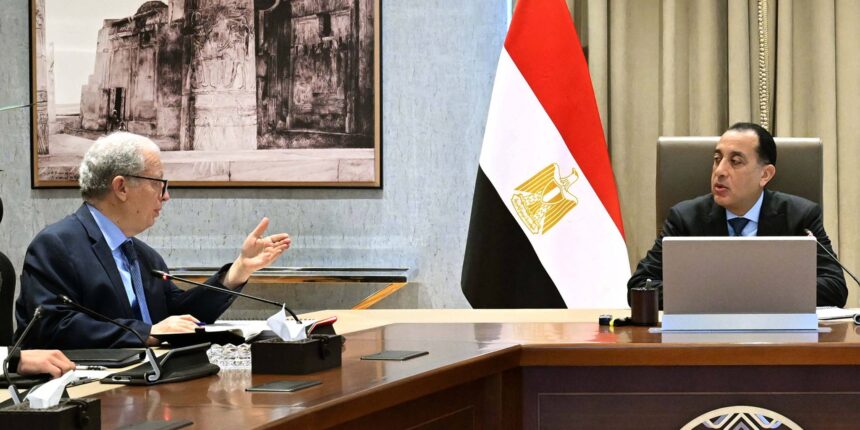
Egyptian Prime Minister Mostafa Madbouly chaired a government meeting on Sunday at the New Administrative Capital to review progress on a number of priority economic files, including the restructuring of state-owned companies, planned stock market listings, and updates to the State Ownership Policy Document.
The meeting was attended by Deputy Prime Minister for Economic Affairs Hussein Eissa and Assistant to the Prime Minister and CEO of the Cabinet’s State-Owned Companies Unit, Hashem El-Sayed.
At the outset, Madbouly highlighted the continued oversight by Eissa of key economic portfolios, stressing the importance of closely monitoring the implementation of directives related to state-owned companies and economic authorities.
Eissa presented updates on several tracks. Regarding the State Ownership Policy Document, he noted that a specialised team is finalising the updated version and coordinating with relevant ministries to incorporate their feedback.
On capital market developments, Eissa reviewed the status of companies temporarily listed on the Egyptian Exchange, explaining that initial listings are being prepared ahead of final registration.
The meeting also addressed the transfer of 40 selected companies to the Sovereign Fund of Egypt, with procedures currently underway to ensure a smooth handover process.
Eissa added that recent discussions with the Central Bank of Egypt focused on positive economic indicators and measures aimed at curbing inflation, maintaining stable prices for essential goods, and supporting sustainable growth.
On restructuring efforts, work is proceeding along two main tracks. The first concerns six major authorities, including the Agricultural Development and Reconstruction Authority, the National Media Authority, the New Urban Communities Authority, the Supply Commodities Authority, and the Railway and Metro Authorities.
The second track covers 14 additional authorities, seven of which are set to be merged, while the remaining seven will be converted into public authorities, with implementation mechanisms currently being defined.
For his part, El-Sayed outlined the criteria used to select the 40 companies earmarked for transfer to the sovereign fund, noting that they hold strong competitive positions in their respective sectors. He added that coordination with the Ministry of Investment and International Cooperation is ongoing to ensure the fund is fully prepared to manage these assets efficiently.
Madbouly concluded by underscoring the strategic importance of these initiatives, describing them as central to Egypt’s economic reform agenda and instrumental in enhancing the performance of key economic indicators.