

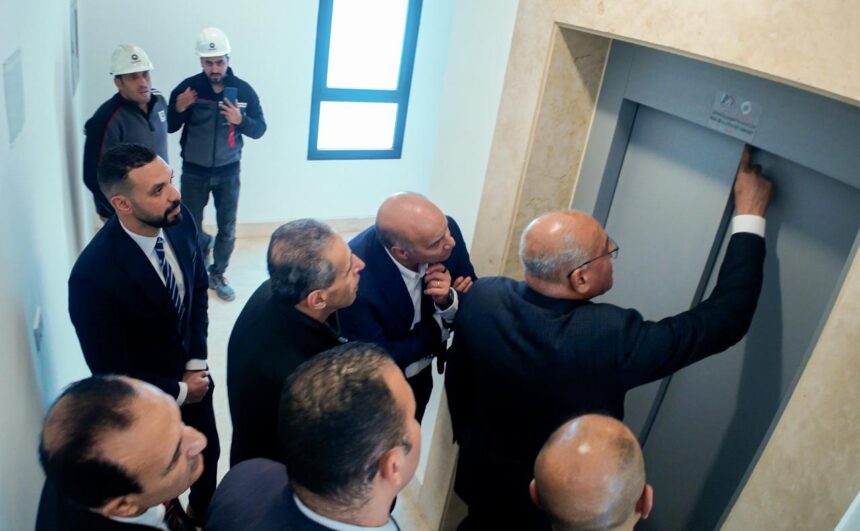
High above the manicured streets of Madinaty’s B8 district, the silent hum of a new elevator marks more than just a mechanical ascent for Talaat Moustafa Group (TMG), the country’s largest listed developer. It represents the first physical output of a strategic pivot in Egypt’s industrial landscape. As Mokhtar Abdel Latif, Chairperson of the Arab Organisation for Industrialization (AOI), inspected these newly installed units this week, the occasion signalled a transition from heavy reliance on European imports to a “Made in Egypt” reality.
This shift from importer to manufacturer is the cornerstone of a new initiative led by Talaat TMG. By localising the production of elevators through a landmark partnership with the AOI and Switzerland’s Schindler, the real estate titan is attempting to insulate the domestic market from foreign currency shocks. The move serves as a “Why now?” response to Egypt’s broader economic pressure, transforming the property sector from a consumer of resources into a driver of industrial self-sufficiency.
The Shift to Industrial Localisation and Currency Stability
The initiative, led by TMG, establishes an integrated industrial framework alongside the AOI and Schindler to manufacture elevators locally. Historically, the Egyptian construction sector has been one of the largest consumers of foreign-made machinery, a factor that has intensified pressure on the nation’s foreign currency reserves during periods of economic volatility.
By internalising the supply chain, TMG aims to reduce this external dependence. According to project briefings, the strategy is rooted in the philosophy of “responsible investment.” The project does not merely serve TMG’s sprawling portfolio of cities and luxury developments; it is designed to bolster the national economy by strengthening local value chains and creating high-tech industrial opportunities within the Egyptian market.
Strategic Synergy: AOI and the Global Standard
The technical heart of this venture lies within the Kader Factory for Developed Industries, an AOI subsidiary. Major General Mokhtar Abdel Latif confirmed that the “Arab Swiss Elevator Company”—the fruit of this tripartite cooperation—is utilising advanced engineering and manufacturing capabilities to meet international benchmarks.
“The project is the result of rigorous engineering and manufacturing studies,” Abdel Latif stated during his tour of Madinaty. He emphasised that the AOI is prioritising the gradual increase of local components, ensuring that technology transfer is not just a slogan but a measurable metric of success. The collaboration is structured to ensure that every stage—from assembly to testing—adheres to Swiss-standard specifications, environmental requirements, and aesthetic standards.
This partnership is particularly timely. Egypt is currently witnessing an urban development surge, creating a massive internal market for elevators. By capturing this demand locally, the TMG-led initiative provides a blueprint for how private developers can partner with state entities and global tech leaders to bypass traditional import hurdles.
Beyond the Build: Social Safety Nets and Food Security
While the industrial pivot addresses the “hard” side of the economy, TMG has simultaneously reinforced its commitment to social stability. The group recently announced what has been described as the largest single donation in two decades to the Egyptian Food Bank.
This dual-track strategy—pairing heavy industrial investment with social protection—is a central pillar of TMG’s current corporate narrative. The group argues that true economic resilience requires both a robust industrial base and a secure social foundation. This record-breaking contribution to food security initiatives aims to mitigate the inflationary pressures facing many Egyptian households, mirroring the group’s effort to mitigate currency pressures through industrialisation.
A Forward-Looking Industrial Horizon
As the first production batches begin their lifecycle in Madinaty, the focus shifts to the scaling of the Arab Swiss Elevator Company. The AOI has underscored its commitment to a strict delivery schedule, ensuring that the local industry can keep pace with the nation’s rapid vertical expansion.
The success of this venture will likely be measured by its ability to move beyond TMG’s own projects and into the wider regional market. For now, the sight of Swiss-engineered, Egyptian-made elevators in the heart of Cairo’s newest districts serves as a quiet but firm testament to a changing economic tide. As the project enters its next phase of implementation, the goal remains clear: ensuring that the next rise of Egypt’s skyline is powered by technology built from within.


