

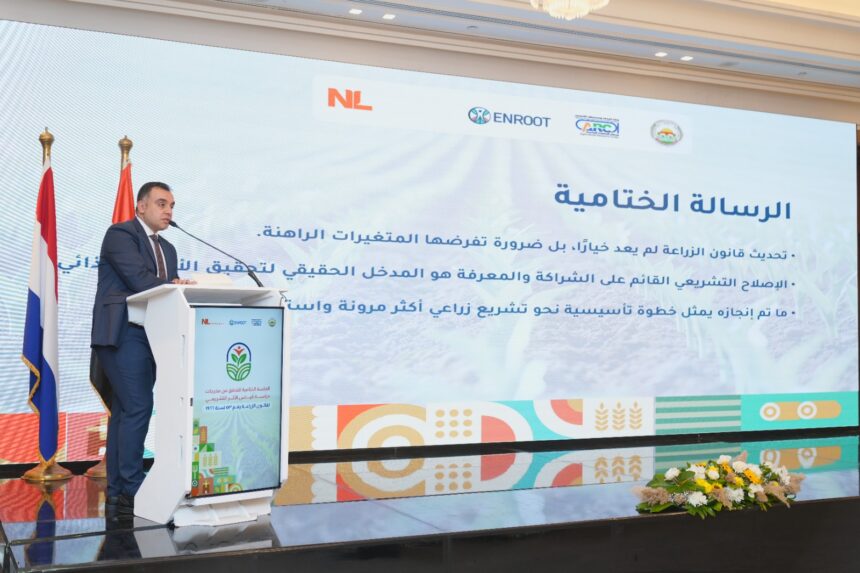
Mohamed El‑Sebaei, former deputy head of the Senate’s Agriculture and Irrigation Committee, said updating Egypt’s Agriculture Law is no longer optional but an urgent necessity imposed by current challenges.
Speaking during a workshop reviewing the legislative impact assessment of Agriculture Law No. 53 of 1966 and its amendments, El-Sebaei said Egypt faces three major challenges that require legislative reform: a persistent legislative and economic gap in the agricultural sector, the growing impacts of climate change on agricultural productivity, and severe water scarcity.
He noted that Egypt relies heavily on transboundary water resources and faces increasing pressure due to the fixed share of Nile water, making efficient water governance and climate-resilient agriculture unavoidable priorities.
El-Sebaei said key recommendations emerging from the discussions included adopting an integrated, participatory approach involving all stakeholders, embedding climate-smart agriculture concepts into agricultural legislation, expanding the role of the private sector, accelerating digital transformation, applying smart governance tools, and strengthening links between scientific research and practical innovation.
For his part, Saad Moussa, deputy head of the Agricultural Research Center and supervisor of international agricultural relations at the Ministry of Agriculture, said Egypt’s agricultural sector faces structural challenges, foremost among them limited water resources and constrained arable land, underscoring the need for legislative frameworks that enhance food security and resource efficiency.
The remarks were made during the closing session of the project “Enhancing the Role of the Private Sector in Upper Egypt’s Agricultural Sector,” implemented by Inroot Development with funding from the Embassy of the Kingdom of the Netherlands, in cooperation with the universities of Assiut, Qena, Sohag, Aswan, and Luxor. The session brought together representatives from government bodies, the private sector, academic institutions, research centers, and development partners.
Hanna Girgis, co-founder and chairman of Inroot Development, said the session marked the culmination of a series of policy workshops that addressed real-world agricultural challenges and produced evidence-based recommendations aimed at modernizing agricultural policy in line with climate realities.
Meanwhile, Hany El‑Salamouni, chief executive officer of Inroot Development, said the project delivered tangible results in 2025, including training nearly 1,000 farmers and 600 agriculture students on climate-smart farming practices and the use of artificial intelligence applications to improve productivity and climate adaptation.
Participants concluded that updating the Agriculture Law is a critical step toward strengthening the sector’s resilience to climate and water stresses, improving productivity, boosting competitiveness, and enhancing food security, particularly in Upper Egypt.


