

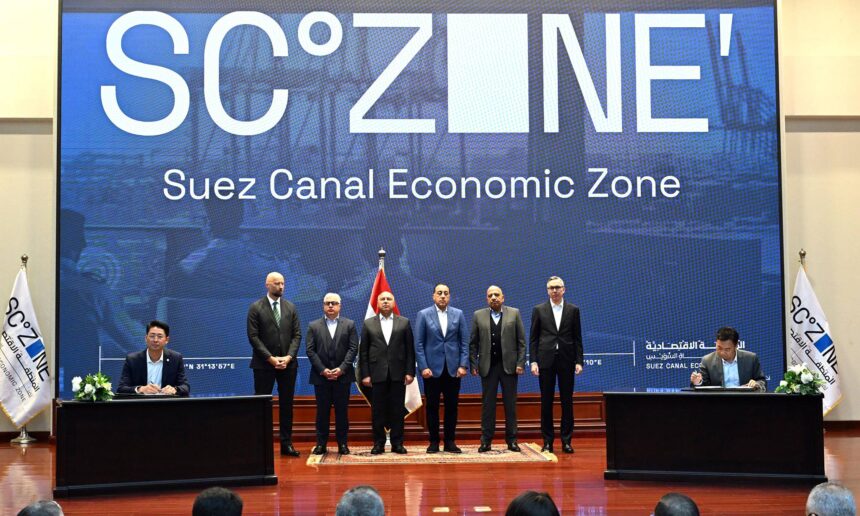
Egyptian Prime Minister Mostafa Madbouly on Sunday oversaw the signing of agreements and contracts for two integrated renewable energy projects worth more than $1.8bn, marking Egypt’s formal entry into the domestic production of solar energy components and battery storage systems.
The first project, developed by Norway’s Scatec, involves the construction of a massive solar power plant in Minya governorate named Energy Valley, or Valley of Sustainable Energy, supported by a battery energy storage system. The second project, developed by China’s Sungrow, entails the establishment of a factory in the Suez Canal Economic Zone (SCZONE) to manufacture energy storage batteries. A portion of the factory’s output will be supplied to the Energy Valley project in Minya. Both projects are being implemented in cooperation with the Ministry of Electricity and Renewable Energy and the General Authority for the SCZONE.
During the ceremony, Madbouly stated that the localisation of industries related to renewable energy is a fundamental pillar for enhancing energy security and achieving a green transition. He noted that attracting such high-quality investments reflects the confidence of international companies in the Egyptian investment climate. Egypt has entered the era of assembling and producing solar energy components, Madbouly said during a later television address, noting that new factories in the SCZONE have reached a local component rate of over 50 per cent. He added that this allows the state to meet its energy needs using Egyptian pounds rather than relying on foreign currency for imports.
The Energy Valley project is described as one of the world’s largest integrated clean energy ventures and the first in the region to provide stable, clean electricity 24 hours a day at a competitive tariff. It features a generation capacity of 1.7 GW AC from solar photovoltaic energy implemented entirely in Minya, supported by battery systems with a total capacity of 4 GWh. This storage capacity is distributed geographically between the governorates of Minya, Qena, and Alexandria to enhance the reliability and stability of the national electricity grid while reducing geographical bottlenecks. The project further includes the construction of new transformer stations and dedicated transmission lines to feed the Wadi Al-Saririya industrial zone in Minya.
The Sungrow factory, located within the TEDA-Egypt industrial developer zone in Sokhna, will be the first of its kind in the Middle East and Africa to produce Battery Energy Storage Systems (BESS). Spanning 50,000 square metres, the facility will create approximately 150 direct jobs and targets a full production capacity of 10 GWh annually. Production at the site is scheduled to commence in April 2027.
The signing ceremony was attended by Deputy Prime Minister for Industrial Development and Minister of Industry and Transport, Kamel al-Wazir, alongside Minister of Electricity and Renewable Energy, Mahmoud Essmat, and Chairperson of the SCZONE, Walid Gamal El-Din. Norwegian Ambassador Erik Husum and Scatec CEO Terje Pilskog were also present. Key contractual milestones included a Power Purchase Agreement signed by Mouna Rizk of the Egyptian Electricity Transmission Company and Mohamed Amer of Valley of Sustainable Energy. Additionally, land usufruct contracts were signed for both the Minya site and the Sokhna factory, the latter involving James Wu of Sungrow and Cao Hui of TEDA-Egypt. A direct supply order was also issued from Scatec to Sungrow for the necessary battery systems.
Following a tour of the Sokhna integrated industrial zone, Madbouly confirmed that 190 factories are now operational in the SCZONE, with another 150 under construction. He estimated that between 50 and 60 of these will be completed within 2026. These factories specialise in industries that did not exist in Egypt before, with 70 per cent of their production intended for export to provide foreign currency and 30 per cent covering domestic market needs. Walid Gamal El-Din highlighted that the Sungrow factory confirms the region’s readiness to host advanced technological projects within the rapidly growing Sokhna industrial area.
Minister of Electricity Mahmoud Essmat emphasised that the private sector is a key partner in these ventures, and the ministry is committed to providing necessary support to increase private domestic and foreign investment in clean energy. Madbouly concluded by stating that the Egyptian government projects economic growth to reach between 7.5 per cent and 8 per cent by 2030, provided the region avoids external shocks. He noted that the private sector’s share of total investment currently exceeds 65 per cent. To sustain this momentum and meet the daily demand for land from global manufacturers, the SCZONE requires an additional EGP 40bn in infrastructure investment for expansion areas.


