
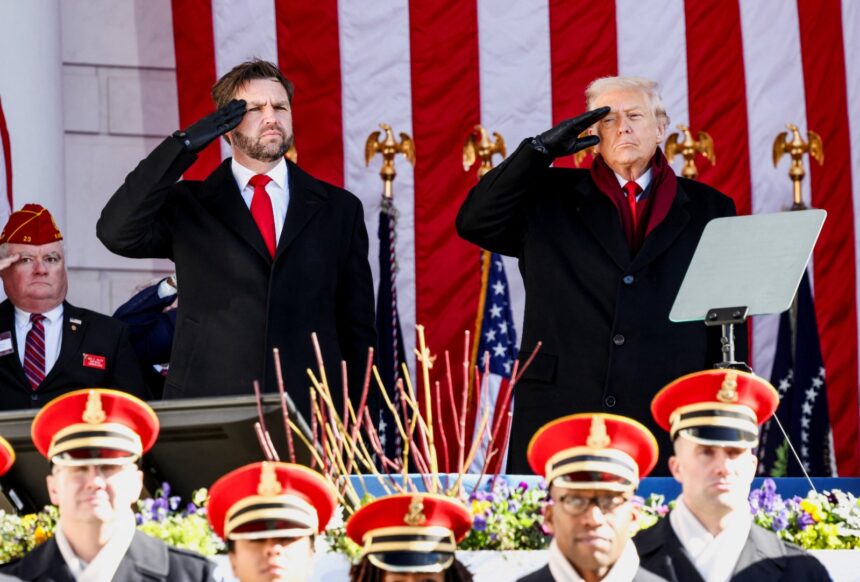
When Erika Kirk took the stage at the Phoenix Convention Centre earlier this month, the atmosphere was less a political summit and more a coronation. Standing before thousands of conservative activists at the annual AmericaFest, the widow of the late Charlie Kirk made a declaration that few in the room doubted: she was ready to see her husband’s friend, Vice President JD Vance, become the 48th President of the United States.
“We are going to get my husband’s friend, JD Vance, elected as 48 in the most resounding way possible,” she told the cheering crowd. The endorsement from the CEO of Turning Point USA—who stepped into the role after the assassination of her husband in September—was more than just a gesture of friendship; it was the clearest signal yet that the starting gun for the 2028 presidential cycle has been fired from within the heart of the White House.
Quietly but methodically, Vance has begun to sketch the contours of his own political future. According to sources familiar with his thinking and reports first detailed by Axios, the Vice President is executing a sophisticated, multi-track strategy. It is a delicate choreography that requires absolute loyalty to President Donald Trump today, while simultaneously building the financial and political machinery necessary to succeed him tomorrow.
By the time the 2026 midterm elections arrive, Vance intends to have transformed his office into a powerhouse of Republican patronage, positioning himself as the undisputed heir to the MAGA (Make America Great Again) mantle without ever appearing to outshine the man at the top.
The Loyalty Test
The first and most critical pillar of the Vance plan is the maintenance of an unbreakable bond with Trump. In a movement where the President’s approval is the ultimate currency, Vance has prioritised being seen as a “loyal lieutenant.”
William Martin, the Vice President’s communications director, has been explicit about this focus. “The Vice President has been very clear since taking office in January that his primary priority is helping President Trump deliver on his campaign promises,” Martin said. This involves public defence of even the President’s most controversial policies, ensuring that Vance remains the preferred choice of a base that remains fiercely protective of Trump’s legacy.
However, being the perfect No. 2 is a hazardous role. Trump has historically been wary of subordinates who seek too much of the limelight. To navigate this, Vance’s team is reportedly focused on 2026 as a bridge, allowing him to campaign for others and build his own brand under the guise of strengthening the President’s congressional majorities.
Building the War Chest
While loyalty wins votes, capital wins campaigns. Vance’s appointment as the finance chairman for the Republican National Committee (RNC) has provided him with a unique advantage. In this role, he has been crisscrossing the country to meet with top-tier donors, effectively locking in financial support years before a primary would begin.
While he enjoys deep-rooted connections with Silicon Valley billionaires, Vance is now focused on expanding his reach to traditional GOP fundraisers. By securing these commitments early, he aims to starve potential 2028 rivals—such as Senators Ted Cruz and Josh Hawley—of the resources needed to launch a challenge.
This financial engine is complemented by a strategy of online dominance. Rather than engaging in public spats with rivals, Vance relies on a phalanx of influential conservative voices, including Donald Trump Jr. and Jack Posobiec, to fighthis corner in the digital arena.
The MAGA Peacekeeper
Internally, the MAGA movement has been rocked by fractures over issues ranging from foreign policy to internal “purity tests.” Here, Vance has sought to position himself as a unifier. During his closing remarks at AmericaFest, he pointedly refused to participate in the “self-defeating” denunciations common in modern primary politics.
“I didn’t come with a list of names of conservatives to denounce,” Vance said, framing himself as a voice of unity against the political left rather than an arbiter of internal dogma. This approach is designed to ensure that no faction of the base feels alienated from him before the 2028 primaries even begin.
The 2028 Horizon
Current polling suggests the strategy is working. According to the Race to the White House national average, Vance holds a commanding lead among potential GOP contenders, garnering more than 45% of the vote. His nearest rivals—including Secretary of State Marco Rubio at 10.9%, Florida Governor Ron DeSantis at 9.4%, and Donald Trump Jr. at 8.6%—trail significantly.
The relationship with Rubio is particularly noteworthy. Vance has described the Secretary of State as his “best friend” within the administration, leading some, like Representative Mike Lawler, to speculate that the two could eventually form a joint ticket. “I think it’s more likely that you’ll have a Vance-Rubio ticket than anything else,” Lawler told CNN, noting that the Vice President currently has a “leg up” on the competition.
As Vance prepares to spend much of the coming year on the campaign trail for Republican candidates, he is not just fighting for a congressional majority. He is honing his rhetoric, deepening ties with local organisers, and cementing his status as the inevitable next step for the party.
For a man who rose to fame by chronicling the struggles of the “forgotten” Americans, the path ahead is now clearly paved with the support of the most powerful figures in his party. Whether he can continue to walk the tightrope between Trump’s shadow and his own ambitions will be the defining story of the next three years.