

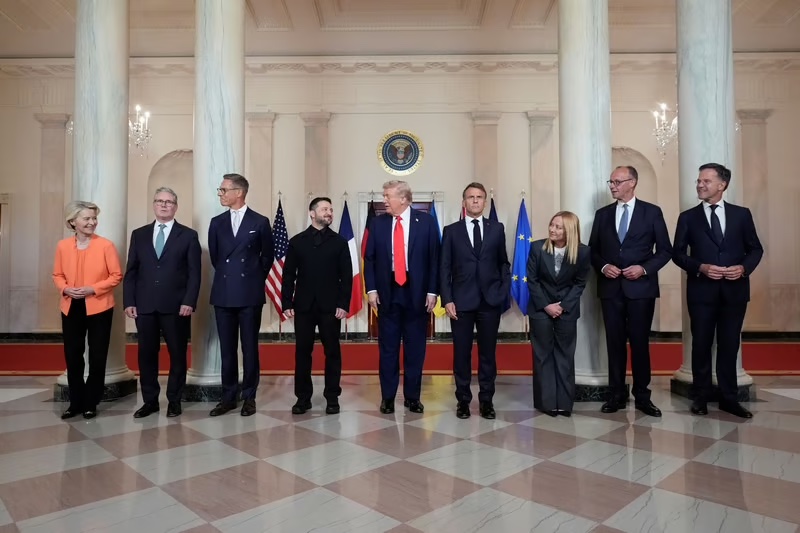
For decades, the European Union has prided itself on negotiating with Washington as a singular, heavyweight bloc of 27 nations. But as President Donald Trump unleashes a fresh diplomatic barrage against the continent, that unity is fracturing into a tense, calculated silence.
Inside the European Commission, a stark realisation has taken hold: the price of responding to the White House’s disdain might be the collapse of Ukraine’s defence.
Trump’s recent attacks—labelling EU leaders “weak” and unveiling a National Security Strategy that calls for “strengthening resistance” within Europe against what his administration terms “civilizational suicide”—have sparked deep divisions within the bloc’s executive arm. According to officials citing the Financial Times, the assault has paralysed Brussels, pitting the desire to defend European institutions against the desperate need to keep the United States engaged in ending the war in Ukraine.
The Ukraine Calculation
The shock within the Commission regarding the “coordinated” US attack—which targets European digital legislation, sustainability laws, and migration policies—has been met with a directive to stand down.
Sources familiar with the discussions revealed that European Commission President Ursula von der Leyen was urged by insiders to refrain from issuing a defensive retort. This strategy of restraint is reportedly driven by direct requests from Ukrainian President Volodymyr Zelenskiy and NATO Secretary General Mark Rutte, who last week asked von der Leyen not to criticise Trump to ensure Washington remains at the negotiating table.
“We cannot say to Zelenskiy: ‘Look, we have supported you all this time, but now we have more important things to focus on, like sustainability rules and social media fines’,” one insider told the Financial Times.
This logic has forced the EU to absorb what many officials view as humiliation. The peace talks currently underway for Ukraine rely heavily on maintaining a working relationship with the US, effectively holding the EU’s reputation hostage to Kyiv’s survival.
Bypassing Brussels
The perceived feebleness of the European response has emboldened national leaders to consider breaking ranks. In a direct challenge to the EU’s traditional unified front, some heads of state are proposing to bypass the Commission entirely to establish direct channels with Trump.
German Chancellor Friedrich Merz suggested on Thursday that Berlin is ready to go it alone. “If Trump is unable to deal with’ EU institutions, Merz said, “there are at least individual member states, including Germany in the first place, of course, with whom such cooperation can continue.”
One EU head of state noted that officials in other capitals are similarly discussing how to sidestep Brussels to speak directly to the American president. This fragmentation mirrors the internal dissent regarding the funding of Ukraine.
Trump’s administration opposes a proposal to use frozen Russian sovereign assets to back a loan for Kyiv, a stance that has scrambled European consensus. While pro-Trump leaders in Hungary, Slovakia, and the Czech Republic have voiced opposition to the loan, other nations are wavering. Italy, Bulgaria, and Malta have joined Belgium in calling for the Commission to find “alternative options”.
Nathalie Tocci, director of the Institute of International Affairs in Rome, suggested that Italian Prime Minister Giorgia Meloni’s hesitation reflects a fear of provoking Trump, who has hinted at alternative plans for the frozen funds.
“They want to send a signal of support to Trump and his plan,” Tocci said.
The Illusion of Negotiation
Some officials compare the current paralysis to the bloc’s strategy during trade negotiations this summer. When faced with the threat of tariffs, the EU chose not to retaliate, instead agreeing to a deal that imposed 15 per cent duties on imports—a move widely criticised by experts as appeasement.
Reflecting on the deteriorating dynamic, one European head of state offered a grim assessment of the bloc’s diplomatic delusions.
“We told ourselves in the summer that we were negotiating three different deals with the US,” the leader said, referring to a trade agreement, NATO spending pledges, and a military supply line for Ukraine. “But we were kidding ourselves. There was always only one negotiation: keeping the US in Europe.”
“Now that is crystal clear,” the leader added. “As is the absence of a clear response.”
For veteran diplomats, the shift in Washington’s tone represents a historic rupture. Anthony Gardner, a former US ambassador to the EU, condemned the language in Trump’s security strategy as a “scandal” that undermines 80 years of bipartisan policy.
“The Trump administration has declared war on the EU,” Gardner said. “That has been clear for a while, but it is now official policy. Our friends have become our enemies.”
