

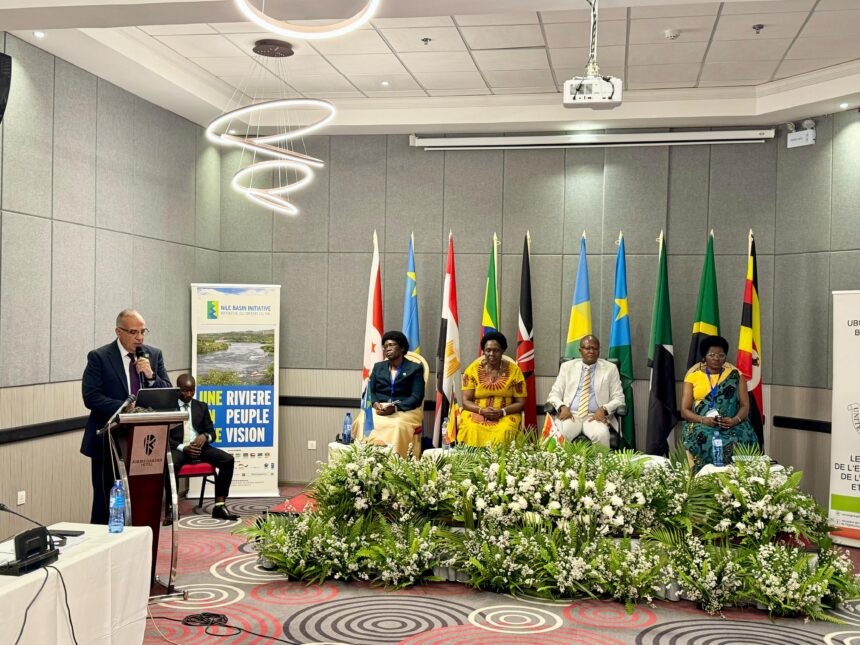
Egypt’s Minister of Water Resources and Irrigation, Hani Sewilam, stressed on Sunday that the challenges facing the Nile Basin cannot be resolved through unilateral measures. He called for renewed inclusivity and trust-building within the Nile Basin Initiative (NBI) as the only viable path toward sustainable cooperation.
Speaking at the 33rd Nile-COM ministerial meeting in Bujumbura, the capital of Burundi, Sewilam said Egypt views the consultative process launched by the ministerial council in November 2024 as “a genuine opportunity to restore inclusivity and rebuild trust.” He added that the mechanism could pave the way for Egypt’s full return to the initiative “in a spirit of cooperation and mutual confidence.”
The minister praised the NBI as “the only comprehensive platform” that has successfully brought Nile Basin countries together for more than 25 years. He urged development partners to continue supporting the ongoing consultations both technically and financially, while refraining from actions that might deepen regional divisions.
Sewilam noted that while most basin countries have chosen dialogue, “it is regrettable that one particular party continues to promote hostile rhetoric and provocative statements aimed at undermining unity.” He stressed that Egypt would continue to exercise “maximum restraint” and refrain from responding within the forum to avoid derailing the initiative.
He reiterated that the sustainable management of shared waters must adhere to international legal principles, especially the obligation not to cause significant harm. He highlighted the successful cooperation under the Nile Equatorial Lakes Subsidiary Action Programme (NELSAP), where 36 investment projects were endorsed following impact assessments and consensus-building among member states.
Sewilam reaffirmed Egypt’s support for “no-harm development,” saying the country seeks to replicate the southern basin’s achievements in the Eastern Nile through transparency, robust impact studies, and compliance with agreed standards. He pointed to Egypt’s recent approvals of development projects in Uganda and Tanzania as evidence of its constructive engagement.
The minister also underscored Egypt’s leadership of the African Water Facility for 2025–2027, during which Cairo plans to accelerate the implementation of seven water and sanitation projects under the basin investment programme. He said Egypt would work closely with international partners to mobilize the necessary funding.
Sewilam concluded by reaffirming Egypt’s unwavering commitment to a unified Nile Basin Initiative, saying: “Together we can move stronger; divided we will be weaker. Let us advance toward a sustainable and prosperous future for all Nile Basin peoples.”

