

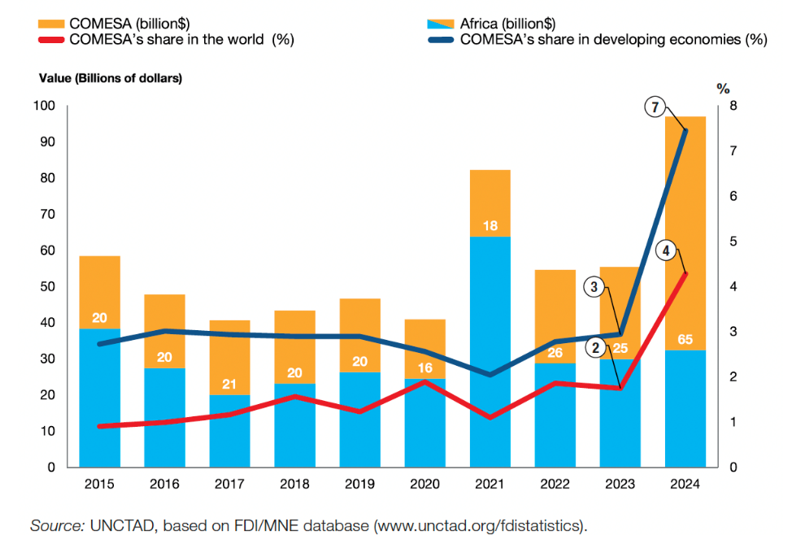
Foreign direct investment (FDI) into the Common Market for Eastern and Southern Africa (COMESA) surged to a record $65bn in 2024, marking a 154% year-on-year increase despite a global downturn in investment flows, according to the inaugural COMESA Investment Report 2025, jointly launched by UN Trade and Development (UNCTAD) and the COMESA Regional Investment Agency (RIA).
The report attributes much of the dramatic rise to Egypt’s Ras El-Hekma mega-project. However, even excluding this project, FDI inflows into the bloc would still have expanded by 16%, reflecting a broad improvement in investor confidence across the region.
COMESA’s share of global FDI doubled from 2% to 4%, while its share of developing-economy inflows rose from 3% to 7%. The bloc accounted for 67% of total FDI into Africa, underscoring its growing weight as an investment destination.
European and North American investors held the largest share of FDI stock in the region, led by the Netherlands and the United States, highlighting sustained interest from advanced economies.
A major highlight of the report was the sharp increase in international project finance (IPF), which nearly doubled to $79bn, equivalent to around 80% of Africa’s total IPF value. Large-scale renewable energy, grid expansion, and construction projects, especially in Egypt, Tunisia, Rwanda and Malawi, were the primary drivers.
Greenfield investment announcements also remained strong, reaching $77bn in 2024, the second-highest level ever recorded. COMESA captured two-thirds of all greenfield investment value across Africa.
However, the report noted that inflows remain highly concentrated: five countries – Egypt, Ethiopia, Uganda, the Democratic Republic of the Congo (DRC) and Kenya – together accounted for 90% of COMESA’s total FDI. Intra-COMESA investment remains limited, representing just 3% of greenfield project numbers and 6% of total project value.
Sectoral trends showed pronounced variation. Construction investment surged nearly fivefold, driven mainly by activity in Egypt. Basic metals investment rose by 71%, while energy and gas supply increased by 22%, retaining its position as the top FDI sector. Meanwhile, extractive industries saw a 61% decline, and ICT investment dropped by 55% after a strong performance in 2023.
Investment in sectors linked to the Sustainable Development Goals (SDGs) produced mixed outcomes. Renewable energy investment grew by 67%, reinforcing COMESA’s emergence as a hub for energy transition projects. Health and education investment jumped by 130%, albeit from a low base. In contrast, agrifood investment fell by 34%, water and sanitation (WASH) investment declined by 76%, and transport-related infrastructure investment dropped by 54%.
The report called for more inclusive and diversified investment across the region, urging policymakers to expand investment beyond a handful of major economies. It emphasised the need to accelerate industrialisation through value-added manufacturing, scale up digital infrastructure, and boost investment in human capital through innovative financing mechanisms. The report also highlighted the importance of strengthening data-reporting systems to support evidence-based policymaking and sustainable development.


