

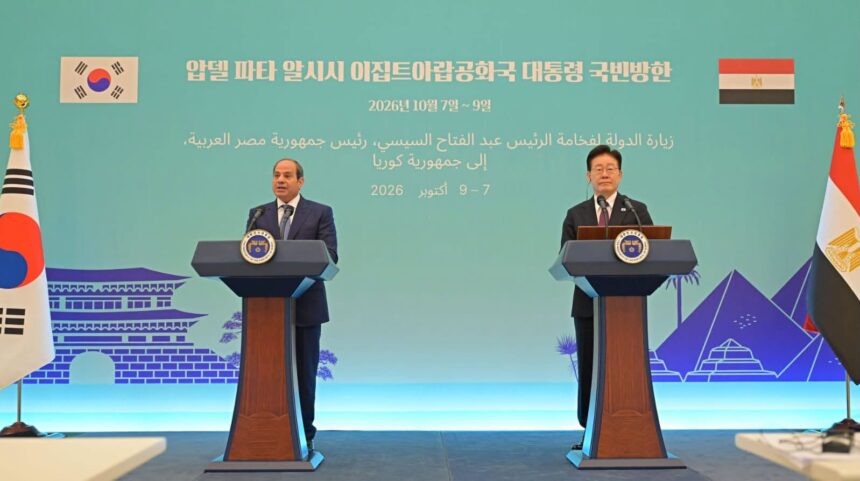
Egypt and South Korea have elevated their bilateral relations to a strategic partnership and launched negotiations for a Comprehensive Economic Partnership Agreement (CEPA), culminating in the signing of 12 agreements during Egyptian President Abdel Fattah al-Sisi’s state visit to Seoul.
Sisi arrived in South Korea on Tuesday for a visit spanning October 7 to 9. The stop marks the first leg of an Asian tour that will also include Malaysia and Indonesia.
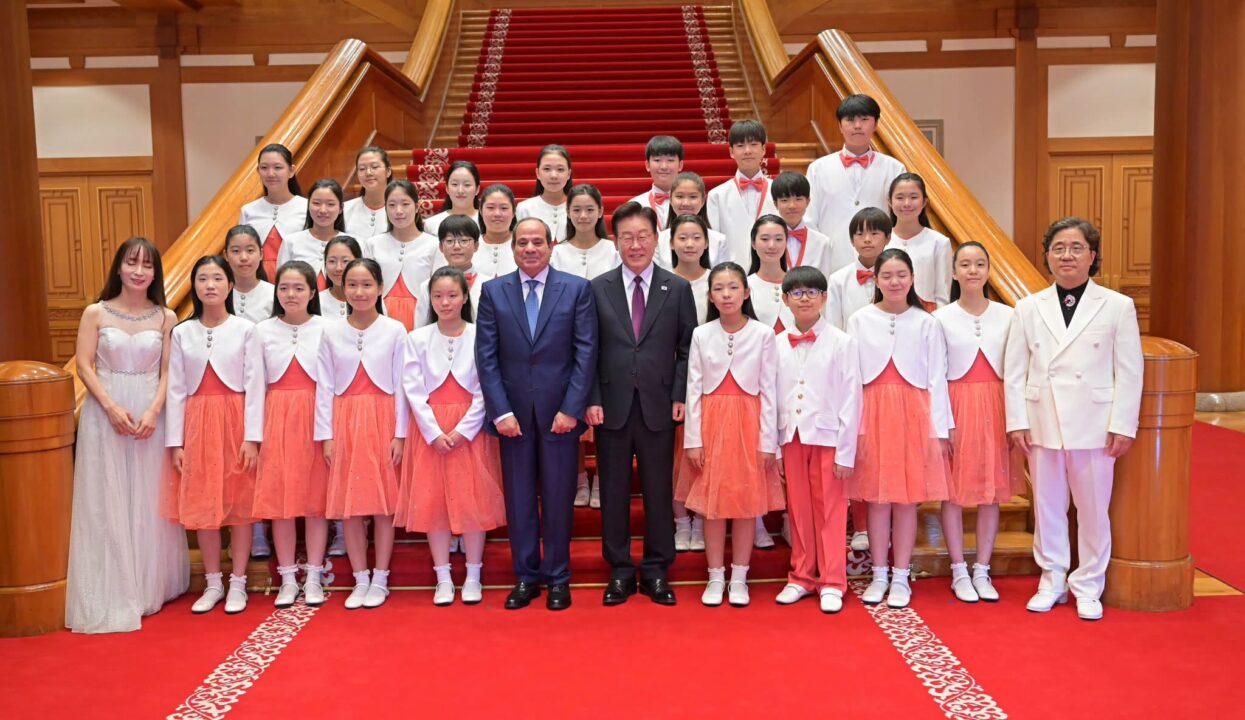
On Thursday, Sisi met with South Korean President Lee Jae-myung at the presidential office, where the two leaders held bilateral and expanded discussions following an official reception featuring a children’s choir and a guard of honour. The talks resulted in the signing of 12 agreements and memorandums of understanding across various sectors.
The diplomatic upgrade follows Lee’s visit to Egypt in November 2025, which marked the 30th anniversary of diplomatic ties between the two nations. As part of the strategic alignment, Egypt endorsed South Korea’s “S.H.I.N.E.” Middle East policy, initially announced at Cairo University in 2025, while Seoul welcomed Egypt’s policy of “strategic balance.” The two nations previously held their first strategic dialogue between foreign ministers in Seoul on June 2, 2026.
Speaking at a joint press conference on Thursday following a luncheon hosted by Lee, Sisi congratulated South Korea on its October 3 National Foundation Day and noted the growing momentum in bilateral ties over the past decade.
“We culminate today the growing momentum in our bilateral relations by announcing the elevation of Egyptian-Korean relations to the level of a strategic partnership,” Sisi said, adding that Egypt looks to benefit from South Korea’s developmental and technological expertise.
Prior to the summit, Sisi held a roundtable discussion on Wednesday with the heads of 23 major South Korean companies. During the meeting, he called for the establishment of an integrated Korean industrial zone within the Suez Canal Economic Zone, positioning Egypt as a strategic gateway for trilateral cooperation and a regional export hub to African, European, and Arab markets.
Sisi outlined Egypt’s recent economic reforms, including exchange rate liberalisation, legislative updates, and an expanded role for the private sector. He detailed investment incentives such as a single-window system, competitive industrial land pricing, guarantees for profit transfers, and provisions for securing foreign technical experts.
The economic discussions identified numerous target sectors for investment and joint manufacturing, including shipbuilding, electric vehicles, electronics, petrochemicals, pharmaceuticals, artificial intelligence, data centres, smart cities, and advanced technologies. Further opportunities were highlighted in agriculture, food processing, aquaculture, textiles, tourism along the Red and Mediterranean seas, oil and gas, mining, and renewable energy, specifically solar, wind, green hydrogen, smart grids, and energy storage.
Both sides also agreed to activate the Egyptian-Korean Business Council and hold a regular economic forum, while exploring joint infrastructure and construction projects in Arab and African countries.
Bilateral cooperation extends to defence industries, technical and vocational education, youth initiatives, Korean language education, and scholarships. The two countries have designated 2027 as the year of cultural exchanges to share creative content and historical heritage.
On regional security, the leaders committed to working towards peace in the Middle East and the Korean Peninsula. Sisi reiterated Egypt’s firm stance on the Palestinian issue, calling for a just settlement based on a two-state solution and the establishment of an independent Palestinian state on the June 4, 1967 borders with East Jerusalem as its capital. He rejected the displacement of Palestinians and Israeli escalation in the West Bank and East Jerusalem, whilst expressing appreciation for South Korea’s future participation in the reconstruction of the Gaza Strip.
Addressing wider regional matters, Sisi emphasised the preservation of sovereignty in the Horn of Africa and stated that the security of the Red Sea and the governance of its affairs fall exclusively on its littoral states. He rejected arrangements aimed at gaining Red Sea access at the expense of regional sovereignty.
Furthermore, Sisi described the Nile River as an “existential issue” for over 100m Egyptians. He expressed support for development in Nile Basin countries but affirmed Egypt’s rejection of any unilateral actions that violate international law or compromise its water rights. The discussions also covered the situations in Yemen, Libya, and the preservation of international freedom of navigation.


