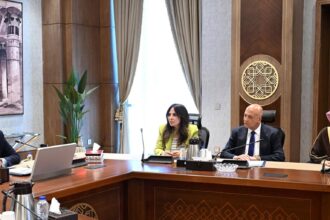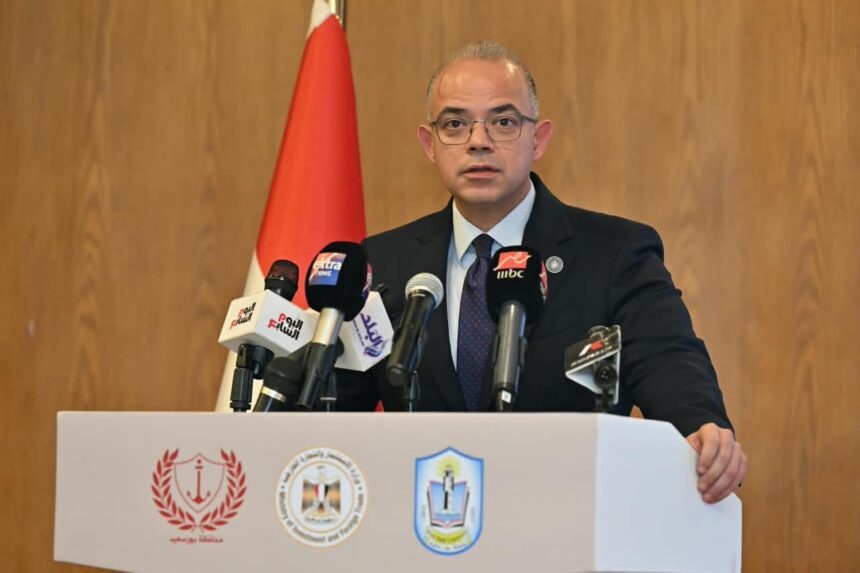
Minister of Investment and Foreign Trade Mohamed Farid, Port Said Governor Ibrahim Abu Limon, and Port Said University President Sherif Youssef Saleh launched the second phase of the “Egypt Exports” initiative in Port Said, under the patronage of Prime Minister Mostafa Madbouly and with the participation of senior officials from entities and authorities affiliated with the ministry, as well as representatives of the business and export communities.
The initiative’s second phase follows its first stop in Gharbeya Governorate and forms part of a programme designed to move from one governorate to another to reach companies where they operate, identify their needs, and provide information, services and available export opportunities. The initiative will also continue to develop its components and introduce new partners and services according to the nature of each governorate and the needs of companies operating there.
The second phase attracted broad participation from companies in Port Said, with around 126 companies taking part.
Participating companies represented several key sectors, including textiles, engineering, chemicals, food industries, and building and construction.
The participation reflects the diversity of Port Said’s industrial base and companies’ interest in benefiting from the services, information and export opportunities offered by the initiative, as well as learning about mechanisms for accessing foreign markets and available support and financing tools.
Farid said the “Egypt Exports” initiative represents an ongoing effort to reach companies across Egypt’s governorates, in implementation of President Abdel Fattah Al-Sisi’s directives to increase exports, expand the exporter base and enhance the competitiveness of Egyptian products.
He stressed that the initiative is not intended to be a one-off event, but rather an ongoing effort to move from one governorate to another, reach companies where they operate and identify their needs.
Farid added that the figures were among the main factors behind the launch of the initiative. The largest 50 exporting companies alone account for around 43% of Egypt’s total exports, worth $91.6bn, while the largest 500 companies account for 76%, worth $163.3bn. The largest 1,000 companies account for 85%, worth $182.6bn, while the largest 2,000 account for 92%, worth $197.7bn.
He said these figures underline the importance of expanding the exporter base, increasing the number of companies that export on a sustained basis, increasing exports by existing companies and helping them enter new markets.
Farid noted that around 3,100 companies benefited from exporter support programmes during fiscal year 2024/2025, while 747 companies benefited from participation in international exhibitions and 34 companies from trade missions. He stressed the importance of broadening companies’ access to export services and programmes.
The minister said the initiative is based on a central message: “You have the right to know.”
He explained that every company has the right to know about available markets and export opportunities, the trade agreements it can benefit from, required specifications, support programmes, and the services provided by different entities in areas including commercial representation, exhibitions, export and import control, export development, training, investment and trade agreements.
Farid said the initiative is evolving from one stop to the next. It began in Gharbeya with a group of entities and services, while the Port Said phase has introduced new partners and services based on companies’ needs.
In addition to export, investment, training and market-related services, these now include financing tools, factoring and banking services aimed at export development, with the goal of connecting companies to financing instruments that can help them pursue export opportunities and expand production and exports.
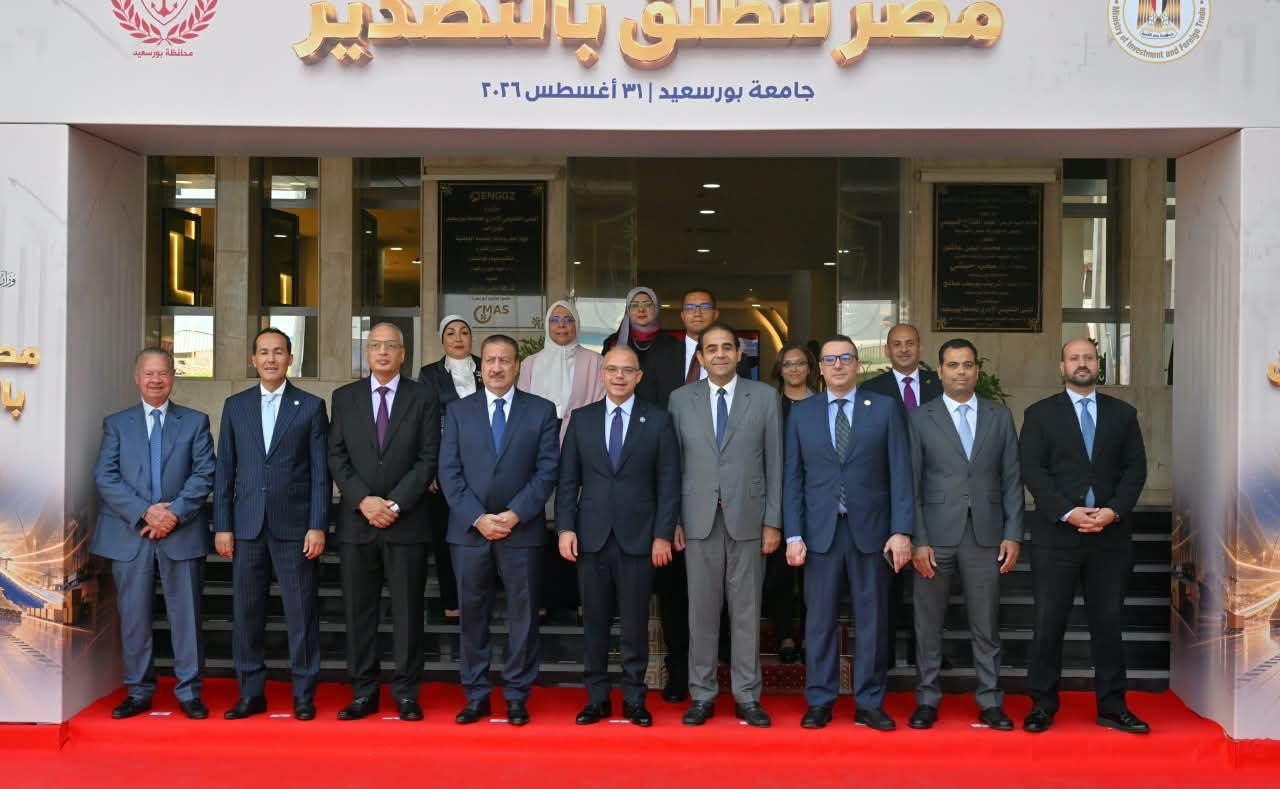
Farid said Port Said was selected as the initiative’s second stop in light of the governorate’s existing export base. Its exports reached around $6.7bn between January 2021 and May 2026, representing around 3% of Egypt’s total non-oil exports.
He added that the governorate also benefits from an industrial base, a port, logistics services and commercial activity, providing important foundations for increasing export activity.
Farid stressed the need to translate these advantages into tangible results in the form of more exporting companies, higher exports and new markets for Egyptian products. He also highlighted the importance of fostering positive competition between governorates, with each seeking to improve its position on Egypt’s export map.
The minister stressed that the initiative’s objective goes beyond increasing the number of exporters and instead aims to build a sustainable export industry. This means helping companies begin exporting, remain present in foreign markets and establish a lasting foothold, with a focus on retaining exporters, increasing their exports and helping them enter new markets, while simultaneously bringing new companies into the exporter community.
Achieving this objective requires connecting companies with information, opportunities, support mechanisms and financing tools, Farid said.
He noted that new financing partners had joined the Port Said phase, including the Egyptian Factoring Federation, the Egyptian Federation for Micro, Small and Medium Enterprise Financing, the Export Development Bank of Egypt, and the Federation of Egyptian Industries, helping companies access the financing tools needed to expand production and exports.
Farid also pointed to efforts to strengthen Port Said University’s role in the investment and foreign trade ecosystem through the signing of two cooperation protocols, one with the Foreign Trade Training Centre and another with the General Authority for Investment and Free Zones (GAFI).
The agreements aim to more closely integrate the university into the investment and foreign trade ecosystem and make use of its capabilities in capacity-building, training and serving the governorate’s business community.
Farid said the Port Said phase is intended to deliver tangible results, including bringing new companies into the exporter community, increasing exports by existing companies, helping them enter new markets and raising the governorate’s contribution to Egypt’s exports.
For his part, Port Said Governor Ibrahim Abu Limon said the selection of the governorate to host the second phase of the “Egypt Exports” initiative carries significant importance.
He said Port Said is not only Egypt’s maritime gateway to the world, but also represents an integrated model of the capabilities that can support the state’s efforts to increase production, maximise exports and open new markets for Egyptian products.
Abu Limon said Port Said’s strategic location, ports, industrial and logistics zones, and diverse investment potential make it a key partner in supporting Egypt’s foreign trade system and enhancing the competitiveness of Egyptian products.
He stressed that the governorate would continue to support every serious investment, competitive domestic industry, and company seeking to expand, increase its exports and open new markets for Egyptian products.
The governor said exports are no longer merely an economic activity, but have become a national priority and a key pillar in building a strong and sustainable economy. Achieving this requires genuine integration between state institutions, the private sector, the industrial community and exporters, he said.
He highlighted the initiative’s importance in building export capabilities, informing companies about opportunities to access foreign markets, and helping them benefit from trade agreements, incentives, financing programmes and services provided by the state to support exporters.
Abu Limon stressed the importance of the initiative’s sessions producing practical proposals and recommendations that contribute to achieving Egypt’s investment and export targets. He welcomed participants to Port Said, Egypt’s gateway to the world and a promising platform for production, investment and exports.
For his part, Port Said University President Sherif Saleh said the university’s hosting of the second phase of the “Egypt Exports” initiative reflects its vision of its role as an integral partner in development and in generating knowledge and economic value.
He stressed that the university is not an educational institution operating in isolation from the economy, but an active partner in supporting the development process.
Saleh said the initiative is directly aligned with Port Said University’s Vision 2032, which stems from the National Strategy for Higher Education and Scientific Research.
He explained that the university has made integration with state institutions, production sectors and businesses one of the pillars of its work, helping it move beyond its traditional educational role to become an active partner in capacity-building, supporting investment and serving the community.
The university has strengthened its integration with Port Said Governorate and the business sector as a direct means of improving the environment supporting investment, Saleh said.
This integration has also extended to industrial partners through partnerships aimed at aligning educational outcomes with labour market needs and creating new pathways for training, employment, dual education and professional qualifications, through the establishment of the university’s Higher Advisory Council and advisory bodies across its various sectors.
Saleh said the presence at Port Said University of the Ministry of Investment and Foreign Trade, export bodies, import and export control authorities, financing institutions, industrial and commercial federations, and the business community represents a practical application of the integration model adopted by the university in its strategy.
He said all participants are united around a single objective: transforming Egypt’s capabilities into competitive strength capable of accessing foreign markets.
Saleh stressed that exporting is not the responsibility of a single ministry or institution, but rather an integrated ecosystem involving the state, universities, industry, the private sector, financing institutions and the business community.
He added that Port Said University is placing its scientific, research and human resources at the service of this ecosystem and seeks to ensure that its graduates, researchers and entrepreneurs contribute to Egypt’s competitiveness in global markets.