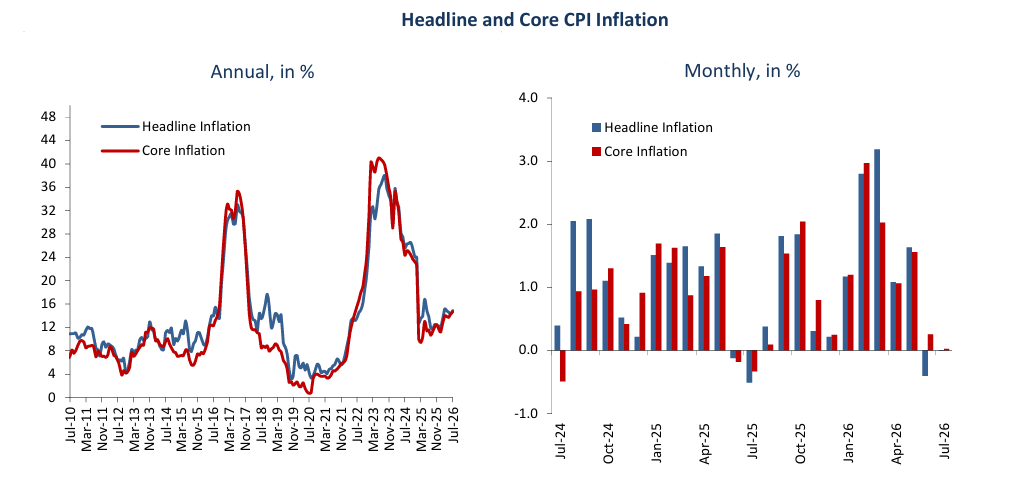
The Central Bank of Egypt (CBE) said the rise in annual urban headline inflation in July 2026 was mainly attributed to an unfavourable base effect, as monthly prices remained stable during the month.
Annual urban headline inflation edged up to 14.9% in July from 14.3% in June, while monthly urban headline inflation recorded 0.0%, compared with negative 0.5% in July 2025 and negative 0.4% in June 2026.
The CBE said a similar pattern was observed in annual food inflation, which increased to 8.0% in July from 5.4% in June despite a month-on-month decline, also reflecting an unfavourable base effect.
Meanwhile, annual non-food inflation decelerated to 19.1% in July from 19.9% in June, continuing to hover around the 20% level since early 2025.
The stability in monthly headline inflation came as lower food prices offset a mild increase in non-food prices.
Monthly food inflation declined by 0.6%, as both volatile and core food inflation fell for the second consecutive month. Meanwhile, non-food inflation recorded a mild 0.3%, its lowest monthly rate since mid-2025.
Annual core inflation also edged up to 14.7% in July from 14.3% in June, mainly reflecting an unfavourable base effect. Monthly core inflation remained at 0.0% in July, compared with negative 0.3% in July 2025 and 0.3% in June 2026.
The stability in monthly core inflation reflected a mild increase in non-food inflation, offset by a decline in core food inflation.
Annual rural headline inflation increased to 11.2% in July from 10.1% in June. Similarly, annual nationwide headline inflation, a weighted average of urban and rural CPI baskets, rose to 13.0% in July from 12.2% in June.
Key drivers of monthly inflation in July
Monthly food inflation declined by 0.6%, contributing negative 0.22 percentage point (p.p.) to monthly headline inflation.
Volatile food prices declined by 0.5%, contributing negative 0.03% to monthly headline inflation. This primarily reflected a 2.1% decline in fresh fruit prices, while fresh vegetable prices increased by a mild 0.5%. Both developments were broadly consistent with typical seasonal patterns.
Core food prices declined for the second consecutive month, falling by 0.7% and contributing negative 0.18% to monthly headline inflation.
The decline deviated from the typical seasonal pattern and reflected lower prices for poultry, which fell 4.8%, as well as eggs, red meat and pasta.
Monthly non-food inflation registered 0.3%, contributing 0.21% to monthly headline inflation.
Services inflation increased by 0.4%, its lowest rate since August 2025, contributing 0.11% to monthly headline inflation. The increase primarily reflected higher rents, partially offset by lower Hajj and Umrah expenses.
Retail inflation increased by a mild 0.6%, contributing 0.09% to monthly headline inflation. This was mainly driven by higher prices for household cleaning products and personal care products, despite stable prices across most other items.
Regulated-item inflation remained stable at 0.0%, contributing 0.01% to monthly headline inflation, as no administered prices were adjusted during the month.
Monthly core inflation recorded 0.0%. Services and retail items contributed 0.15% and 0.13%, respectively, to monthly core inflation, while core food items fully offset these increases with a negative contribution of 0.25%
Key drivers of annual inflation in July
Annual food inflation accelerated to 8.0% in July from 5.4% in June, contributing 3.01% to annual headline inflation. The CBE attributed the acceleration mainly to an unfavourable base effect.
Volatile food inflation accelerated to 31.5% in July from 16.9% in June, contributing 1.76% to annual headline inflation. This reflected annual price increases of 50.0% for fresh vegetables and 10.1% for fresh fruits.
Core food inflation increased to 4.2% in July from 3.4% in June, contributing 1.25% to annual headline inflation. This was driven by an 8.5% year-on-year increase in red meat prices, partially offset by a 17.7% decline in egg prices.
Annual non-food inflation eased to 19.1% in July from 19.9% in June, contributing 11.87% to annual headline inflation.
The deceleration was driven by several factors.
Regulated-item inflation declined to 11.4% in July from 13.7% in June, contributing 2.52% to annual headline inflation and reflecting slower fiscal consolidation measures.
Services inflation remained stable at 27.3% in July, contributing 7.52% to annual headline inflation. This reflected steady inflation across most services, with higher healthcare costs offsetting lower Hajj and Umrah expenses.
Retail inflation stood at 12.4% in July, contributing 1.83% to annual headline inflation. This was mainly driven by higher prices for household cleaning products.
Annual core inflation increased to 14.7% in July from 14.3% in June, reflecting the dynamics of the aforementioned items as well as an unfavourable base effect.
Services and retail items contributed 10.41% and 2.53%, respectively, to annual core inflation, while core food accounted for 1.73%