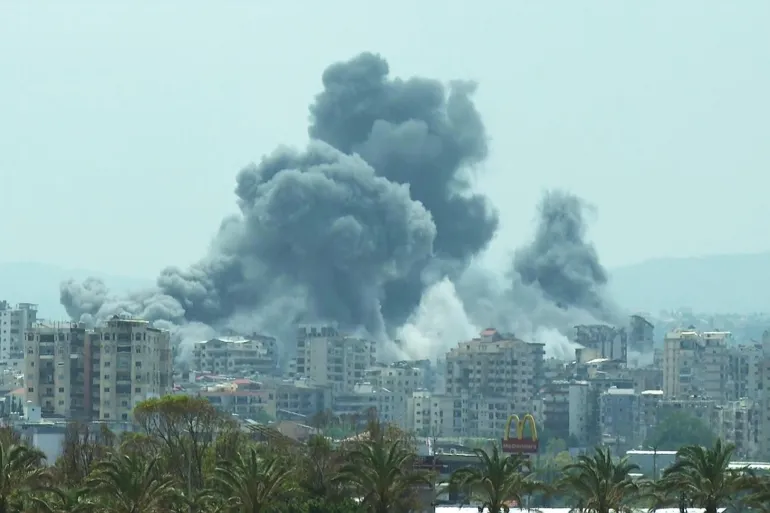
Tensions escalated sharply along the Lebanese-Israeli frontier after the Israeli military issued evacuation warnings for parts of Beirut’s southern suburbs ahead of planned airstrikes. At the same time, Hezbollah intensified rocket and drone attacks against Israeli forces in southern Lebanon, heightening fears of a broader regional confrontation.
Israeli Prime Minister Benjamin Netanyahu and Defence Minister Israel Katz said in a joint statement that they had instructed the military to target sites in Beirut’s southern suburbs, a stronghold of Hezbollah. Following the warning, videos circulated on social media showing heavy traffic congestion and residents leaving the area.
In response, the commander of Iran’s Khatam al-Anbiya Central Headquarters warned residents of northern Israel to evacuate should Israel proceed with strikes on Beirut’s southern suburbs. The warning was issued in response to what Tehran described as repeated Israeli violations of ceasefire agreements.
On the ground, Hezbollah announced a series of attacks targeting Israeli troops and military vehicles in southern Lebanon. The group said it launched rocket barrages at Israeli forces near Beaufort Castle and in the towns of Qantara and Dbayn. Hezbollah also claimed responsibility for drone strikes targeting an operations room at the Al-Abbad military site and an Israeli communications vehicle in Qantara, saying the attacks achieved direct hits.
The Israeli military said it intercepted one rocket over Kiryat Shmona, while two others landed near Israeli forces operating in southern Lebanon without causing casualties. Israel’s Home Front Command also reported air raid sirens sounding in Rosh Hanikra and surrounding areas following the launch of rockets and drones from Lebanon.
An Israeli military spokesperson said operations would continue throughout Lebanon, “from Beirut’s southern suburbs to the city of Tyre,” adding that Israeli forces were working to further degrade Hezbollah’s military capabilities through expanded and targeted operations.
The spokesperson described control of the Beaufort Castle area as strategically important, claiming it serves as a major Hezbollah stronghold and that more than 400 projectiles had been launched from the area since the outbreak of hostilities.
Meanwhile, Lebanon’s Ministry of Public Health said the death toll from Israeli attacks had risen to 3,433, with 10,395 people injured since 2 March.
The escalation prompted regional and international reactions. Saudi Arabia’s Foreign Ministry condemned what it described as Israeli aggression against Lebanese territory, reiterating its rejection of Israeli incursions into Lebanon and violations of the country’s sovereignty.
The European Union also called on Israel to halt its military escalation. EU spokesperson Anouar El Anouni urged Israel to respect Lebanon’s sovereignty and territorial integrity and avoid actions that could further destabilise the region.
In Beirut, Lebanese President Joseph Aoun defended the path of direct negotiations with Israel, arguing that diplomacy remains Lebanon’s only viable option. Speaking to a delegation from the country’s private sector network, Aoun said that “negotiation is safer than war,” adding that although diplomacy can be a lengthy and challenging process, “all issues are ultimately resolved through negotiations.”
Israeli Defence Minister Katz, however, warned that Israel would not tolerate continued attacks originating from Lebanon.
“If there is no quiet in northern Israel, there will be no quiet in Beirut,” Katz said, adding that Israel intends to establish a military-controlled zone around the Litani River in southern Lebanon.
The latest developments underscore the fragility of the security situation along the Lebanese-Israeli border and raise concerns that continued escalation could draw additional regional actors into the conflict despite growing international calls for de-escalation and diplomatic engagement.