
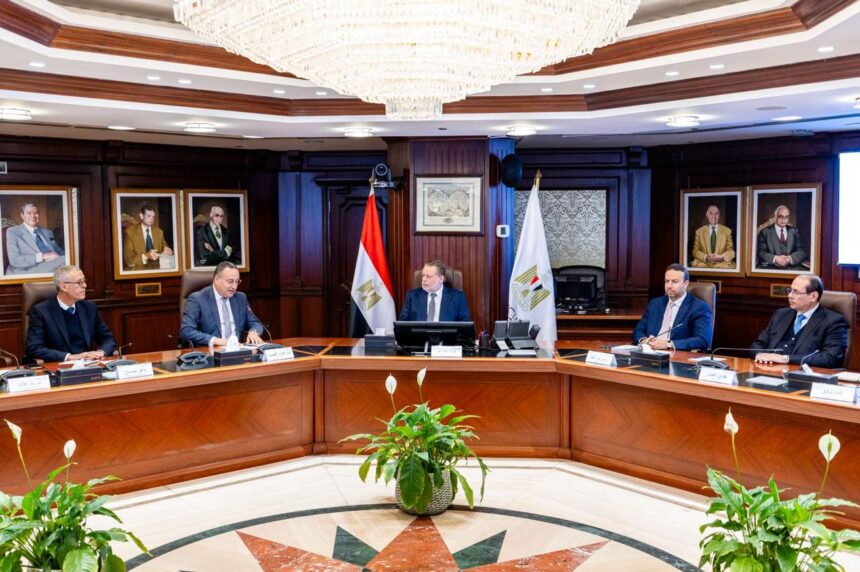
Hassan Abdalla, Governor of the Central Bank of Egypt (CBE), has met with Abdel Aziz Qansouh, Minister of Higher Education and Scientific Research, to discuss avenues for cooperation between the banking sector and higher education and scientific research institutions.
The Monday meeting was held within the framework of the Egyptian state’s vision to invest in human capital and support the development of the education system.
Attendees included Rami Abou El Naga and Tarek El Khouly, Deputy Governors of the Central Bank, and Ghada Tawfik, Deputy Governor for Corporate Social Responsibility. Also present were Maher Mesbah, Secretary-General of the Council of Private Universities; Sherif Keshk, Assistant Minister for Smart Governance; the minister’s legal advisers, Atef Omar and Mahmoud Ahmed; and Mohamed Ibrahim, Assistant to the Secretary-General of the Council of Private Universities.
Discussions reflected a shared commitment to supporting the education system and expanding sponsorship programmes for outstanding and research-promising students.
The two sides reviewed the latest developments in the national initiative to support distinguished students, the “Future Scientists Scholarship”, launched jointly by the Central Bank and the ministry. The initiative aims to support high-achieving students from eligible social backgrounds across all governorates, enabling them to complete their university education as a fundamental right and contributing to balanced, inclusive national development.
In this context, reference was made to account “7070”, opened at Egyptian banks to receive donations dedicated to supporting outstanding students. The mechanism enhances participation by banking institutions, the private sector and wider society in supporting talented students and reinforces the principle of social solidarity in investing in education and scientific research.
The initiative reaffirms the state’s commitment to ensuring fair and equal access to quality education for high-performing students and to building a generation capable of driving comprehensive development and shaping the future.
In its first phase, the cooperation provided full scholarships to 1,953 students, underscoring the commitment to investing in human capital and promoting science and innovation as key pillars of sustainable development.