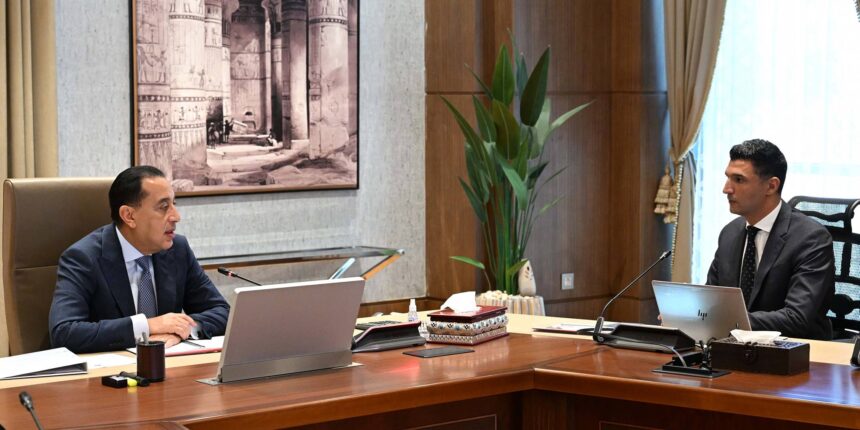
Prime Minister Mostafa Madbouly met with Minister of Industry Khaled Hashem at the government headquarters in the New Administrative Capital to review the ministry’s vision and work plan for the coming phase.
At the outset of the meeting, Madbouly stressed that the industrial sector ranks among the government’s top priorities at this stage, noting that recent economic reform measures have provided strong momentum for industrial growth.
The Prime Minister highlighted the positive performance indicators achieved by Egyptian industry in recent months, attributing them to what he described as unprecedented government support. He reaffirmed the state’s commitment to introducing further facilitative measures aimed at localising and deepening industrial production, boosting exports, achieving broader economic and social objectives, and reducing the import bill.
Madbouly also underscored ongoing efforts to attract additional domestic and foreign investment across key industrial sectors and to expand partnerships with major international companies in specialised fields.
He emphasised the importance of identifying promising export opportunities, determining optimal project locations across governorates and industrial zones, aligning with global industrial trends, expanding green industries, and investing in workforce training to enhance competitiveness and generate foreign currency revenues.
The Prime Minister added that he will continue to hold regular meetings with representatives of industrial chambers and export councils to review their proposals and discuss mechanisms to advance the sector.
During the meeting, Hashem presented the Ministry of Industry’s roadmap for the upcoming period, which focuses on increasing non-oil exports. He outlined several strategic pillars underpinning this objective.
On human capital development, the minister said the ministry plans to expand structured vocational training programmes to produce skilled labour capable of addressing gaps in the labour market, particularly within targeted industrial sectors.
Regarding product development, Hashem highlighted plans to scale up the production of competitive goods based on scientific and technological methodologies, while strengthening feeder and intermediate industries. He also stressed the need to enhance the efficiency of regulatory bodies to ensure product quality and expand green supply chains to improve the global competitiveness of Egyptian products.
On processes and procedures, the minister revealed plans to prepare an integrated industrial map detailing all available investment opportunities and their respective sectors. The roadmap also includes offering additional incentives, modernising the industrial ecosystem, and removing obstacles facing investors.
He further announced the establishment of a comprehensive database covering production capacities and market needs, with a focus on strategic sectors. The ministry will also expand the automation of licensing, land allocation, and investor services, alongside activating performance monitoring systems across its affiliated entities.
Hashem disclosed that the ministry aims to establish and develop five priority industries, each supported by five complementary feeder industries, selected based on domestic demand, export potential, and competitive advantage.
The strategy will be implemented through partnerships with leading global, regional, and local companies, while taking into account social, technical, and logistical considerations within the national industrial map.