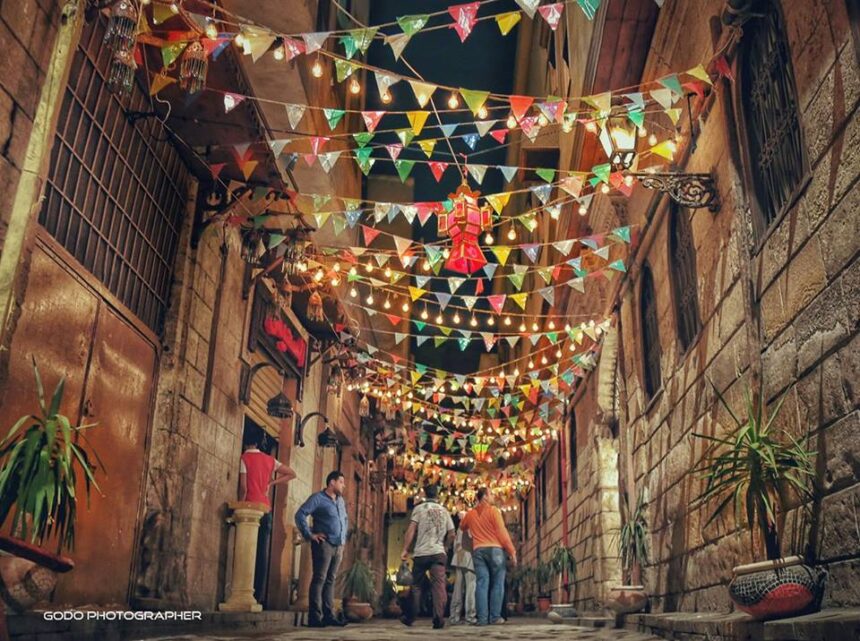
At its core, Ramadan carries layers of memory. There is a Pharaonic echo in the old children’s chant “Wahawi Ya Wahawi,” a Fatimid sweetness in traditional desserts such as kunafa and qatayef, a Mamluk thunder in the cannon that announces sunset and the breaking of the fast, and the footsteps of the mesaharati, the traditional night caller who walks the streets before dawn beating a drum to wake families for their pre-dawn meal.
Ramadan is a month in which centuries coexist, civilizations overlap, and spirituality merges with identity. Yet something has quietly shifted. Ramadan has increasingly become an event to be managed, programmed, marketed, and broadcast, rather than lived and contemplated.
This is not nostalgia. Cultures evolve. Symbols change. The traditional Ramadan lantern may transform from handcrafted brass into LED lights, and the mesaharati may be replaced by a smartphone alarm. But a deeper question remains: what happens when rituals survive while meaning erodes? What happens when a month of self-discipline becomes a season of consumption, and contemplation yields to spectacle?
Ramadan was never merely about abstaining from food. It was a recalibration of the relationship between self and other, between desire and discipline, between the individual and society. Its primary message is social before it is ritualistic: to remember the hungry, to reduce the inflation of the ego, to realign the moral compass. It redistributes sensitivity, reorders priorities, and offers society a collective moment of self-review.
Here is where Ramadan intersects with what I call the “governance of meaning.” Governance should not be confined to laws, regulations, and institutional structures. Societies are not managed by budgets alone, but by shared narratives. Meaning is not a cultural luxury; it is invisible infrastructure. It builds trust, manages differences, and regulates social rhythms. When meaning is governed wisely, societies stabilize. When it is left to noise or emptiness, fragmentation follows.
In this sense, Ramadan functions as an annual act of governing meaning. It reorganizes time, disciplines appetite, and reshapes the daily rhythm of society. Working hours shift. Social interactions are restructured. Public space slows down. It is a built-in ethical reset embedded within culture itself.
Yet like any system, it can malfunction. When the month becomes an advertising race, when charity turns into performance rather than compassion, when fasting is reduced to lavish tables and entertainment marathons, the governance of meaning weakens. The issue is not the existence of markets or media; both are part of life. The issue is proportion and purpose: does the market serve meaning, or is meaning instrumentalized to serve the market? Does media deepen reflection, or replace it with seasonal noise?
If Ramadan becomes merely a month of lights and television dramas, it loses its civilizational function. But if it remains a moment of collective ethical recalibration, it strengthens the invisible bonds that hold societies together, especially in times of turbulence.
In a region marked by chronic tensions, Ramadan offers something rare: a shared rhythm. Millions fast together, break their fast together, and pray together. For thirty days, society rehearses solidarity. This rehearsal is not only emotional; it is strategic. It demonstrates that collective discipline is possible, and that empathy can become habit rather than exception.
The question, therefore, is no longer whether we fast, but whether we still understand why we fast. If we preserve the meaning, the rituals will remain alive. If meaning fades, the rituals may persist, but as architecture without soul. Societies do not collapse only under economic or political crises; they weaken when their shared meaning erodes.
Ramadan does not return each year merely to decorate the calendar. It returns to test the depth of our collective consciousness. Either we recognize its role in shaping awareness, or we allow it to dissolve into a seasonal spectacle. True governance is not measured by the number of decisions issued, but by our ability to steward meaning. And when meaning is lost, no policy can fully restore it.. Modern states spend billions constructing inclusive identities. Ramadan offers a shared identity, already formed, at no financial cost.
Dr Ramy Galal is an Egyptian writer and academic specialising in public management and cultural policies. He has authored studies on cultural diplomacy, the orange economy, and restructuring Egypt’s cultural institutions.
Galal holds a PHD degree from Alexandria University, a master’s degree from the University of London, and a Diploma from the University of Chile.
A former senator, and former adviser and spokesperson for Egypt’s Ministry of Planning. He was also the spokesperson for the Egyptian Opposition Coalition.