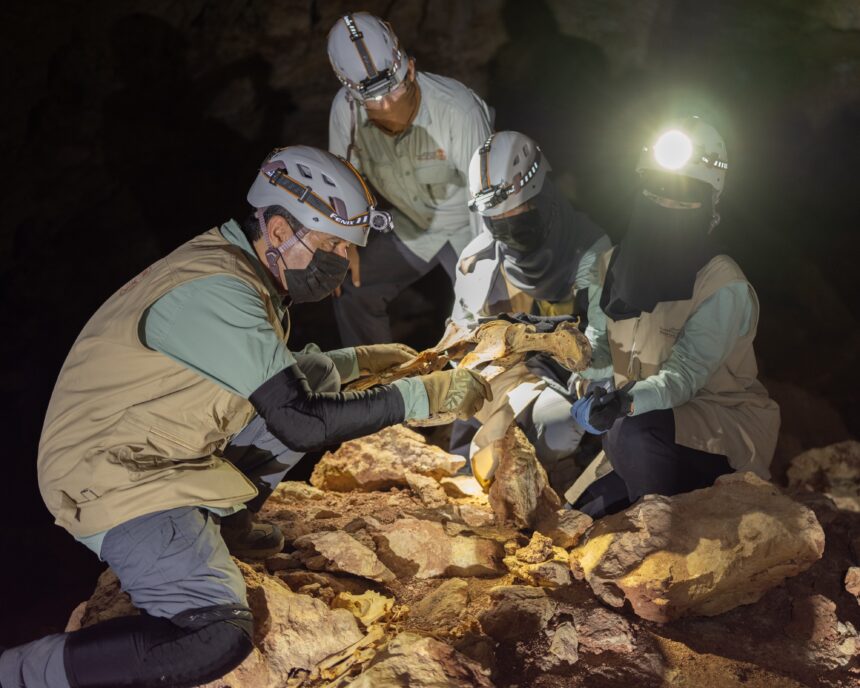
A Saudi-international research team has uncovered seven naturally mummified cheetahs, along with dozens of skeletal remains, preserved inside a network of caves in the Arar region near the Saudi-Iraqi border. The discovery provides the first long-term physical evidence that cheetahs once inhabited the Arabian Peninsula, according to a study published on January 15 in Communications Earth & Environment.
Researchers say the unexpected find could reopen the question of cheetah extinction in Arabia, not as a closed chapter of the past, but as a living issue closely linked to the future of ecological restoration and reintroduction efforts in the region.
“This discovery is of exceptional scientific importance,” said lead author Ahmed Al-Boug, vice president of the National Center for Wildlife and a biodiversity conservation expert. “For the first time, we have long-term physical evidence showing that cheetahs inhabited the Arabian Peninsula, rather than relying solely on scattered historical accounts.” He added that the findings also provide the first proof that more than one cheetah subspecies once existed in the region, as well as the only historical evidence so far of cheetah diet in Arabia.
Radiocarbon dating revealed that the oldest remains date back more than 4,000 years, while the most recent are around 130 years old. Imaging analyses showed that the cheetahs represented different age groups, ranging from cubs to adults, suggesting that the caves were not simply natural traps but may have served as shelters or even birthing sites.
According to Al-Boug, the discovery underscores “the critical role caves can play in preserving genetic and biological evidence of species that disappeared long ago,” noting that landscapes which appear empty today may conceal rich environmental archives beneath the surface.
One of the study’s most striking findings emerged from genomic analysis, which revealed that ancient cheetahs in Saudi Arabia did not belong to a single lineage. While the most recent samples were genetically linked to the critically endangered Asiatic cheetah, now found only in Iran, older samples showed closer genetic ties to the Northwest African cheetah.
This, Al-Boug explained, suggests that cheetah populations in Saudi Arabia were not exclusive to the Asiatic subspecies. Instead, Northwest African cheetahs, or closely related genetic lineages, occupied the region for extended periods. The finding challenges the prevailing assumption that the Asiatic cheetah is the only suitable candidate for potential reintroduction programmes in the Arabian Peninsula.
From a conservation standpoint, Al-Boug said the discovery “significantly broadens the range of options,” allowing planners to consider African subspecies – or at least a wider pool of genetic diversity – rather than relying solely on a single subspecies already facing extreme extinction risk.
The study also suggests that the disappearance of cheetahs from the Arabian Peninsula was driven primarily by human pressures, including overhunting and the subsequent decline of prey species, rather than by dramatic environmental or climatic change. Al-Boug stressed that extinction in the region is believed to have resulted mainly from human activity.
He pointed to Saudi Arabia’s experience in captive breeding and wildlife reintroduction, citing successful programmes involving the Arabian oryx, Nubian ibex, and sand gazelles. However, he cautioned that significant challenges remain. Among the most serious, he said, is retaliatory killing linked to livestock predation. Ensuring adequate wild prey populations and working closely with local communities, he emphasised, are essential prerequisites before any attempt to reintroduce cheetahs to the Arabian landscape.