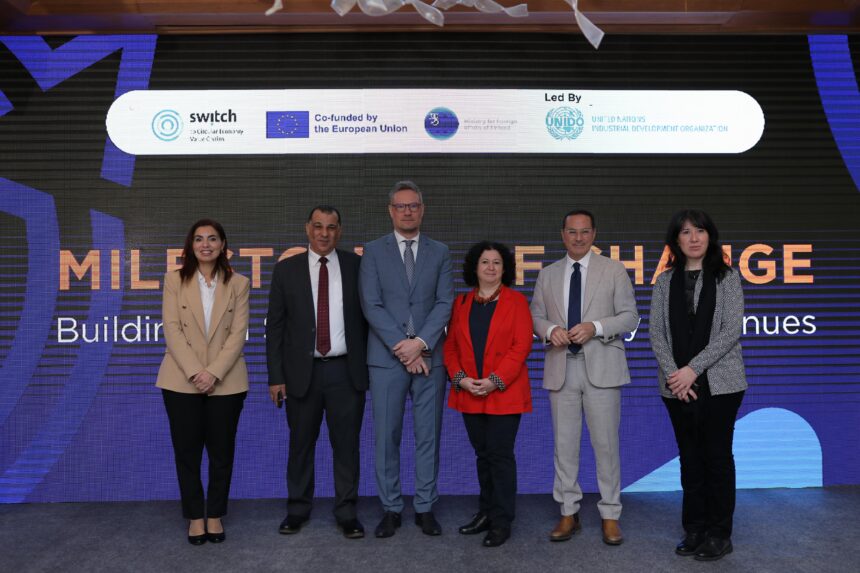
The United Nations Industrial Development Organization (UNIDO), the Delegation of the European Union to Egypt, the government of Finland, and the Egyptian ministry of industry, together with major technology partners including Orange Group, Nokia and Cordon, celebrated the progress of the One Circle pilot project since its launch in 2023.
During the event, stakeholders announced the next phase of the initiative, detailing its expansion, new strategic partnerships, and a roadmap through 2026. Held under the theme “One Circle – Milestones of Change”, the event highlighted how the project has transformed circularity in Egypt’s ICT sector from a conceptual ambition into a practical reality through coordinated efforts between the private sector, government, and development partners.
A core part of this progress is the establishment of two key centres: a network equipment repair line developed with Nokia and DSV, and a smartphone refurbishment hub created with Upgrade, E-Tadweer and Orange Egypt. These centres represent a major shift in how electronic devices are managed throughout their lifecycle.
Müge Dolun, Programme Manager at UNIDO, said One Circle demonstrates that the circular economy is a viable model that delivers economic value, sustainability and sector-wide development. She noted that the two centres have repaired more than 300 network modules and sold over 1,300 certified refurbished smartphones through Orange Egypt, clear evidence of rising consumer confidence in sustainable, affordable circular devices.
The project has also collected 10.22 tonnes of e-waste and more than 2,000 mobile phones through formal channels, ensuring proper treatment and reducing the environmental impact of unmanaged waste. By extending device lifecycles and promoting reuse, One Circle helped avoid 70,918 kg of CO₂ emissions.
Beyond infrastructure, the project has prioritised capability-building—creating over 60 jobs in circular ICT activities, delivering vocational training, and expanding its partner network from 15 entities at launch to 44 today. This growth reflects its broadening impact across technical, logistical and regulatory value chains.
These achievements come at a crucial time, as Egypt remains the largest producer of e-waste in Africa, underscoring the need for scalable circular solutions. The project also demonstrated that behavioural change is possible: school outreach programmes recorded a 100% improvement in students’ understanding of e-waste, while awareness activities reached more than 3,000 people across schools, villages and rural communities.
Finland’s Ambassador to Egypt, Riika Eela, stressed the importance of international cooperation, saying: “Finland supports initiatives in Egypt because challenges such as waste reduction are planetary in nature and demand the pooling of expertise across borders. Cooperation, including government-to-government efforts, is essential to ensure a smooth and sustainable transition to a circular economy.”
Lorenzo Vingut Harrington, Head of the Green and Sustainable Transformation Team at the EU Delegation to Egypt, said: “The SWITCH2CE initiative focuses on advancing sustainable practices fully aligned with EU Circular Economy principles.”
Closing the event, Emad Abdel Hameed noted that One Circle aligns with Egypt’s Industrial Strategy 2025–2030 and Vision 2030, which aim to raise industry’s contribution to GDP above 20%, increase green industries to at least 5% of GDP, and expand industrial employment to seven million jobs by 2030.
Starting in 2026, the project will further scale up repair and refurbishment operations, strengthen formal e-waste collection channels, and support regulatory development. It is also expanding its strategic partnerships, now including Raya Trade and The Greek Campus, positioning Egypt as a regional model for circular ICT.