

A new report from the UN Conference on Trade and Development (UNCTAD) warns that prolonged military operations and long-standing restrictions have driven the economy of the Occupied Palestinian Territory into its most severe contraction on record, erasing decades of development gains and deepening fiscal and social fragility.
The report, Developments in the Economy of the Occupied Palestinian Territory, finds that two years of military escalation and movement restrictions have triggered an unprecedented economic collapse across the Palestinian economy. This has unfolded against a backdrop of structural vulnerabilities, with far-reaching social, environmental and institutional consequences.
According to UNCTAD, extensive damage to infrastructure, productive assets and public services has reversed decades of socio-economic progress. The resulting crisis is now among the ten worst economic contractions recorded globally since 1960, while conditions in Gaza represent the most severe downturn on record.
At the same time, plummeting revenues and the withholding of fiscal transfers by the Israeli Government have severely constrained the Palestinian Government’s ability to maintain essential services or invest in recovery at a moment when large-scale spending is urgently required. The escalation has pushed the Palestinian economy from a prolonged slowdown into a near-total collapse, with repercussions across all sectors. In Gaza, the entire population has fallen into multidimensional poverty. The West Bank is experiencing its sharpest economic downturn on record, driven by heightened insecurity, increased movement restrictions and a collapse in productive activity.
By the end of 2024, Palestinian GDP had fallen back to its 2010 level, while GDP per capita returned to that of 2003—effectively wiping out 22 years of development gains in under two years.
Gaza: Economy reduced to a fraction of its former size
For nearly twenty years, 2.3 million Palestinians in Gaza have lived under severe restrictions on trade, movement and access to resources within one of the world’s most densely populated areas. Limited entry of goods, restrictions on productive inputs and technology, and recurrent military operations have dismantled Gaza’s productive base, creating near-total dependence on external assistance.
In 2024 alone, Gaza’s GDP contracted by 83% compared with 2023, following a major decline the previous year. Over 2023–2024, GDP shrank cumulatively by 87% to $362m. GDP per capita fell to $161—among the lowest globally—and is now just 4.6% of the West Bank’s per capita income, down from near parity in 1994.
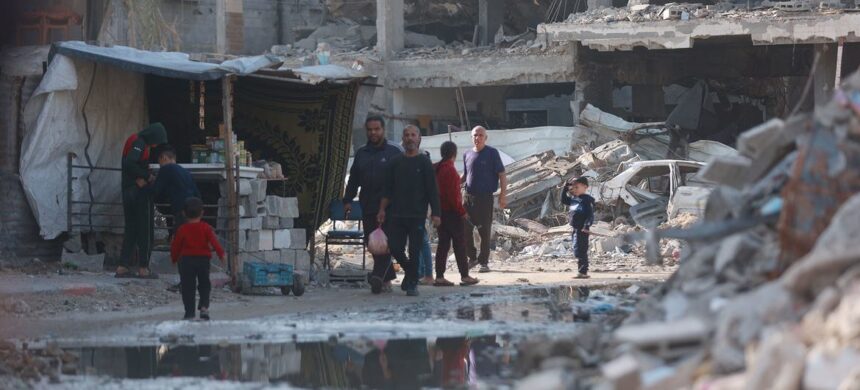
Destruction of infrastructure, widespread loss of productive capacity and mass displacement have caused lasting damage to human capital. Disruptions to education and basic services will have long-term consequences for livelihoods and societal resilience. Housing, utilities and essential infrastructure have been devastated, cutting off access to food, water, healthcare and public services, and creating an acute humanitarian and economic emergency.
UNCTAD warns that even with substantial international assistance, recovery to pre-October 2023 GDP levels could take decades. It stresses that ensuring the durability of the October 2025 ceasefire is essential to enable meaningful reconstruction, while humanitarian aid remains urgently needed.
West Bank: Sharpest downturn on record
Settlement expansion and movement restrictions continue to fragment the West Bank, constrain trade and investment, and reduce access to land, markets and resources for more than 3.3 million Palestinians. These constraints increase transport costs, lengthen travel times and disrupt access to employment, education and healthcare.
Since late 2023, movement restrictions have intensified further, sharply reducing economic activity. West Bank GDP contracted by 17%, while GDP per capita fell by 18.8%, returning to levels last seen in 2014 and 2008 respectively.

Fiscal pressures deepen institutional strain
The fiscal situation deteriorated markedly after October 2023, making 2024 one of the most challenging years for the Palestinian Government. Revenue shortfalls, the withholding of fiscal transfers, a contracting economy and declining external support have deepened the crisis, with pressures continuing into 2025.
Between January 2019 and April 2025, cumulative deductions and withheld fiscal transfers amounted to an estimated $1.76bn—equivalent to 12.8% of GDP in 2024 and 44% of total net revenues. Combined with a shrinking tax base and falling donor contributions, these shortfalls have severely limited the Government’s capacity to pay salaries, sustain essential functions and deliver basic services.
UNCTAD stresses that urgent and sustained international financial support is needed to stabilise public finances, safeguard institutional capacity and enable effective reconstruction.
Rebuilding Gaza requires more than $70bn
UNCTAD estimates the cost of reconstruction and recovery in Gaza at more than $70bn, underscoring the scale of investment needed to rebuild infrastructure, restore services and revive livelihoods.
The report calls for immediate and coordinated international intervention to halt the economic collapse, address the deepening humanitarian crisis and lay the foundations for sustainable peace and development. It urges a comprehensive recovery plan for the Occupied Palestinian Territory, coupled with restored fiscal transfers and measures to ease constraints on movement, trade and investment.
UNCTAD’s role
For nearly four decades, UNCTAD has provided policy research, technical cooperation and capacity-building support to the Palestinian people. Its work focuses on trade facilitation, productive capacity and institutional development, in partnership with public and private stakeholders and civil society, while also promoting international consensus on the needs of the Palestinian economy.

