In my early years, studying in Germany was my biggest dream. To me, Germany was not just a country; it was a symbol of precision, discipline, and intellect.
At home, that dream was a constant conversation between my parents. My father saw Germany as the land of science and responsibility; my mother saw it as a far and cold land, a place that might take her son away.
I grew up between two voices: one pushing me toward the world, and another pulling me closer to her heart.
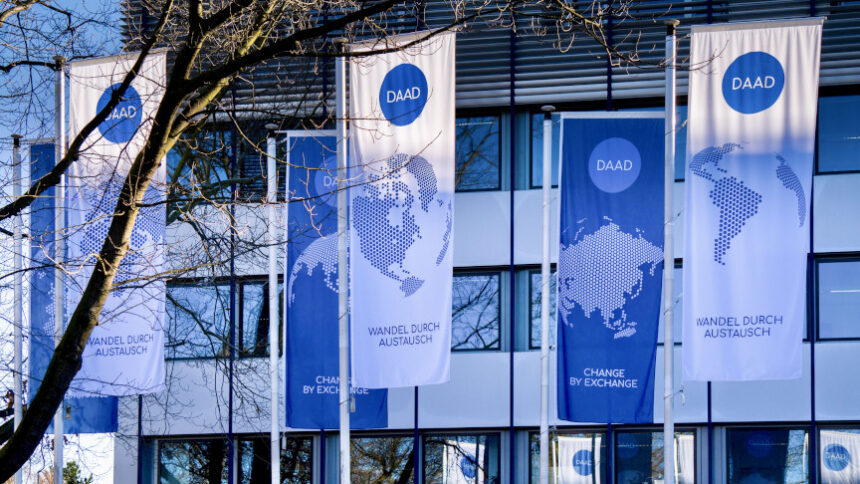
When my father passed away, his dream stayed with me like an unfinished promise. I didn’t go to Germany then, I had to take care of my family and my mother herself. But every time I saw the word DAAD- The German Academic Exchange Service (Deutscher Akademischer Austauschdienst)- on an announcement, I felt as if my father was smiling from afar.
Years passed. I studied at the University of East London, then at King’s College London, and later at Thunderbird School of Global Management. Finally, I found myself at the Hertie School of Governance in Berlin, even if only for less than a month. That time in Berlin was the bridge between memory and fulfillment. It felt as if my father’s voice had crossed time to meet me there, while my mother’s prayers waited for my safe return home.
For some time, I’ve been trying to learn German, not very successfully in finding a speaking partner, but the passion remains alive. Perhaps my early fascination with Germany came from its sense of order, strength, and structure, qualities I later learned to admire in their civilizational, not ideological, context.
I may not yet have the German tongue, but I deeply admire the German mind, especially its educational philosophy that never separates scientific progress from human depth.
The DAAD represents that very spirit, a model of openness, balance, and intellectual rigor.
It is led today by Dr. Wiebke Bachmann, a remarkable figure who embodies the modern German vision of education.
Dr. Bachmann combines academic insight with administrative excellence, representing a new generation of international educational leadership in Germany.
Her belief that education is not about instruction but about participation, and that academic exchange is not a luxury but a necessity for global balance, perfectly captures what makes the DAAD so unique. Through her leadership, the DAAD continues to reflect the best of Germany, a country that uses knowledge as a bridge for peace, not a tool of dominance.
Since its founding in 1925, the DAAD has supported more than 2.6 million students and researchers worldwide, turning Germany into one of the most influential cultural forces in the world.
What distinguishes the German cultural presence is that it does not impose, it inspires. It respects diversity and believes that identity grows through dialogue, not isolation.
As I write these lines, I do not write as an applicant for a scholarship, but as a son who learned that what began as a family dream can evolve into a national idea. I dream that Egypt will one day have its own version of the DAAD, a program that redefines the relationship between education and culture, between the individual dream and the public good.
A program that invests in young minds the way Germany invests in the world, building bridges of trust, knowledge, and shared humanity.
I may not have studied in Germany as my father wished, but I learned something even greater: that culture is politics, politics is culture, and one scholarship can change the fate of thousands of minds.
For me, the DAAD will always remain somewhere between my mother and my father, between dream and tenderness, between discipline and warmth, between science and humanity.
Dr Ramy Galal is an Egyptian writer, and academic specializing in public management and cultural policies. He has authored studies on cultural diplomacy, the orange economy, and restructuring Egypt’s cultural institutions.
Galal holds a PHD degree from Alexandria University, a master’s degree from the University of London, and Diploma From the University of Chile.
A former senator, and former adviser and spokesperson for Egypt’s Ministry of Planning. He was also the spokesperson for the Egyptian Opposition Coalition.