

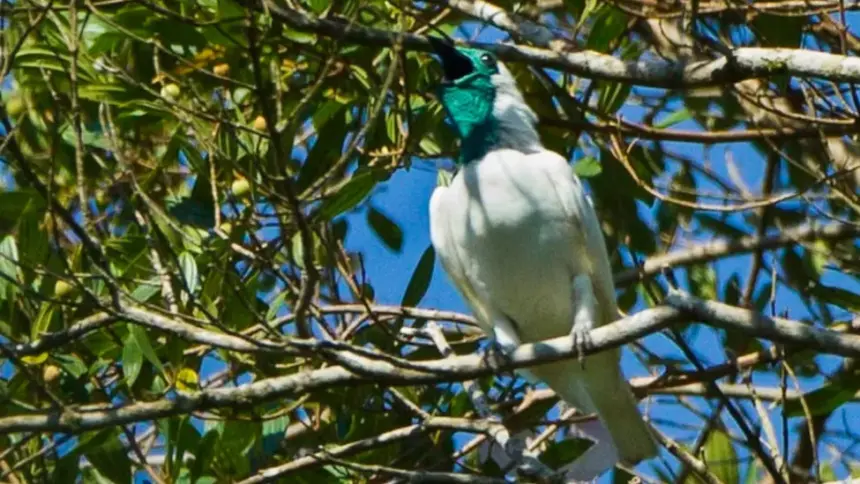
Birdsong may sound to us like little more than natural music, with melodies varying from one species to another. But behind every call lies a physical equation that determines how loud it can be and how far it can travel. A new study suggests that a bird’s body size and the width of its beak opening may be among the most important factors explaining the enormous differences in the loudness of bird calls.
The study, recently published in the journal Evolution, measured the sound intensity of 123 bird species belonging to 39 families. The researchers found that the maximum recorded sound level ranged from about 64 decibels in one hummingbird species to 122.4 decibels in the bare-throated bellbird, a difference of 58.3 decibels between the quietest and loudest species included in the study.
João C. T. Menezes, a researcher in biology and zoology at the University of Massachusetts Amherst and lead author of the study, said the question was not simply which birds are the loudest, but which evolutionary and physical factors allow some species to produce exceptionally powerful sounds while others remain much quieter despite also relying on vocal communication.
The team collected field recordings between December 2018 and January 2025 in the US state of Massachusetts and several Brazilian states. They used calibrated equipment to measure sound pressure, recorded the distance between each bird and the researcher, and adjusted the measurements to represent the expected sound level at a distance of one metre from the bird. After excluding species for which there were insufficient measurements, the authors retained 123 species for analysis.
Menezes said the differences between species were striking. The bare-throated bellbird produced the highest reading, at 122.4 decibels, while the white bellbird and the red-legged seriema also exceeded 120 decibels. Eight other species surpassed 100 decibels, including the Canada goose, the white-throated toucan, and the screaming piha.
When the researchers converted the difference from the decibel scale into direct sound pressure, they found that the strongest recorded call produced more than 800 times the sound pressure of the quietest species in the sample, highlighting the enormous diversity in birds’ vocal capabilities.
The study suggests that the bare-throated bellbird and the red-legged seriema can now join the white bellbird as candidates for the loudest known birds, although the result depends on how “loudest” is defined.
One of the main questions the team sought to answer was what allows these birds to produce such powerful sounds. According to Menezes, comparisons showed that larger species tend to produce louder calls, while birds with wider beak openings are also capable of reaching higher sound levels, even after body size is taken into account.
The researchers suggest that larger birds may have stronger respiratory muscles capable of generating greater air pressure, while a wider beak opening may allow more acoustic energy to escape into the environment rather than being reflected back into the vocal tract.
Beak gape width appears to provide a more consistent explanation than body size. The relationship between beak width and sound level remained clear when the researchers repeated their analysis using only 76 species for which measurements were available from two or more individuals. By contrast, the relationship with body size became less statistically certain.
The study found no strong evidence that birds living in dense forests are louder, nor did it identify a clear relationship between sound intensity and the ability to fly. Having multiple mating partners also did not appear to be a decisive factor, although some analyses suggested a possible association with louder calls.
The findings also reveal an intriguing paradox, according to Menezes. Some birds are able to produce sounds louder than those of much larger terrestrial animals, including lions, elephants, and bison. This suggests that body size and beak width do not tell the whole story, and that birds may possess additional vocal mechanisms that scientists have yet to fully understand.
The study has several limitations that make it difficult to generalise the findings. For some species, the measurements were based on recordings from only a single individual. The recordings were also collected in the field in the United States and Brazil, rather than from a globally balanced sample covering all bird families.
The team was also unable to fully adjust the measurements for factors such as the direction of the bird’s head and body, the effects of vegetation and weather, and the social context in which the call was produced, all of which can influence the measured sound level.
The researchers also emphasised that sound-intensity data are still available for only a very small fraction of the world’s bird species. Future measurements of species that have not yet been studied could therefore reveal even louder calls or identify new evolutionary factors that explain how some birds achieve such extraordinary vocal power.


