

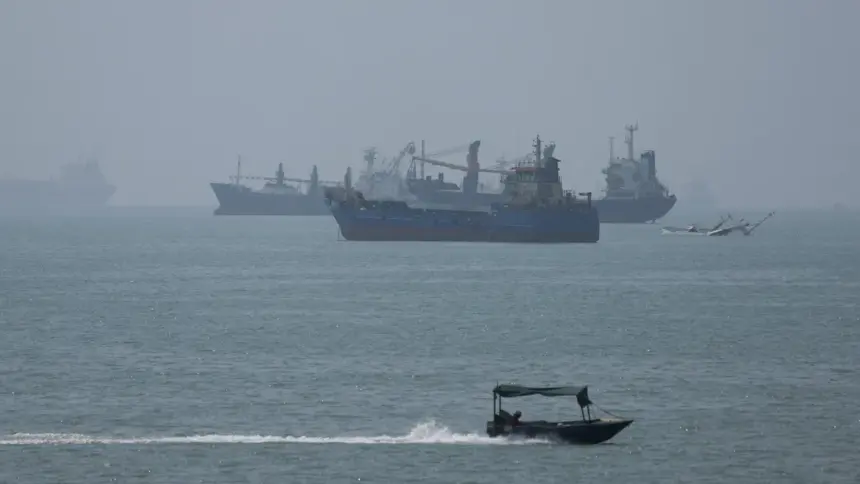
The naval force of Iran’s Islamic Revolutionary Guard Corps (IRGC) declared on Saturday that it retains “complete control” over the Strait of Hormuz, asserting that the waterway will remain closed to vessels attempting to cross without coordination with Tehran as the US military continues to enforce a naval blockade.
Iran’s state news agency IRNA quoted the IRGC Navy as stating that the closure will continue “until the end of the US military’s hostile actions against Iran and the implementation of the agreed commitments”. Meanwhile, US Central Command (CENTCOM) stated on Saturday that its forces have redirected 82 commercial vessels, disabled three ships, and boarded two others to ensure compliance as part of the ongoing US blockade against Iran, sharing imagery on social platform X of a watchstander aboard the guided-missile destroyer USS John Paul Jones (DDG 53).
In a statement published by state media on Saturday, the Iranian government pledged to stand “firmly” against US sanctions and what it described as US-Israeli “conspiracies”. The government affirmed that diplomacy and defence are “complementary, coordinated and inseparable tools” for protecting national interests and regional security, adding that it is pursuing both paths simultaneously while focusing on curbing inflation, creating employment, supporting domestic production, and gradually reducing reliance on the US dollar.
The IRGC Navy dismissed US assertions that the Strait of Hormuz remains open to maritime traffic as a “clear lie”. The statement followed reports on Friday by news outlet Axios, citing US officials, claiming that Iran had lost a significant portion of its control over the strait, with the US military effectively controlling most of the waterway.
The IRGC’s assertion follows statements on Friday by Iranian President Masoud Pezeshkian, who said Tehran had established a route for crossing the Strait of Hormuz following consensus with Muscat based on the “Islamabad Memorandum of Understanding”. Speaking in a televised interview, Pezeshkian stated Iran would open the agreed transit corridor if four conditions are met: lifting the “blockade”, removing sanctions on fuel and petrochemicals, releasing frozen assets, and halting Israeli attacks on Lebanon. He provided no further details on the proposed passage or the parties involved in implementing the commitments.
Separately, US diplomats and their families have begun a gradual return to embassies across the Middle East after ordered departures during the early days of the Iran war, following the lifting of certain personnel restrictions by the US State Department this week. According to the Associated Press, the measures stem primarily from legal frameworks within human resources policy regarding paid leave limits rather than a shift in President Donald Trump’s administration policy toward Iran. By Friday, US embassies in Qatar, Kuwait, and Bahrain permitted family returns—restricted to those over 18 in Kuwait and Bahrain—following earlier allowances for families of US government personnel in Israel and those over 21 in Lebanon.
