

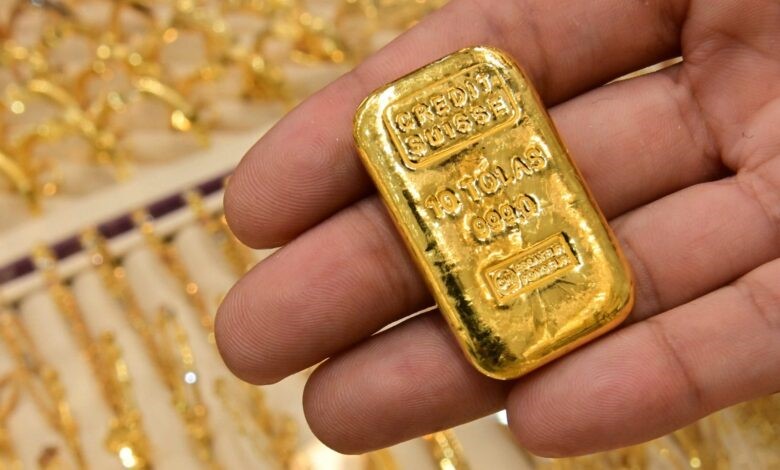
Gold prices in Egypt recorded a strong weekly increase, supported by a sharp rally in international bullion markets after weaker-than-expected US labour market data fuelled expectations that the US Federal Reserve could adopt a less restrictive monetary policy, according to a technical report issued by online gold and jewellery trading platform iSagha.
The report showed that the price of 21-karat gold, the benchmark for the Egyptian market, rose from EGP 5,790 per gram last Saturday to EGP 5,925 today, an increase of EGP 135, or around 2.5%.
Meanwhile, 24-karat gold reached EGP 6,771 per gram, 18-karat gold rose to EGP 5,078 per gram, and the gold sovereign was priced at EGP 47,400.
According to iSagha, the weekly trading range reached approximately EGP 270 between the highest and lowest prices, reflecting heightened volatility in the domestic market in line with strong movements in global gold prices.
Saied Embaby, Chief Executive Officer of iSagha, said the international gold market regained strong momentum after US labour market data showed that the economy created only around 57,000 jobs in June, well below market expectations of approximately 110,000. The figures marked the weakest monthly employment growth in four months and pointed to a noticeable slowdown in economic activity.
He said the weaker employment data boosted demand for gold as a safe-haven asset by reinforcing expectations that the Federal Reserve may slow the pace of monetary tightening. Lower interest rate expectations reduce the opportunity cost of holding non-yielding assets such as gold, supporting continued investment inflows into the precious metal.
Embaby said Egypt’s gold market remained balanced throughout the week, noting that the pricing gap, which averaged around 2.7%, reflected normal operating, distribution and transaction costs rather than market distortions.
He added that investors holding surplus gold assets may consider taking advantage of current price levels to realise profits, while indicating that a sharp decline in prices appears unlikely in the near term as long as signs of slowing US economic activity and labour market weakness persist.
The report also showed that the gap between domestic gold prices and their fair value ranged between EGP 99.52 and EGP 164.41 per gram, equivalent to 1.79%-2.96%, indicating stable market conditions and normal operating margins without pricing imbalances.
Globally, gold prices rose from $4,016.96 per ounce on 29 June to $4,176.17 on 3 July, recording weekly gains of $159.21, or nearly 4%.
According to the report, weaker US employment data prompted investors to reassess expectations for US monetary policy, reducing the probability of an interest rate increase at the Federal Reserve’s September meeting to around 50%, down from approximately 67% before the jobs report.
Embaby said these developments restored momentum to the gold market by strengthening expectations of a more accommodative monetary policy, providing significant support for precious metal prices.
He added that comments by Kevin Warsh regarding easing inflation expectations, together with lower oil prices and improving commercial shipping through the Strait of Hormuz amid continued progress in US-Iran negotiations, further boosted investor confidence and supported the rise in global gold prices.
The report also noted that the US Dollar Index fell below the 101-point level and was on track to record its largest weekly decline since April, further enhancing gold’s attractiveness given the traditionally inverse relationship between the US dollar and bullion.
Central banks also continued to underpin the market after adding approximately 41 metric tonnes of gold to their reserves during May, according to data from the World Gold Council. The purchases reflect the continued strategy of monetary authorities to diversify reserve assets and increase long-term gold holdings.
The report added that global physical demand remained broadly balanced despite weaker buying in India due to elevated prices, while demand in China improved modestly, helping to maintain overall market stability.
Embaby said gold prices continue to be supported by several fundamental factors, including slowing US employment growth, a weaker US dollar and sustained central bank purchases.
Looking ahead, he said the outlook for the coming weeks remains cautiously optimistic. If US labour market data continues to weaken and expectations of further interest rate increases continue to fade, the price of 21-karat gold in Egypt could approach EGP 6,000 per gram. If US economic data remains broadly stable, prices are likely to trade within a range of EGP 5,900-5,950 per gram, while a decline towards EGP 5,800 would become more likely only if inflationary pressures re-emerge and expectations of tighter US monetary policy strengthen.
Embaby added that any short-term corrections in gold prices could represent attractive buying opportunities for investors seeking to build long-term positions, given continuing global economic uncertainty and gold’s enduring role as a hedge against market volatility and inflation.


