

Gulf energy markets faced widespread disruption on Sunday as Saudi Arabia applied record oil premiums and Qatar declared Force Majeure on a portion of its gas exports following Iranian attacks that also damaged infrastructure in Kuwait and the United Arab Emirates, even as Iraq attempted to resume shipments through the Strait of Hormuz.
Saudi Arabia added a record premium to the price of its flagship crude headed to Asia, at a time when Iran’s near-closure of the Strait of Hormuz is choking energy flows in the region and increasing market volatility. State oil giant Aramco will raise the price of its “Arab Light” grade for May shipments by a premium of $19.50 per barrel above the regional benchmark, according to a price list seen by Bloomberg. This level remains below the expectations of traders and refineries, which had reached $40 per barrel in an agency survey.
The difference between market expectations and the set price is partly due to sharp fluctuations and a decline in some Middle Eastern crude prices during the last week of March, oil traders said. Additionally, Aramco’s oil is priced based on loading from the Ras Tanura port in the Arabian Gulf, though all the company’s exports are currently being shipped from the Yanbu port on the Red Sea coast. This shift imposes additional costs on buyers to transport those shipments.
U.S. and Israeli strikes on Iran have disrupted global energy trade, with Tehran’s near-closure of the vital Strait of Hormuz limiting the supplies of its neighbours across the Gulf. Brent crude has jumped by more than 50% and fuel prices have risen sharply. Saudi Arabia and the UAE are the only Gulf producers with significant export alternatives that bypass the Hormuz bottleneck. Aramco has reached the maximum capacity of its pipeline to the Red Sea coast at 7m bpd, currently exporting about 5m bpd of crude, or approximately 70% of its total pre-war shipments. Aramco Chief Executive Amin Nasser said during a phone call on March 10 that the company has halted most of its medium and heavy crude production, focusing instead on selling its light and extra-light grades from the Yanbu port.
In Qatar, the CEO of QatarEnergy, Saad al-Kaabi, stated that Iranian attacks have disrupted 17% of Qatar’s liquefied natural gas (LNG) export capacity, causing estimated annual losses of $20 bn and threatening supplies to Europe and Asia. Al-Kaabi told Reuters on Thursday that two out of 14 LNG production lines, in addition to one of the two gas-to-liquids facilities, were damaged in “unprecedented” strikes. He added that repair work will result in a production halt of 12.8m tonnes per year of LNG for a period ranging between three to five years.
“I could not have imagined in my wildest dreams that Qatar—and the region—would be vulnerable to such an attack, especially from a sister Muslim country in the month of Ramadan,” al-Kaabi said. The state-owned QatarEnergy may be forced to declare Force Majeure on long-term contracts for up to five years for LNG supplies destined for Italy, Belgium, South Korea, and China. U.S. oil major ExxonMobil is a partner in the affected facilities, holding a 34% stake in production line “S4” and a 30% stake in line “S6.” The impact extends to condensate exports, expected to fall by 24%, while LPG will decline by 13%, helium by 14%, and both naphtha and sulphur by 6%.
The regional escalation saw Kuwaiti oil facilities suffer “severe material damage” from Iranian drone attacks targeting sites belonging to the Kuwait Petroleum Corporation (KPC). KPC reported that the attacks targeted facilities of the Kuwait National Petroleum Company (KNPC) and the Petrochemical Industries Company (PIC), causing fires at several locations. Emergency teams contained the fires and prevented them from spreading. Earlier, a fire broke out at the KPC headquarters, which also houses the Kuwaiti Ministry of Oil; the building was fully evacuated. These developments follow recent aerial attacks on the Mina Al-Ahmadi and Mina Abdullah refineries, as well as strikes on Kuwait Airport.
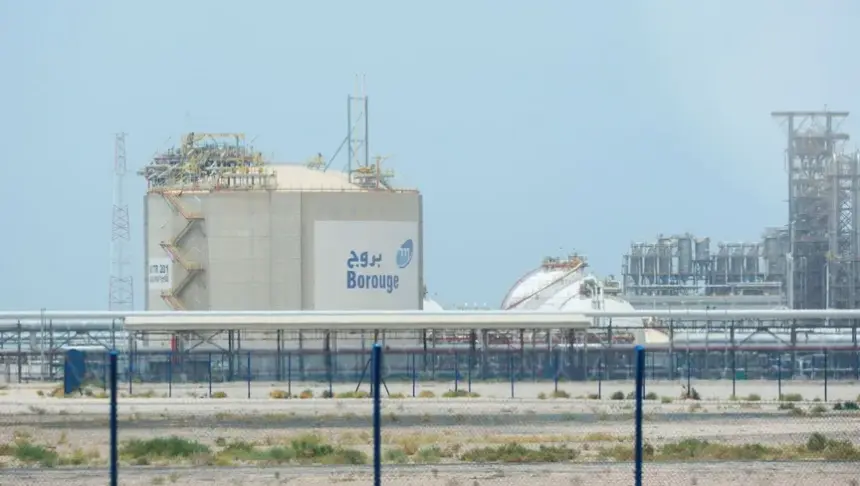
In the UAE, operations at the Borouge petrochemical plant in Ruais Industrial City, Abu Dhabi, were temporarily suspended on Sunday after fires broke out due to falling debris from an intercepted aerial attack. The Abu Dhabi Media Office reported on X that no injuries were recorded. Borouge, established in 1998 as a partnership between ADNOC and Borealis, has a nominal capacity of about 5m tonnes per year of polyolefin products. Two days prior, Abu Dhabi halted operations at its Habshan gas facilities, its largest natural gas processing plant, following a fire. Additionally, Bahrain’s Bapco Energies reported that an Iranian drone targeted a storage facility, causing a fire that has since been extinguished.
Hours before these attacks, Iran’s semi-official Fars news agency published a “targets list” including electricity, water, and steam facilities, as well as oil, natural gas, and petrochemical assets. The list included PIC, following an Israeli Air Force strike on the Mahshahr petrochemical complex inside Iran.
Amid these disruptions, Iraq has informed Asian trading and refining companies that they can resume loading oil shipments as vessels are now able to cross the Strait of Hormuz due to an Iranian exemption. The Iraq Oil Marketing Company (SOMO) stated in a notice on Sunday that Iraqi shipments are now “exempt from any potential restrictions.” SOMO requested buyers to provide loading schedules within 24 hours, adding that all loading terminals, including Basra, are “operating at full capacity.”
Iran had announced over the weekend that it was exempting Iraq from maritime shipping restrictions. While no specific details were provided, the “Ocean Thunder” tanker, carrying 1m barrels of Iraqi crude, crossed the strait on Sunday. Iraq, which mostly sells oil on a free-on-board (FOB) basis, saw its exports plummet by 97% in March compared to the previous month, averaging just 99,000 bpd. Asian buyers said they are seeking clarification on terms, including whether Iraq will provide its own tankers to ensure safety during the transit.

