

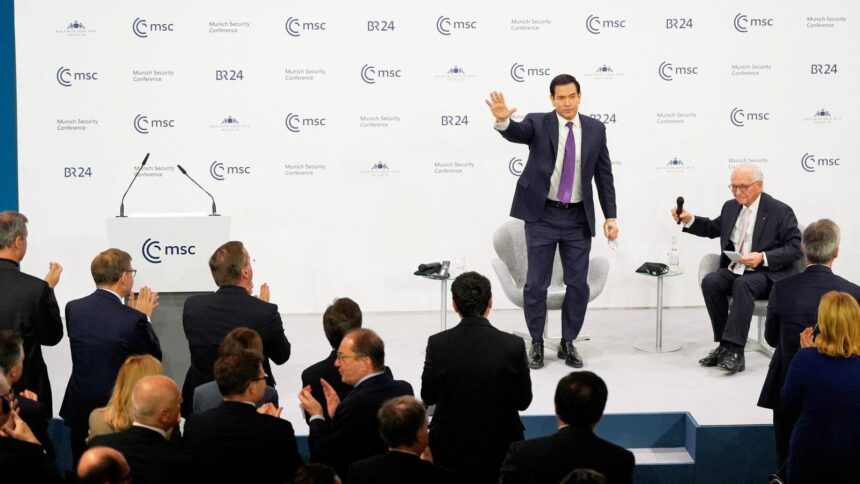
In the halls of the Bayerischer Hof in Munich, where the 62nd session of the Munich Security Conference convened in February 2026, the atmosphere transcended that of a routine diplomatic gathering addressing scattered global crises. Instead, it felt like a direct confrontation with a profound historical question: Are we witnessing a temporary disruption within the international system, or the deliberate dismantling of the foundations that have structured the global order since the end of World War II? Hovering over nearly every debate was the presence of Donald Trump, not merely as a former or returning president, but as the embodiment of a fundamental shift in the philosophy of American leadership.
The conference’s annual report, titled “Under Destruction,” did more than document global anxiety; it articulated a structural warning. Its central argument suggests that the world has entered an era in which international politics is driven by strategic demolition rather than incremental reform. Alliances are being reshaped through pressure, institutions are tested through threats, and economic instruments are deployed as overt tools of geopolitical leverage. Within this framework, Trumpism appears not simply as a domestic political orientation but as a governing doctrine aimed at redefining the United States’ global role; from guarantor of the system to perpetual negotiator of its terms.
The liberal order that emerged after 1945 rested on a foundational assumption: American power would restrain itself through institutions, and long-term alliances would serve as investments in stability rather than financial burdens. Yet the approach highlighted in Munich reflects a different calculus. Commitments are no longer fixed, alliances are no longer sacrosanct, and every relationship is subject to renegotiation according to cost-benefit logic. Tariffs, demands for increased European defence spending, and open scepticism toward transatlantic obligations are not isolated policy choices; they form part of a broader vision that treats the international system as an architecture open to redesign.
In his address to the conference, Secretary of State Marco Rubio sought to project a steadier and more reassuring tone. He invoked the historic transatlantic bond and spoke in emotive terms about an alliance that had once rescued the world at pivotal moments. On the surface, the speech aimed to restore European confidence. Yet a closer reading reveals continuity beneath the rhetoric. Reassurance did not eliminate conditionality. Calls for greater European defence capabilities were framed less as sovereign strategic evolution and more as a prerequisite for sustaining American engagement. The paradox of the moment lies here: diplomatic warmth overlaying firm strategic demands, partnership redefined in terms of contribution rather than shared identity.
Within the conference corridors, discussions reflected the depth of the ongoing shift. European concern has moved beyond abstract unease into institutional recalibration, with intensified discourse surrounding “strategic autonomy” and expanded continental defence industries. The war in Ukraine remained a decisive test of American commitment, as any retrenchment or conditional restructuring of support would be interpreted across European capitals as the end of unquestioned security guarantees. Simultaneously, China observes transatlantic friction as a historic opening to recalibrate global influence, whether through economic initiatives or by advancing an alternative model of political stability less anchored in liberal multilateralism.
It would be reductive, however, to describe the current moment as an outright collapse of the international order. More precisely, it represents a profound phase of systemic reconfiguration. International relations appear to be shifting from institutional permanence towards continuous negotiation. Trumpism does not demolish institutions in a single stroke; rather, it erodes their underlying assumptions, most notably the principle of long-term, unconditional commitment. The implicit message is unmistakable: the system is not an inherent value but a framework subject to revision if it fails to align with national interests as defined by the current leadership.
History teaches that periods of systemic rebalancing carry both risk and opportunity. Fragmentation can produce dangerous vacuums, yet it can also yield a more pragmatic and less idealised order. The outcome depends on whether global actors can manage transformation without descending into open confrontation. In Munich, there was no formal declaration of rupture, but there was tacit acknowledgment that the post-World War II order, in its classical form, can no longer be taken for granted.
The 2026 Munich Security Conference did not deliver a definitive verdict on the future of the international system. What it did reveal, with striking clarity, is that under Trump’s leadership the United States no longer sees itself solely as guardian of the order, but increasingly as arbiter of its terms. Between conciliatory diplomatic language and assertive strategic leverage, a less predictable and more negotiable world is taking shape. The central question is no longer whether the international order will change, but how far it will shift, at what cost, and who will ultimately bear the burden of that transformation. In Munich, the prospect of dismantlement ceased to be theoretical; it became a subject of open deliberation beneath the conference lights, as the world watched to see whether demolition will culminate in collapse, or in the construction of something fundamentally different.
Dr Marwa El-Shinawy – Academic and writer