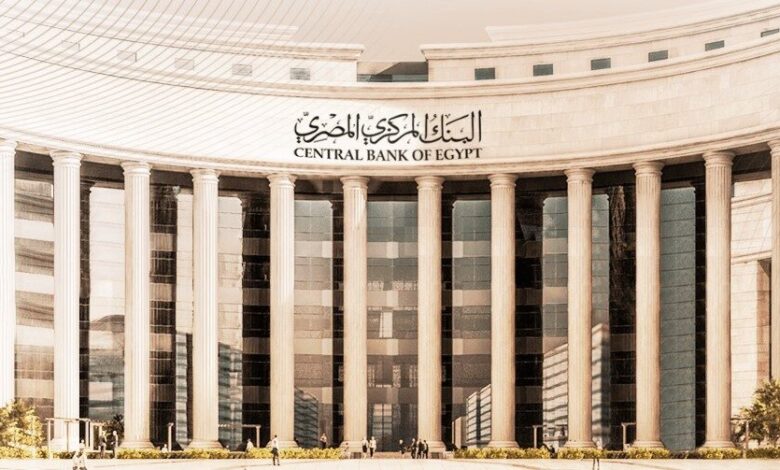
The Egyptian market is awaiting banks’ return to work on Sunday to assess how lenders will adjust interest rates on savings products and loan facilities following the decision by the Central Bank of Egypt (CBE) to cut key rates by 1%.
Last Thursday, the CBE’s Monetary Policy Committee reduced its benchmark rates – the main guide for short-term pound interest trends – to 19% for overnight deposits and 20% for overnight lending. The credit and discount rate, as well as the main operation rate, were lowered to 19.5%.
In a parallel move aimed at supporting liquidity, the CBE’s board cut the mandatory reserve requirement ratio for banks to 16%, down from 18%.
The first direct reaction to the rate decision was an automatic decline in returns on variable-rate savings certificates and loan products linked to the key policy rates – commonly referred to as corridor-linked products.
Egypt’s banking sector offers several variable-rate certificates, most notably the “Platinum” certificate issued by the National Bank of Egypt and the “Al Qimma” certificate offered by Banque Misr. Returns on these instruments adjust automatically in line with changes to benchmark rates.
Similarly, a wide range of corporate and retail loan products priced against the corridor have seen borrowing costs fall by the same percentage as the central bank’s cut.
However, attention is now turning to fixed-rate savings products, where banks retain discretion over whether to amend pricing in response to the policy shift. Market participants are closely watching to see whether lenders will revise yields on newly issued certificates or maintain current levels to preserve deposit inflows.
Investors are also assessing how the rate cut could affect yields on domestic government debt instruments scheduled for auction this week, particularly in light of foreign investors’ appetite for Egyptian pound-denominated assets.
Acting on behalf of the Ministry of Finance, the CBE is set to offer two Treasury bill (T-bill) auctions on Sunday totalling EGP 70bn: EGP 25bn in 91-day bills and EGP 45bn in 273-day bills.
On Monday, the central bank will offer four Treasury bond (T-bond) auctions worth a combined EGP 40bn. These include three fixed-coupon bond offerings totalling EGP 33bn – EGP 8bn for two-year bonds, EGP 20bn for three-year bonds, and EGP 5bn for an additional three-year tranche, alongside a zero-coupon bond auction valued at EGP 7bn with a 716-day maturity.
The key question for the market is whether the 100-basis-point rate cut will translate into lower accepted yields at these auctions, and whether foreign portfolio investors will maintain strong participation amid evolving interest-rate differentials.
The coming days are therefore expected to provide clearer signals on how quickly the monetary easing cycle will filter through to savings returns, borrowing costs, and the pricing of sovereign debt instruments.