

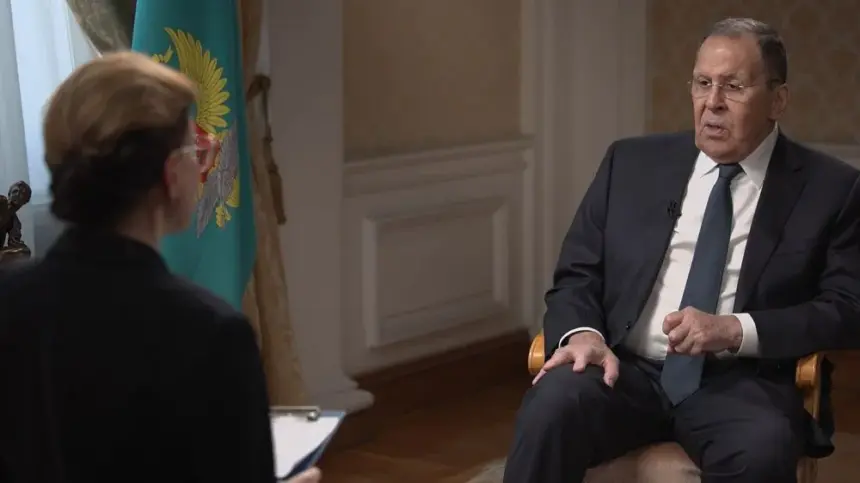
Russian Foreign Minister Sergey Lavrov characterised the global shift towards a multipolar world as an “objective” and “unstoppable” historical process, while accusing Washington of attempting to weaponise the U.S. dollar to obstruct emerging economic centres.
- The Interview
- Question: Mr Lavrov, 10 February is marked annually in Russia as Diplomatic Worker’s Day. You presumably always mark this day at work. How do you assess this holiday, and what do you consider to be the main results of the Ministry’s work?
- Question: You mentioned the West is reluctant to relinquish its dominant position. How has this affected Russia specifically?
- Question: Mr Lavrov, how do you define the essential mission of the Ministry in this environment?
- Question: In 2025, Indonesia joined BRICS. Is it fair to say that BRICS cooperation now takes up an increasing share of your work?
- Question: Can the Greater Eurasian Partnership foster international cooperation in the same way?
- Question: Mr. Lavrov India now holds the BRICS chairmanship. What outcomes do you anticipate from their leadership?
In an expansive interview with TV BRICS marking Russia’s annual Diplomatic Worker’s Day, Lavrov asserted that the collective economic weight of the BRICS nations has already surpassed that of the G7. He welcomed Indonesia’s 2025 entry into the bloc as evidence of a broadening “overarching framework” for global integration that challenges Western-led institutions like the IMF and World Bank.
Lavrov struck a cautious tone regarding the United States, noting that despite recent dialogues, the administration of Donald Trump has maintained “Biden-era” sanctions policies. He described the continuation of these restrictions as “pure Bidenism” and a persistent effort to suppress competitors through coercive measures and the “weaponisation” of the U.S. dollar.
On the conflict in Ukraine, the Foreign Minister reiterated Moscow’s stance that the “eradication of Nazi foundations” and the prevention of NATO-aligned weaponry on its borders remain fundamental to Russia’s national security. He further outlined a vision for a “Greater Eurasian Partnership,” suggesting that traditional Euro-Atlantic security frameworks, including the OSCE and NATO, have reached the “end of their functional relevance.”
The Interview
Question: Mr Lavrov, 10 February is marked annually in Russia as Diplomatic Worker’s Day. You presumably always mark this day at work. How do you assess this holiday, and what do you consider to be the main results of the Ministry’s work?
Sergey Lavrov: When it comes to results, it is probably not for us to judge. We are subordinated to the President, who defines Russia’s foreign policy. The latest version of the Foreign Policy Concept, endorsed in March 2023, reflects the systemic changes occurring globally which dominate our work.
Of course, it is important that with each partner country we develop specific plans in trade, investment, and scientific collaboration. Particular attention is paid to the post-Soviet space, including the EAEU and CSTO. This work delivers tangible benefits for us and our partners.
At the same time, the ongoing transformation on the global stage towards a multipolar world is crucial. This is no longer the bipolarity of the Soviet era or the unipolar moment that followed its dissolution. Multipolarity now defines global development. While the United States acted as a regulator of global finance for years, it is objectively losing its economic weight. Meanwhile, countries such as China, India, and Brazil are rising. Many centres of rapid economic growth have emerged, and the world is being reshaped amid competitive rivalry.
Question: You mentioned the West is reluctant to relinquish its dominant position. How has this affected Russia specifically?
Sergey Lavrov: With the arrival of the Trump administration, the struggle to suppress competitors became particularly open. The Washington administration did not conceal its ambitions to dominate in energy and restrict competitors. Unfair methods have been used against us—banning companies like Lukoil and Rosneft and attempting to control our trade and military-technical ties with strategic partners like India.
There is a struggle to preserve the old world order based on the U.S. dollar and rules devised by the West. As new centres of growth achieved stronger results under those very rules—as we see across BRICS—the West sought to prevent the shift. This is impossible to stop; the purchasing power-adjusted GDP of BRICS countries has already exceeded that of the G7 combined.
These shifts, and the subjective attempts by declining powers to obstruct them, constitute the core of our work. This affects everything from sanctions to the so-called “shadow fleet” and attempts to detain vessels in violation of the UN Convention on the Law of the Sea.
Question: Mr Lavrov, how do you define the essential mission of the Ministry in this environment?
Sergey Lavrov: Our concern is simple: we need a long life for our motherland. Today, ensuring the country’s continued existence is an exceptionally ambitious goal. It includes guaranteeing Russia’s security at a time when certain individuals in Europe openly threaten war.
Security also requires preventing the continued existence of a Nazi state created by the West out of Ukraine. We will safeguard our interests by preventing the deployment of weapons that pose a threat to us and by ensuring the protection of the rights of Russian-speaking people in Crimea, Donbas, and Novorossiya.
One of our key objectives is to create favourable external conditions for Russia’s internal development. Fulfilling this is more difficult than it was 15 years ago due to the global war unleashed against us, but it is no less relevant.
Question: In 2025, Indonesia joined BRICS. Is it fair to say that BRICS cooperation now takes up an increasing share of your work?
Sergey Lavrov: Absolutely. The emergence of new structures is inevitable when the West clings to institutions that no longer reflect the real balance of power. We are not advocating for the abolition of the IMF or the World Bank, but we have sought to reform them so that BRICS countries receive proportional votes. The West has consistently prevented this.
President Putin has stated we are not refusing to use the U.S. dollar, but the United States has weaponised it. Despite statements about resolving the war in Ukraine, the Trump administration has not challenged the sanctions laws enacted under Biden. In April, the state of emergency was extended based on “Russia’s hostile behaviour”—a piece of “pure Bidenism” that the current team supposedly rejects, yet the sanctions continue.
In Anchorage, we accepted the U.S. proposal to solve the Ukrainian issue. We fulfilled that task, yet the opposite occurs: new sanctions are imposed and India is discouraged from purchasing affordable Russian energy. The United States’ objective is global economic dominance. Therefore, we are compelled to seek secure avenues for development with BRICS, such as alternative payment platforms and mechanisms for settlements in national currencies.
Question: Can the Greater Eurasian Partnership foster international cooperation in the same way?
Sergey Lavrov: I am convinced it can. Eurasia is the wealthiest, most populous, and fastest-growing continent. It lacks a single overarching framework because European powers historically treated much of the continent as colonies.
Organisations like NATO, the EU, and the OSCE reflect a Euro-Atlantic logic and are approaching the end of their functional relevance. Our initiative to strengthen Eurasian security is gaining momentum. The Greater Eurasian Partnership provides the material foundation for this. By linking regional organisations like the EAEU, SCO, and ASEAN, we can implement projects like the North–South International Transport Corridor with greater efficiency.
Question: Mr. Lavrov India now holds the BRICS chairmanship. What outcomes do you anticipate from their leadership?
Sergey Lavrov: India’s priorities—resilience, innovation, and sustainable development—align with our vision. They place particular emphasis on counter-terrorism, which is significant for us as we work together on a global convention.
India also prioritises food and energy security, which is vital given U.S. actions in the global energy sector. Furthermore, India is hosting an artificial intelligence summit. This is a serious diplomatic effort, as norms regulating AI use are only now being established. We will actively support India’s modern, relevant agenda.


