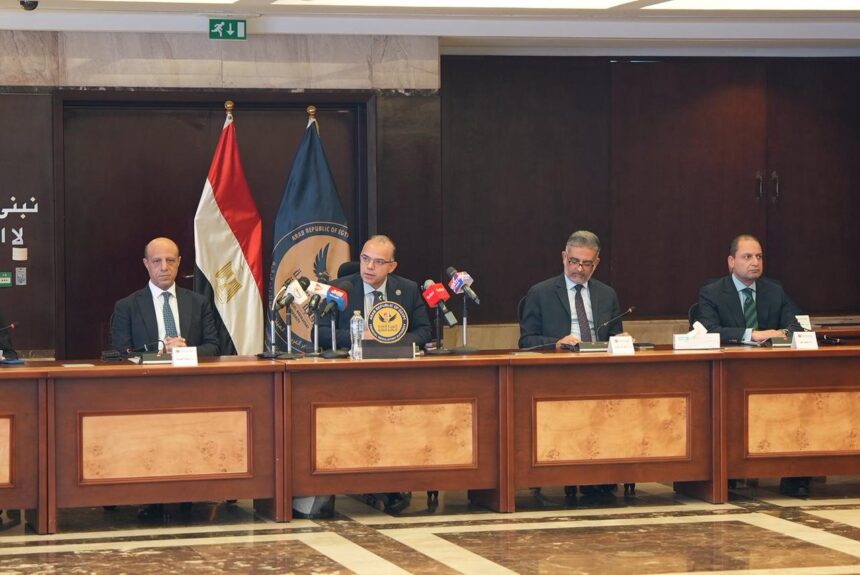
The Financial Regulatory Authority (FRA) has released its annual report for 2025, titled From Regulation to Empowerment, documenting what it described as unprecedented advances across Egypt’s non-banking financial activities. The authority said its regulatory decisions have evolved into effective empowerment tools, contributing to stronger economic growth and deeper financial markets.
Mohamed Farid, Chairperson of the FRA, said 2025 represented a genuine turning point in beginning to reap the fruits of the authority’s reform policies implemented since 2022. He stressed that there is no “magic wand” in the reform process, noting that sustainable development is cumulative and requires a clear vision, disciplined execution, and continuous engagement with market participants.
Farid said technology has become the common denominator in developing all non-banking financial sectors, explaining that the FRA has treated digital transformation as a core empowerment tool rather than a procedural upgrade. He emphasised that development and modernisation are reflected in tangible improvements in market efficiency and in citizens’ and companies’ ability to access financial services with greater ease.
He added that, in preparing and updating regulatory frameworks, the authority was keen to listen closely to the market, noting that decisions related to modernisation and development were the result of extensive dialogue with companies and institutions operating across the sector. This approach, he said, ensures a balance between encouraging innovation, protecting users’ rights, and safeguarding market stability.
Farid said the FRA has institutionalised innovation through the launch of its regulatory sandbox, which serves as a structured platform to receive, nurture, test and develop new ideas within a secure supervisory environment before their full market rollout.
These efforts have led to the creation of an integrated financial technology ecosystem comprising 73 fintech companies, including 45 already operating and 28 completing licensing procedures, under a flexible supervisory model aligned with global developments.
He noted that digital identity verification tools (E-KYC) have become a practical reality, with around 354,000 digital verification operations carried out during 2025. Males accounted for 85% of these operations, compared to 15% for females. Of the total, 63% related to financing activities, 28% to capital market transactions, and 9% to the insurance sector.
Digital transformation also supported the signing of around 189,000 digital contracts during the year, including 122,000 in the capital market and 67,000 across various financing activities. Farid said this significantly reduced the time and cost of accessing financial services while expanding the beneficiary base.
Farid noted that Egypt’s capital market recorded a historic surge in 2025, with total trading value reaching EGP 15.7trn, compared to around EGP 2.3trn in 2024. Treasury bill and bond trading accounted for EGP 13.1trn, while equity trading reached EGP 2.4trn.
He added that the market welcomed 299,000 new investors over the year, reflecting growing confidence driven by the authority’s regulatory and reform measures.
Farid said the FRA continued to develop listing rules and introduce new financial products, including the activation of Special Purpose Acquisition Companies (SPACs), such as Catalyst Partners Middle East with capital of EGP 3bn and Hassan Allam Investment. He also highlighted the execution of Egypt’s first reverse acquisition, through which Egytrans acquired NOSCO, increasing its capital to EGP 224.9m, as well as the listing of ValU via a parent-company dividend distribution mechanism.
He said the authority placed particular emphasis on protecting investors’ rights, citing updated voluntary delisting rules designed to ensure fairness and safeguard minority shareholders, including the case of Ezz Steel, which resulted in hundreds of millions of pounds being returned to shareholders.
Farid noted that gold investment funds attracted around 324,000 investors, with total investments reaching EGP 5.145bn in 2025. He also pointed to the launch of Egypt’s first organised voluntary carbon market to support sustainability efforts and reduce carbon emissions.
He added that the FRA granted the Egyptian Exchange its first licence to trade futures contracts, strengthening hedging tools and risk management mechanisms within the capital market.
Non-banking financing sectors continued to play a developmental role in 2025, Farid said. Medium, small and microenterprise finance injected around EGP 105.3bn, serving 4.2 million beneficiaries. Leasing activity reached EGP 147.2bn, mortgage finance totalled EGP 24.3bn, posting growth of 51.9%, while consumer finance recorded EGP 61.3bn and factoring reached EGP 64.9bn.
Farid said 2025 also marked a strong launch for real estate crowdfunding as an innovative investment solution. The authority received 32 applications from entities seeking to enter the market, including 21 companies applying for licences to practise the activity and 11 companies involved in promoting and underwriting real estate investment funds.
Regulatory efforts have so far resulted in approvals for five companies, three of which have obtained full licences. One company has already launched Egypt’s first official digital platform allowing citizens to invest digitally in fractional real estate ownership. Farid said the initiative aims to broaden ownership and provide safe, organised investment alternatives suitable for all segments of society.
He added that the insurance sector recorded a notable leap in 2025, with total premiums rising to EGP 110.1bn, up 30.6%. This included EGP 61.9bn in life insurance and EGP 48.2bn in property insurance, while claims paid reached EGP 46.7bn.
Farid also noted that the activation of the movable collateral registry enabled the registration of assets worth EGP 3.2trn through 145,000 registrations, improving companies’ access to financing.
He said 2025 also saw the launch of the financial derivatives market as a major step in developing Egypt’s capital market, with the FRA issuing a comprehensive regulatory framework governing the trading of derivatives, futures and options in line with international best practice.
Farid concluded that the 2025 results reflect the FRA’s success in building a more efficient and competitive non-banking financial market, grounded in digital transformation, market engagement, institutionalised innovation and strong stakeholder protection, in support of sustainable economic growth.