

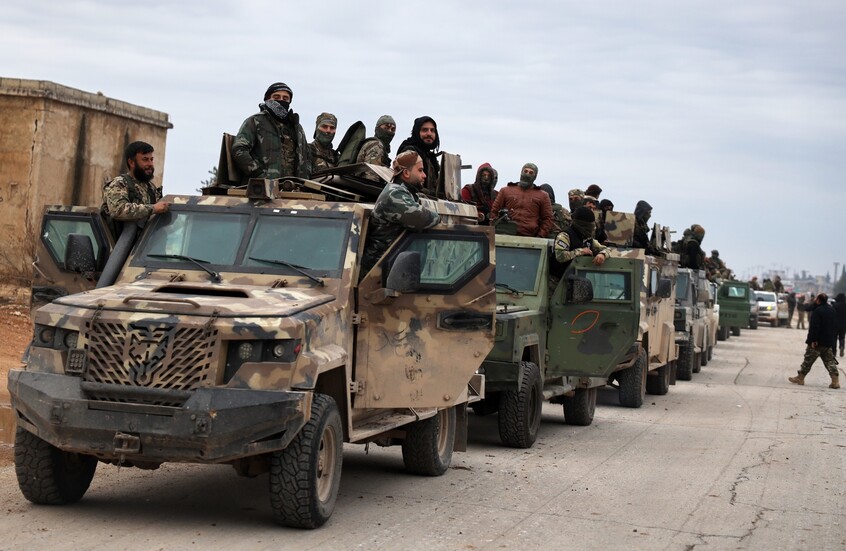
The Syrian army’s Operations Command warned civilians in the provinces of Raqqa, Deir ez-Zor, and eastern Aleppo on Wednesday against entering Syrian Democratic Forces (SDF) sites or tunnels, alleging the areas have been heavily booby-trapped.
The warning comes as Syria’s Ministry of Interior declared the al-Hol camp in eastern Hasakah and recently deployed security prisons as “restricted security zones.” According to the state news agency SANA, the ministry stated that “work is currently underway to secure the al-Hol camp areas and security prisons, search for the remaining escaped Islamic State prisoners, and complete the collection of data necessary to control the security situation.”
The Syrian Ministry of Defence had announced a four-day ceasefire with the SDF starting at 20:00 local time on Tuesday. The ministry said the decision was made “in commitment to the understandings announced by the Syrian state with the SDF and out of keenness for the success of the national efforts exerted.”
However, Syrian Minister of Defence Murhaf Abu Qasra later stated that the Kurdish-led SDF began “arbitrary arrest operations” in Hasakah in the country’s far north-east, less than a day after the ceasefire began. Abu Qasra demanded that SDF elements immediately cease these operations and release all detainees from the Hasakah region, warning that such actions “threaten the ceasefire in its entirety.”
Further warnings from the army’s Operations Command on Wednesday alleged that “the SDF and PKK organisations have booby-trapped doors, corridors, and tunnels, and placed explosive devices in the form of rocks and building bricks.” The statement added that retreating forces had dismantled household furniture and cars at former sites and near public roads.
The command further claimed that booby-trapping extended to mosques, alleging that “many booby-trapped copies of the Quran were found placed in inappropriate locations,” and noted that a number of civilians and military personnel had been killed or injured by these mines and devices.
In response, the SDF issued a statement confirming its “full commitment to the ceasefire agreed upon with the government in Damascus.” The group stated it would not initiate military action unless its forces were attacked and expressed openness to “political paths, negotiated solutions, and dialogue.” The SDF added it was ready to proceed with the implementation of the January 18 agreement to serve “calm and stability.”
The broader agreement, announced on Sunday, stipulates an immediate and comprehensive ceasefire on all fronts and contact points. It includes the withdrawal of all SDF military formations to the east of the Euphrates River as a preliminary step for redeployment. Under the terms, the Syrian government is to receive full and immediate administrative and military control of the Deir ez-Zor and Raqqa provinces. The agreement also provides for the integration of all civilian institutions in Hasakah province into Syrian state structures and gives the government control over all border crossings and oil and gas fields in the region.
Separately, the SDF on Wednesday denied what it termed “misleading claims” regarding an explosion in the Tel Kojer/Al-Ya’rubiyah area. “We categorically deny the claims made by the Minister of Defence of the Damascus government, who alleged that our forces carried out an attack targeting an ammunition depot,” the SDF said. The group stated it had no military activity in the area and claimed that, according to its information, “the explosion resulted from an accident during the transfer of ammunition by Damascus factions.”

