

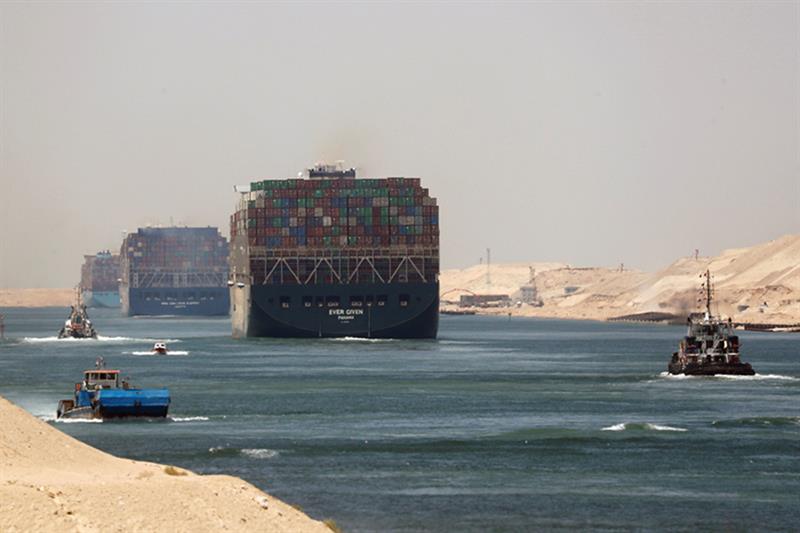
Suez Canal revenue increased by 18.5% in the first half of the fiscal year (FY) 2025/26, Chairperson Osama Rabie said on Wednesday, as he declared conditions ready for the full return of global shipping lines to the waterway.
Speaking during an expanded meeting at the Suez Canal Authority (SCA) headquarters in Ismailia with representatives from 20 shipping lines and agencies, Rabie stated that the “Peace Summit” held in Sharm El-Sheikh succeeded in restoring security and stability to the region. He added that the summit sent messages of reassurance to the international maritime community regarding the freedom of navigation in the Red Sea and the Bab al-Mandab Strait.
Navigation statistics for the first half of FY 2025/26 showed a 5.8% increase in the number of transiting vessels and a 16% rise in net tonnage compared to the same period in FY 2024/25. Rabie noted that current indicators suggest a continued recovery in navigation as some lines resume transits following the stabilisation of conditions in the Red Sea.
“The circumstances are now strongly prepared for the return of all shipping lines,” Rabie said, describing the canal as the most sustainable route for global trade between East and West. He highlighted the SCA’s ongoing strategy to develop the waterway, including the expansion and doubling of the southern sector and the introduction of new maritime services.
Representatives from major global shipping companies indicated that a breakthrough is imminent. Hani el-Nadi, representing A.P. Moller-Maersk in the Middle East and North Africa, confirmed that the return of one of the group’s services is a “preliminary step towards a full return” and serves as a positive indicator for other lines. Amr el-Shafei, operations director at CMA CGM, praised the early announcement of incentives, which assists lines in planning schedules that can extend up to six months.
Marwan el-Simmak, representing Hapag-Lloyd, predicted that 2026 would be the “year of return” for shipping lines to the Suez Canal, noting that massive investments made by these lines in Egyptian ports necessitate a return to the waterway to maximise investment value.
The SCA has maintained a 15% discount for container ships with a capacity of 130,000 tonnes or more, and Rabie confirmed that the authority is currently studying additional incentives and flexible options for specific vessel types.
During the meeting, industry leaders proposed further measures to accelerate the recovery. Adel Lamie, head of the Port Said Navigation Chamber, suggested organising an international conference to reassure clients, while Abdel Aziz Nabil of Inchcape recommended efforts to reduce maritime insurance costs for vessels transiting the Red Sea.
Ahmed Mekkawi, representing Gulf Agency Company (GAC), reported increased inquiries from owners and charterers of Liquefied Natural Gas (LNG) vessels regarding Suez Canal transits. Wassim Choucri of Wilhelmsen also anticipated growth in LNG transits for 2026, driven by expansion in the sector and Egyptian political efforts to support regional stability.
Mohamed Abdel Qader, head of the Suez Chamber of Navigation, said that the return of Maersk services serves as a “strong message of reassurance” that the Red Sea is safe for navigation. Meanwhile, Hany el-Salamouny of COSCO stated that global shipping lines recognise there is no sustainable alternative to the Suez Canal, given the high costs associated with the Cape of Good Hope route.
Deputy Chairman Admiral Ashraf Atwa emphasised that the return of shipping lines is an “urgent necessity” to ensure the efficiency of global supply chains. Rabie concluded the meeting by pledging to study all proposals, including the potential establishment of an institute for maritime agents and additional volume-based incentives suggested by representatives from MSC, ONE, and LBH.


