

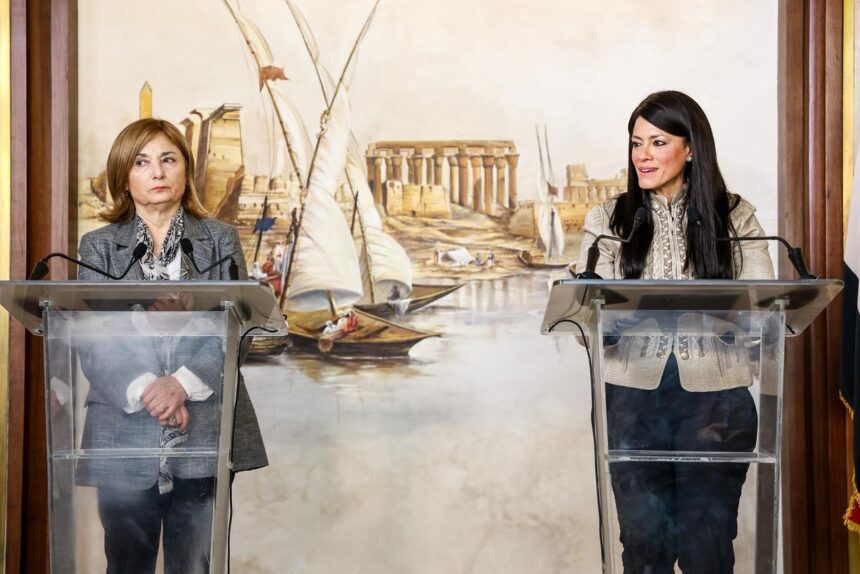
Egypt is scheduled to receive a €1bn disbursement from the European Union this coming Thursday under the Macro-Financial Assistance (MFA) budget support mechanism, according to Minister of Planning, Economic Development and International Cooperation Rania Al-Mashat. The payment follows the government’s implementation of 16 economic and structural measures under the National Structural Reform Program designed to enhance macroeconomic stability.
Speaking at a joint press conference with European Investment Bank Vice President Gelsomina Vigliotti, Al-Mashat stated that Egypt is implementing more than 100 economic and structural policies designed to support the macroeconomy and improve the competitiveness of the Egyptian economy. The Minister noted that the new financing provides broader fiscal space for spending on social protection, health, and education, while concessional mechanisms help reduce short-term financial burdens and extend debt maturities. This development follows the signing of a Memorandum of Understanding for the second phase of the MFA mechanism worth €4bn during the Egyptian-European Summit in Brussels on 22 October 2025.
The upcoming payment represents the first tranche of the second phase of the MFA, which totals €5bn in overall support. A total of 38 reforms have been completed under the strategic partnership so far, including 22 measures linked to a €1bn tranche disbursed in January 2025 and the 16 measures completed for the current installment. Following this week’s payment, €3bn remains to be disbursed in two tranches during 2026. The 16 recent reforms involved coordination between the Central Bank of Egypt and various ministries, including Finance, Investment, and Electricity, to improve public financial management and facilitate investment licensing.
Recent fiscal reforms included strengthening domestic revenue mobilization and further activating amendments to the Public Finance Management Law to monitor financial information between economic authorities and the Ministry of Finance. The government also worked to foster the Medium-Term Budget Framework by adopting a formal coordination protocol between the Central Bank and relevant ministries to unify data-sharing and economic forecasting. These efforts built upon earlier progress, such as the 2024 implementation of an electronic payroll tax system and the establishment of an annual ceiling on general government debt.
To improve the business environment, the government implemented a competitive bidding system for the pricing and sale of industrial land to reduce the risk of violations. Additionally, the launch of an electronic platform for investment licenses aims to facilitate applications and attract more demand-driven foreign direct investment. These steps follow previous measures to increase transparency, including the 2024 publication of details regarding divestment and IPO transactions and the creation of a unified “negative list” of restrictions applied to foreign investment.
In terms of the green transition, the government issued a Prime Ministerial decision setting fees for groundwater extraction for non-agricultural purposes and adopted clear ministerial guidelines for drilling and operating wells. The Cabinet also approved a revised feed-in tariff for waste-to-energy projects and designated the entire marine ecosystem of the Red Sea as a protected area to ensure the sustainability of the tourism industry. To support energy efficiency, the mandate of the Cabinet’s Energy Planning Unit was formally expanded to include strategic planning.
Social protection measures have also been integrated into the reform program, with the government increasing the number of households under the Takaful and Karama cash transfer programs by 100,000 to reach 4.7 million beneficiaries by late 2024. Furthermore, the state expanded microfinance projects and launched the “Mehany 2030” electronic platform to develop youth skills and facilitate the transition from the informal to the formal sector. Al-Mashat emphasized that these reforms reflect the European Union’s confidence in Egypt’s national program and its support for the state’s efforts to boost financial stability.


