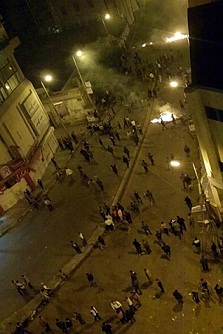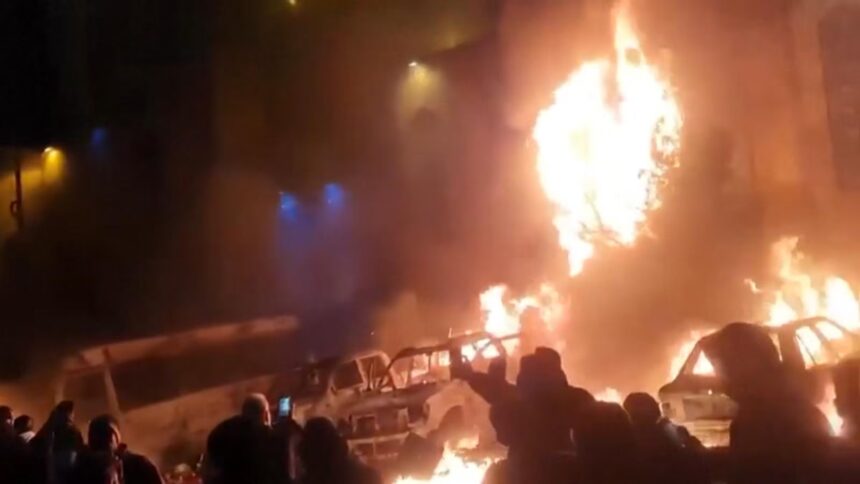
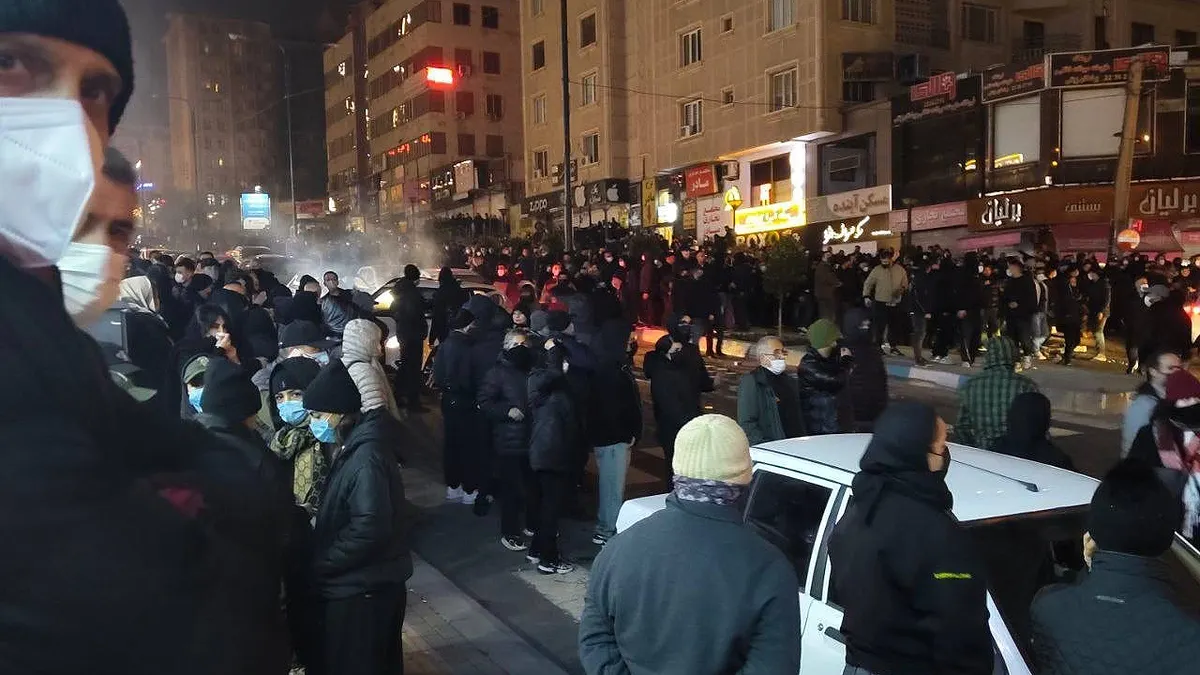
The orange flicker of burning rubbish bins illuminated the debris-strewn streets of Saadat Abad on Friday night as thousands of people gathered in the cold. In the northern Tehran district, usually a bastion of the middle class, the air was thick with smoke and a chant that would have been unthinkable in previous decades: “Long live the Shah.”
Across the country, from the religious centre of Mashhad to the industrial hubs of Isfahan and Tabriz, similar scenes played out for a second consecutive night. Despite a tightening digital blackout and the looming presence of security forces, the protests—marked by the rhythmic thud of “Death to the Dictator” chants—have evolved from a local grievance over the price of bread into a nationwide challenge to the Islamic Republic’s nearly 50-year rule.
By Saturday morning, the Iranian military formally entered the fray. In a statement carried by semi-official news agencies, the army urged citizens to remain vigilant to “thwart the enemy’s plans,” vowing to protect strategic infrastructure and public property “under the command” of Supreme Leader Ali Khamenei. It is the clearest signal yet that the state is shifting from a police response to a military footing as it struggles to contain a crisis born of economic collapse.
The current wave of unrest began on 28 December, ignited by a strike among merchants in Tehran’s Grand Bazaar. Driven by a currency crisis that has sent inflation spiralling, the protest quickly resonated with a population of 90 million, many of whom can no longer afford basic staples. What started as a “bazaar protest” has now metastasised into a broader political rebellion, drawing in diverse social strata across cities like Karaj, Yazd, and Hamedan.
The Human Rights Activists News Agency (HRANA) reports that the violence has already claimed at least 65 lives, with more than 2,300 people arrested. The rising death toll has caught the attention of Washington, adding a dangerous layer of international tension to the domestic turmoil.
President Donald Trump, speaking from the White House on Friday, warned the Iranian leadership against using “excessive violence.” While ruling out ground troops, he suggested that any potential strike would hit the regime “hard in the place where it hurts.” US Secretary of State Marco Rubio echoed this on Saturday, posting on X that the United States “supports the brave Iranian people.”
Within Iran, the response has been a mix of defiance and admissions of failure. Supreme Leader Ali Khamenei, 86, dismissed the American threats, claiming Trump’s hands were “stained with Iranian blood” and accusing protesters of “destroying their own streets” to please Washington.
However, President Masoud Pezeshkian has struck a more sombre tone. “We are stuck, and stuck badly,” he told a cabinet meeting, according to Bloomberg, describing the situation as a “catastrophe” that has plagued his administration from day one. While Pezeshkian has urged security forces not to target “peaceful protesters,” his government’s primary solution—a monthly cash grant of $7 (roughly 9.8m EGP)—has been mocked as a drop in the ocean of 53% inflation.
The economic reality is stark: 20 million Iranian families have fallen into poverty over the last five years. In the month following Israeli strikes on Iran, the prices of rice and baby milk jumped by up to 30%. Mismanagement has also led to a water crisis and regular power cuts, despite Iran possessing some of the world’s largest oil and gas reserves.
This sense of systemic failure has revived the ghost of the Pahlavi dynasty. Reza Pahlavi, the 65-year-old son of the late Shah living in exile, made a rare and direct appeal on Friday, telling Khamenei to “leave this country” and live in Moscow. While analysts doubt a monarchist restoration is likely, the frequency of “Behlavi” chants in Tehran shopping malls suggests a profound nostalgia for the pre-1979 era, used by many as a linguistic weapon against the current system.
The state is now moving to sever the protesters’ ability to coordinate. By Friday night, the internet was almost entirely severed, and international calls were blocked. The Revolutionary Guard’s (IRGC) intelligence wing sent mass text messages to citizens, demanding they report “suspicious persons” and warning parents to keep their children indoors.
“Dandruff of the victims of recent terrorist incidents is on the necks of those who designed them,” the IRGC said in a statement via Tasnim, framing the unrest as a foreign-backed conspiracy involving Israel.
The immediate outlook remains grim. On state television, a presenter warned parents that the streets had become a line of fire: “If something happens, if someone is shot, do not complain.” It is a chilling coda to a week of fire and fury, as a government that admits it is “stuck” prepares to use the full weight of its military to hold a line that its economy can no longer support.