

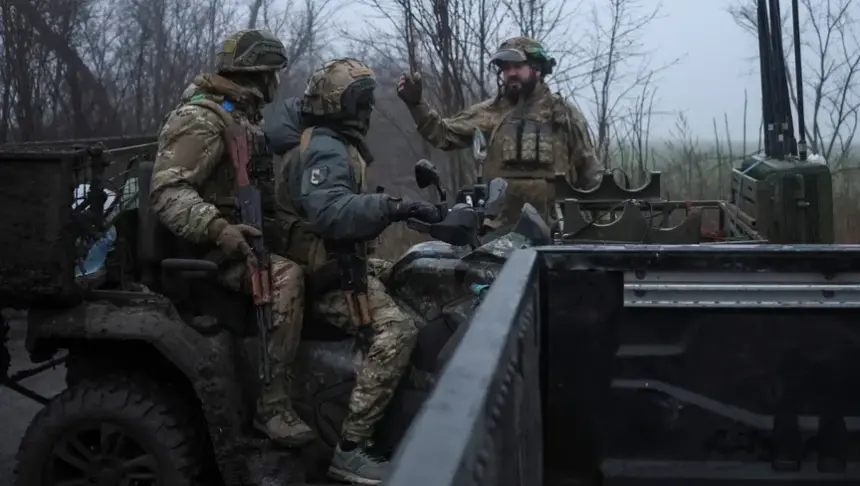
The Kremlin issued a stark ultimatum on Monday, insisting that Ukrainian forces must completely abandon the Donbas region before any cessation of hostilities can begin. The demand, delivered by spokesperson Dmitry Peskov, effectively sets a hard territorial price on the optimistic “20-point” peace framework discussed only hours earlier at Donald Trump’sMar-a-Lago resort.
“We are talking about the withdrawal of the regime’s armed forces from the Donbas,” Peskov told reporters in Moscow, following a 75-minute phone call between President Vladimir Putin and the US President-elect. Warning of the consequences of delay, Peskov added that Kyiv would “lose more territory” if a deal is not struck. While he refused to confirm if this demand extended to the Kherson and Zaporizhzhia regions, the message was clear: Russia views the “final stages” of peace not as a compromise of borders, but as a formalisation of its military gains.
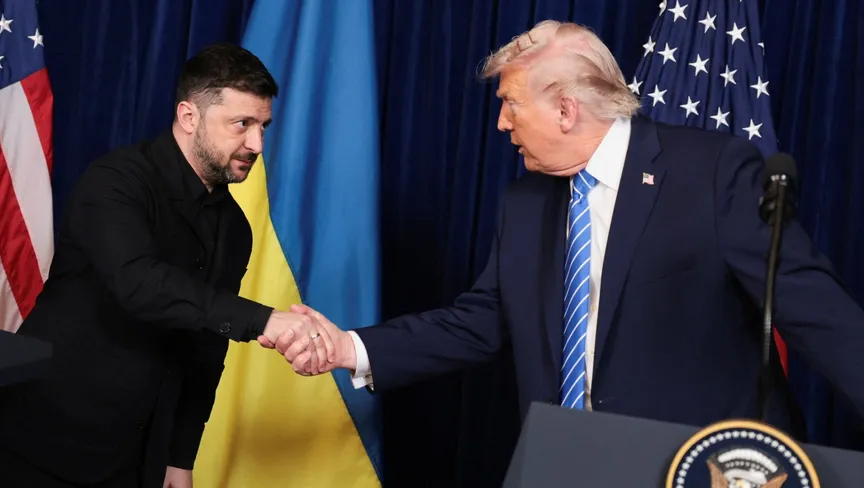
The Russian pivot to territorial demands provides a cold reality check to the diplomatic momentum built on Sunday. By the third year of a war that has reshaped global security, the central conflict has narrowed to a singular, “thorny” question of land. While Trump declared peace “much closer” after his meeting with President Volodymyr Zelenskyy, the Kremlin’sinsistence on a total Ukrainian retreat from the east remains the primary obstacle to any “deal of the century.”
The 15-Year Shield
Speaking to journalists on Monday, Zelenskyy sought to frame the diplomatic progress through the lens of long-term security rather than immediate retreat. He confirmed that the draft framework currently includes US security guarantees for Ukraine spanning 15 years—a commitment he is pushing to extend to 50 years to ensure lasting deterrence.
“A mechanism for monitoring the ceasefire will be part of these arrangements,” Zelenskyy said, though he cautioned that the 20-point plan is not yet a fait accompli. For the Ukrainian leader, the legitimacy of any agreement rests on a national referendum. To conduct such a vote, Zelenskyy is demanding a minimum 60-day ceasefire—a pause that Moscow’spresidential aide, Yuri Ushakov, claimed both Trump and Putin agreed would only “prolong the conflict” by allowing Ukraine to rearm.
The Atomic Wildcard
While the battle lines in the Donbas remain fixed, negotiators have reportedly found common ground on Europe’s most dangerous flashpoint: the Zaporizhzhia nuclear power plant. Trump indicated that “great progress” has been made on the facility, which has been under Russian control since 2022.
US proposals currently favour a “joint control” mechanism for the plant. In a rare sign of practical cooperation, the International Atomic Energy Agency (IAEA) confirmed on Sunday that repairs to power lines had already begun following a localised ceasefire. Trump suggested that Putin had even pledged to assist in Ukraine’s reconstruction, offering “cheap energy” as a sweetener for a final settlement—a comment that Zelenskyy met with a stoic, silent smile.
A January Deadline
The diplomatic schedule is now moving into a high-intensity phase. Trump announced that American, Ukrainian, and Russian working groups—focused separately on security and economics—will be established by early January. Thisfollows what Ushakov described as a “friendly and businesslike” call between the US and Russian leaders, with a second follow-up call expected imminently.
Simultaneously, a “coalition of the willing” led by French President Emmanuel Macron and British Prime Minister Keir Starmer is set to meet in Paris in early January to formalise Europe’s contribution to Ukraine’s security guarantees.
The Referendum Hurdle
Despite the flurry of high-level meetings in the Florida sun, the final word may belong to the Ukrainian people. Zelenskyy emphasised that any deal involving “thorny territorial issues” must pass through the Ukrainian parliament or a popular vote.
As the delegations prepare for a week of technical meetings to “put the finishing touches” on the plan, the gulf between the Kremlin’s demand for withdrawal and Kyiv’s demand for a democratic mandate remains vast. Zelenskyy’s closing statement on Monday served as a reminder of the stakes: “Ukraine is ready for peace,” he said, but it would be a peace signed not just in Mar-a-Lago, but by the citizens in the bunkers of the Donbas.
