

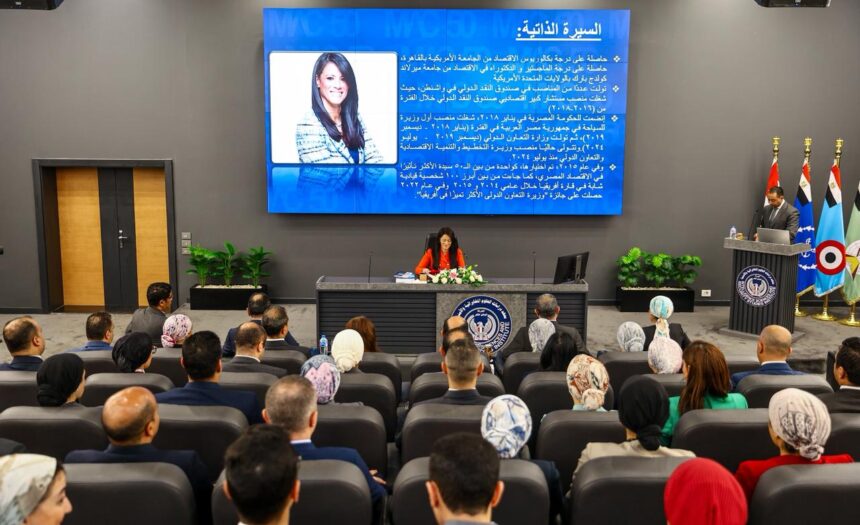
In a room filled with the nation’s newly designated military attachés, the talk was not of ballistics or borders, but of textiles, tech hubs, and the price of global trade. Dr. Rania Al-Mashat, Egypt’s Minister of Planning, Economic Development and International Cooperation, stood before the officers with a directive that extended beyond traditional diplomacy: to represent an economy that she claims has finally pivoted from “managing challenges” to a narrative of “construction and production.”
The setting was symbolic. Addressing the officers as the “shield of the nation,” Al-Mashat sought to arm Egypt’s overseas representatives with a balance sheet to match their uniform. Her message was clear: the Egypt they will represent in 2026 is intended to be a far cry from the debt-burdened state of recent years, aiming instead to be a hub for private-sector-led industry and green energy.
By the third quarter of 2025, the “kernel” of this shift has become evident. Following a series of rigorous fiscal and monetary reforms initiated in March 2024, the Egyptian government is projecting 2026 as a definitive turning point. With growth expected to exceed 5% this fiscal year and an ambitious 7% target on the horizon, the administration is betting that a strict EGP 1 trillion (bn) ceiling on public investment will finally give the private sector the “breathing room” it needs to drive the national engine.
The Private Sector Pivot
Central to Al-Mashat’s briefing was the assertion that Egypt’s growth is no longer a state-funded monolith. Currently, the productive sectors—industry, tourism, and Information and Communications Technology (ICT)—are largely under private stewardship. “The economy is driven by productive, private-sector-led sectors,” Al-Mashat noted, pointing out that 98% of the tourism and industrial sectors are now privately held.
This transition is being felt on the ground. Industrial growth has begun to feed into a surge in exports, while the tourism sector is on track to welcome nearly 19 million visitors this year. Even the Suez Canal, which handles roughly 12% of global trade and remains a vital pulse-point for the economy, is showing signs of recovery. Despite the canal being hit hard by regional volatility, Al-Mashat cited ongoing peace efforts—sponsored by President Abdel Fattah El-Sisi and U.S. President Donald Trump—as a catalyst for the waterway’s recent performance gains.
Governance and the ‘Billion-Pound Ceiling’
To ensure this recovery is sustainable, the Ministry has enforced a hard cap on public spending. By limiting public investment to EGP 1 trillion in the 2024/2025 fiscal year, the government has intentionally redirected bank credit toward private enterprises, particularly in the industrial sector.
This fiscal discipline is part of a broader “National Structural Reform Programme” overseen by the Ministry. The scale is vast, involving:
- 40 national entitiesworking in coordination.
- 430 specific measurescovering tax reform, trade, and labor markets.
- Unified performance indicatorsacross all ministries to ensure “horizontal objectives” are met.
“Macroeconomic stability and reform are mutually reinforcing paths,” Al-Mashat told the attachés. “Reforms enhance stability, and stability enables reform.”
The Human and Green Capital
While the figures focus on finance, the strategy increasingly emphasizes the “human pillar.” For the 2025/2026 plan, 48% of public investments are earmarked for human development sectors. The Ministry maintains that a productive future is impossible without a healthy, skilled workforce at the “centre of development.”
Simultaneously, Egypt is repositioning itself as a renewable energy player to mitigate the high costs of fuel imports. Through the “NWFE” (Nexus of Water, Food and Energy) platform, the state has already mobilised approximately USD 5bn in concessional financing for green projects. The ultimate goal is ambitious: a power grid that derives 42% of its energy from renewable sources by 2030.
Diplomacy of the Balance Sheet
As these military attachés prepare for their postings, they carry with them more than 65 new cooperation protocols signed in 2025 alone. Egypt’s strategy now relies on “concessional financing”—lower-cost alternatives to market borrowing—which has secured USD 9.5bn for budget support and USD 17bn for the private sector since 2020.
The completion of the IMF’s fifth and sixth reviews acts as a final seal of approval for this roadmap. As the session concluded, Al-Mashat’s “kicker” for the officers was a reminder of their role in this economic architecture. By representing a stable, reforming Egypt, they are not just envoys of the military, but ambassadors of a 2026 turning point that seeks to translate high-level macro-stability into “tangible benefits for citizens” on the street.


