
In an unforgivable cinematic debacle, the film “Al-Sett”–directed by Marwan Hamed, written by Ahmed Mourad, and starring Mona Zaki–desecrates the legacy of Kawkab Al-Sharq Umm Kulthum, the eternal national and artistic symbol of Egypt and the Arab world. What should have been a reverent tribute to the greatest voice in Arab history has instead emerged as a disgraceful production that grotesquely distorts her image, portraying her as miserly, money-obsessed and reduced to a crude caricature that strips her of dignity and diminishes her monumental national stature.
This is not merely an artistic failure; it is a deliberate insult and a blatant betrayal of an icon who gave her wealth, her labour and her very soul to Egypt in its darkest moments–donating millions to the army after the 1967 defeat and inspiring generations with a voice that resonated across the world.
The primary culprit in this cultural crime is Ahmed Mourad’s catastrophic screenplay. It fixates on distorted details and advances flagrantly false historical claims. Umm Kulthum is depicted as stingy, obsessively auditing accounts in a vulgar manner, and exaggerated into a calculating, chain-smoking opportunist, while her legendary generosity and unquestionable national sacrifices are wilfully ignored. Even more damning is the film’s dialogue, which bears no relation whatsoever to the historical period in which Umm Kulthum lived. Entirely modern expressions, lifted from contemporary vernacular, are absurdly placed in the mouth of a woman of the early twentieth century.

This alone is conclusive proof that no serious effort was made to research her authentic legacy. The writer neither studied her interviews, nor listened attentively to her archival recordings, nor grasped the linguistic register and rhetorical authority that defined her speech. How can the vast legacy of a woman of Umm Kulthum’s stature be reduced to such a grotesque and degrading image? What is presented can only be described as a gross artistic betrayal and a deliberate mutilation of a legend, rife with naïve distortions of her relationship with Gamal Abdel Nasser and other well-documented historical events. This approach is not the “humanisation” of an icon, as the filmmakers claim, but a cheap provocation that tramples cultural sanctity.
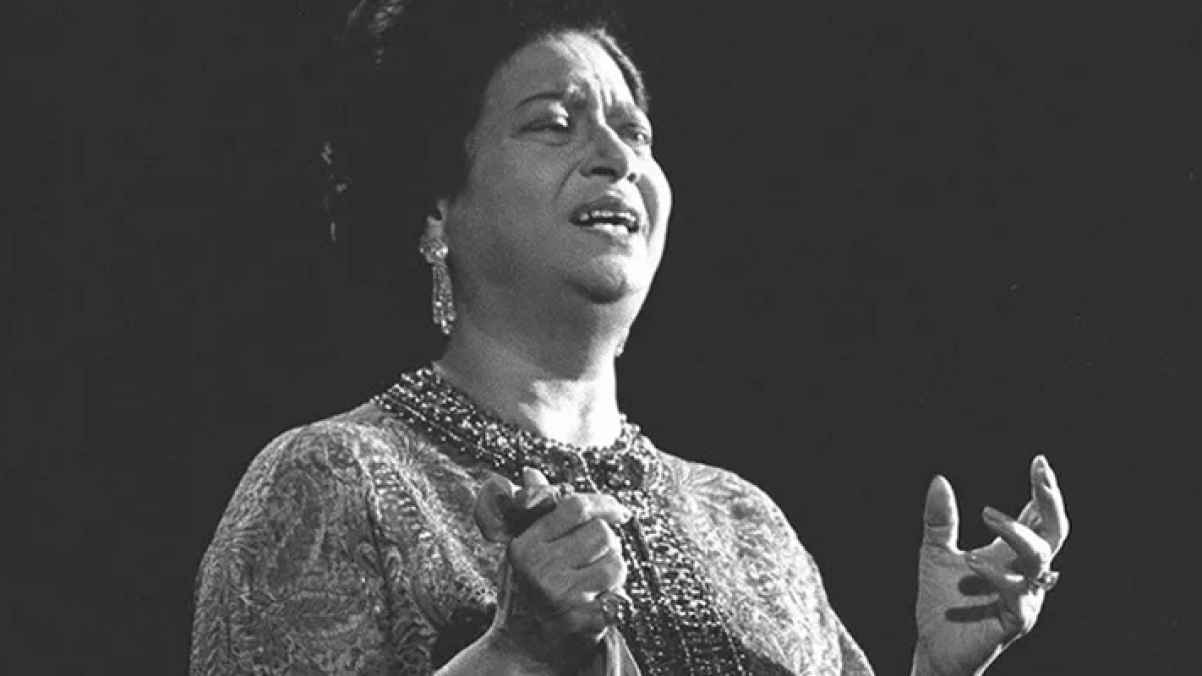
Mona Zaki’s performance constitutes yet another calamity. She utterly fails to capture the spirit of Umm Kulthum, delivering a heavy, contrived portrayal marred by an unverified dialect and a distorted accent that bears no resemblance to the strength, authority and rootedness of the great Egyptian peasant woman. There is no physical resemblance, and the performance lacks emotional gravity, prompting many viewers to lament: “We went in to see Umm Kulthum, and instead we found Mona Zaki.” Marwan Hamed’s direction fares no better–unfocused, visually excessive and dependent on hollow stylistic flourishes that merely conceal the weakness at the film’s core. The final product resembles an unintentionally farcical black comedy, riddled with historical errors and deliberate misrepresentation.
Public outrage is therefore entirely justified. From Mohamed Sobhi, who lived through Umm Kulthum’s era and described the film as inaccurate, to Khaled Montasser, who labelled it a “distortion of a legend”, and broadcaster Sayed Ali, who accused the filmmakers of “demolishing Egypt’s symbols”, the verdict is nearly unanimous. Audiences perceive the film as a direct insult, portraying Umm Kulthum as a chain-smoker, unfilial and opportunistic, raising urgent questions: why this distortion now, and in whose interest is it to dismantle our national symbols so brazenly?
At a time when there appears to be a concerted effort to dismantle the nation’s icons one by one, Al-Sett arrives as the latest instalment in a series of systematic distortions targeting Egypt’s cultural identity with calculated malice. This is no coincidence, nor a passing artistic lapse, but part of a broader trend aimed at stripping national figures of their symbolic stature and recasting them as morally compromised individuals–a prelude to erasing collective memory and weakening national belonging. Who stands behind this dubious current? And why is the desecration of Kawkab Al-Sharq being permitted with such audacity?

Finally, should this obscene distortion be allowed to pass without accountability? The creators of Al-Sett–Marwan Hamed, Ahmed Mourad, Mona Zaki and the producers–have committed a cultural crime against an immortal Egyptian icon. They must be held to account. The relevant authorities, along with Umm Kulthum’s family, should pursue legal action to establish a clear and decisive precedent against exploiting Egypt’s heritage for dubious commercial gain. The insult to Umm Kulthum is not a fleeting artistic misjudgement; it is an act of national betrayal that demands a firm response–before others are emboldened to defile even more of our sacred symbols.