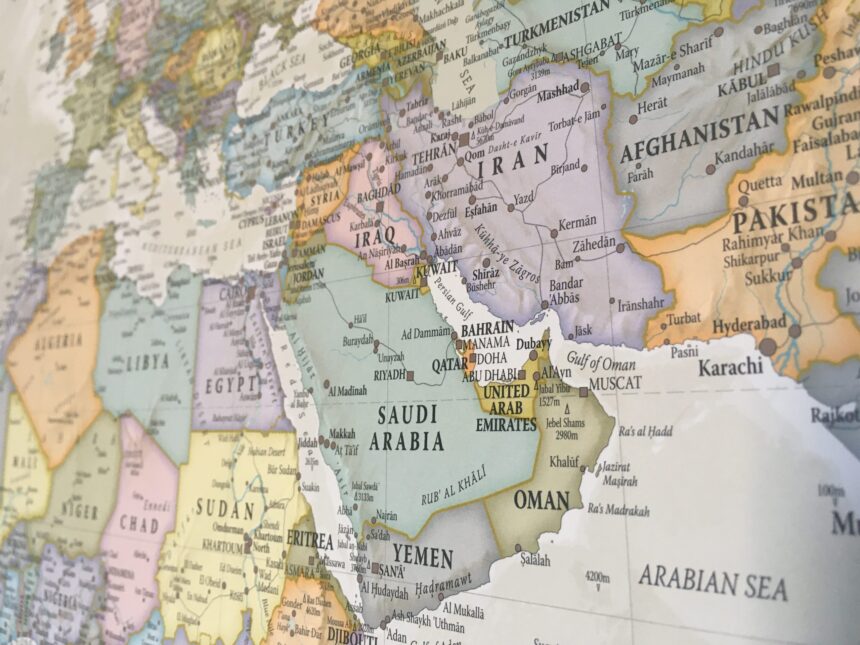
As 2025 draws to a close, the Middle Eastern political theatre is bracing for a seismic shift. At its zenith lies the long-anticipated normalisation between Israel and several Gulf capitals—a process that has remained in the wings since Donald Trump’s first term. However, the foundations of this shift are being laid by evolving dynamics in Yemen, where power balances are being recalibrated, and in Lebanon, which has notably asserted its independence by declining a formal meeting between its foreign ministry and Iranian leadership.
A central Israeli prerequisite for advancing normalisation with Gulf states remains the neutralisation of Iranian proxies across the region. Consequently, the current diplomatic manoeuvres involving Gulf actors in Yemen and Lebanon appear designed to broker compromises that effectively strip these conflicts of their Iranian dimension.
Shifting Sands in Syria and Lebanon
Developments in Syria have added a layer of complexity. Recent American policy has pivoted towards the potential establishment of a Kurdish or quasi-Kurdish entity in eastern Syria, coupled with significant pressure on Damascus to accept a demilitarised buffer zone stretching from its southern suburbs to the Israeli border—an area currently under de facto Israeli military influence. These measures serve as leverage against the Syrian administration, dangling the prospect of massive investment, the lifting of Caesar Act sanctions, and the consolidation of legal authority in the post-Assad era following the collapse of the previous regime in December 2024.
The rhetoric emerging from Washington regarding these “geopolitical” implications is far from mere diplomatic noise. It signals a calculated U.S. approach to decouple Lebanon and Syria from Tehran’s orbit. By framing Hezbollah’s military and political influence within a broader regional restructuring, the U.S. is effectively preparing Lebanese public opinion for a new, albeit uncomfortable, era.
The Looming Deadline
Israel’s northern and southern frontiers remains its most volatile challenges. In Lebanon, initiatives to restore state authority and centralise arms within the Lebanese Armed Forces (LAF) have largely stalled due to the absence of a viable mechanism to disarm Hezbollah. Israel is increasingly impatient; Defense Minister and U.S. officials have signaled that “major and severe strikes” against Hezbollah’s strongholds in the southern suburbs and the Bekaa Valley are imminent if precision missiles and drones are not surrendered by the turn of the year.
All eyes are now on the expiration of the ceasefire deadline intended for the LAF to secure the area south of the Litani River. While Hezbollah maintains that previous agreements apply only to this specific geographic zone, Israel and its allies argue that the regional balance of power has fundamentally shifted since 7 October 2023.
While economic “carrots”—including promises of Gulf and European reconstruction aid—are being offered in exchange for disarmament, Beirut continues to demand a total cessation of hostilities and the right to sovereign rehabilitation. This deadlock leaves the region in a state of suspended animation as 2026 approaches.
The Gaza “Yellow Line”
In Gaza, the situation is even more intricate. A primary U.S.-Israeli condition for any “day after” scenario is the total removal of Hamas from governance. This demand has created diplomatic friction with certain Gulf states, leading to proposals to partition the Strip, with reconstruction commencing only in areas verified to be free of militant activity.
However, the “Yellow Line”—the security buffer established by Israel within Gaza—threatens to become a permanent political frontier. As suggested by Israeli Chief of Staff Eyal Zamir, this line serves as a “forward defensive line” to compensate for a lack of geographic depth. Critics argue the truce has been transformed from a peace-building opportunity into a tool for territorial partitioning. For Israel, this corridor is viewed as the only way to ensure Gaza remains demilitarised; for others, it represents a permanent obstacle to Palestinian sovereignty.
Conclusion: A New Regional Architecture
As dialogue remains stalled, the region awaits the next major American move: the potential announcement of a “Peace Council” in January 2026. Washington appears to be orchestrating a scenario that separates Iran from its nuclear ambitions on one front, and its “Axis of Resistance” proxies on the other.
The strategy focuses on a Gulf-backed political reintegration of these factions, provided they align with the new regional requirements. Yet, as the road to broad normalisation remains blocked by the ruins of Beirut and Gaza, the true test of this high-stakes gamble is set for the coming year.
Dr Hatem Sadek is a professor at Helwan University