

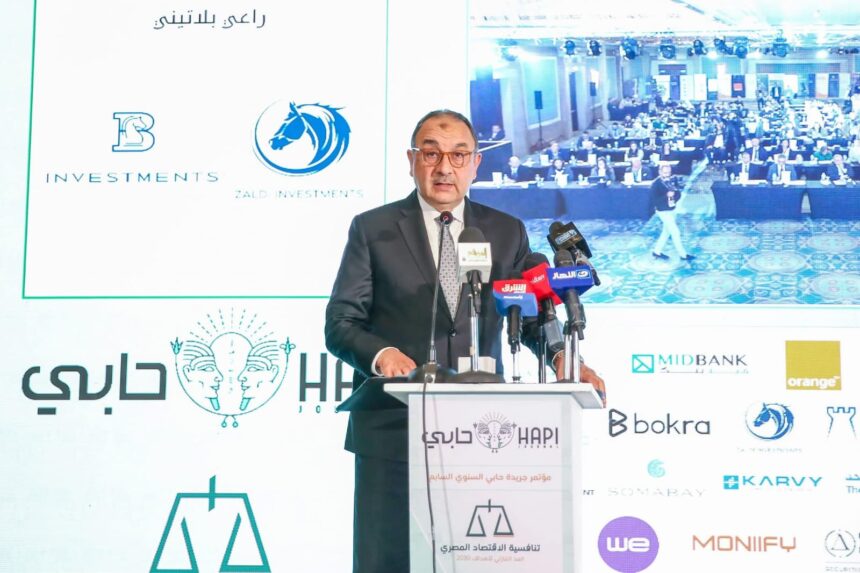
Mohamed El-Shimy, Minister of the Public Enterprises Sector, announced that exports by affiliated companies reached approximately $1bn during fiscal year (FY) 2024/2025, with 40% of companies now exporting to international markets. He added that sector revenues rose by around 20% year-on-year, while the market capitalisation of publicly listed companies increased by 36% over the same period.
El-Shimy noted that the results achieved across revenues, profitability, exports, and partnerships exceeded the targets set, reflecting the success of the Ministry’s reform agenda.
The Minister made these remarks during the opening session of the seventh edition of Hapi newspaper’s annual conference, where he outlined the strategic framework guiding the Ministry’s work. He explained that the strategy is grounded in Egypt’s Vision 2030, the government’s programme of action, and the State Ownership Policy Document, with the aim of maximising returns on state investments, enhancing competitiveness, and strengthening the contribution of affiliated companies to national economic output.
El-Shimy stressed that the Ministry has adopted a comprehensive reform approach that goes beyond financial performance to encompass institutional efficiency, governance, management practices, operating models, and human capital development. He added that a unified performance governance framework has been introduced for affiliated companies, directly linked to the Sustainable Development Goals (SDGs), to support the transition towards a diversified, knowledge-based and competitive economy driven by productivity, value added, financial sustainability and an improved business environment.
He further highlighted ongoing efforts to strengthen corporate governance, sustainability, and occupational health and safety, alongside restructuring boards of directors. These initiatives are complemented by a green economy strategy aimed at transforming affiliated companies into low-emission entities and enhancing their global competitiveness.
The Minister emphasised that boosting national economic competitiveness requires the optimal utilisation of state assets, higher investment returns, and expanded partnerships with the private sector, underpinned by governance and competitive neutrality. He reaffirmed that public enterprises operate under the same rules as private-sector companies, without preferential treatment, ensuring a fair and attractive investment climate that enhances investor confidence.
El-Shimy pointed out that the achievements of the past decade represent a structural transformation rather than a temporary upswing, noting that revenues of affiliated companies have grown by more than 360%, despite a reduction in the number of companies and the transfer of some entities to other authorities.
He added that the past fiscal year witnessed several companies shifting from loss-making to profitable operations, alongside tangible progress in project execution, the resolution of long-standing structural challenges, and a faster-than-targeted expansion of private-sector partnerships.
Highlighting key strategic projects, El-Shimy referred to the national spinning and weaving development programme, noting that its first phase was completed in December 2024, the second phase is under way, and full completion is scheduled for mid-2026.
He also pointed to the revival of El Nasr Automotive Manufacturing Company, which resumed operations after more than 15 years of inactivity and returned to profitability following decades of losses. The revival includes the modernisation of bus and passenger vehicle plants, preparations for electric vehicle production, and comprehensive upgrades to production lines.
In the pharmaceuticals sector, El-Shimy said that companies under the Holding Company for Pharmaceuticals have undergone extensive upgrades to comply with Good Manufacturing Practice (GMP) standards, covering approximately 97 production lines. The reforms also included the revival of El Nasr Pharmaceutical Chemicals Company and the restart of previously idle facilities, such as the Egyptian Carbon Anode Blocks Company in partnership with BP, and the ferrosilicon plant at KIMA in cooperation with a Saudi investor.
As part of efforts to deepen cooperation with local and international private-sector partners, El-Shimy highlighted several high-quality agreements, including a solar power plant project to supply Egyptalum with clean energy in partnership with Norway’s Scatec; a joint venture between the Holding Company for Pharmaceuticals and US-based Dawah Pharma to manufacture and export Egyptian pharmaceuticals and dietary supplements; and a project to develop a phosphate industrial complex at El Nasr Mining Company.
Additional initiatives include plastic recycling and textile waste recycling projects at Misr for Artificial Silk and Polyester Stable Fibres Company, implemented in partnership with Emirati and Egyptian investors.
El-Shimy concluded by reaffirming the Ministry’s full commitment to reform, openness to private-sector partnerships, and disciplined governance of state assets, in support of Egypt’s broader and sustainable economic development trajectory.


