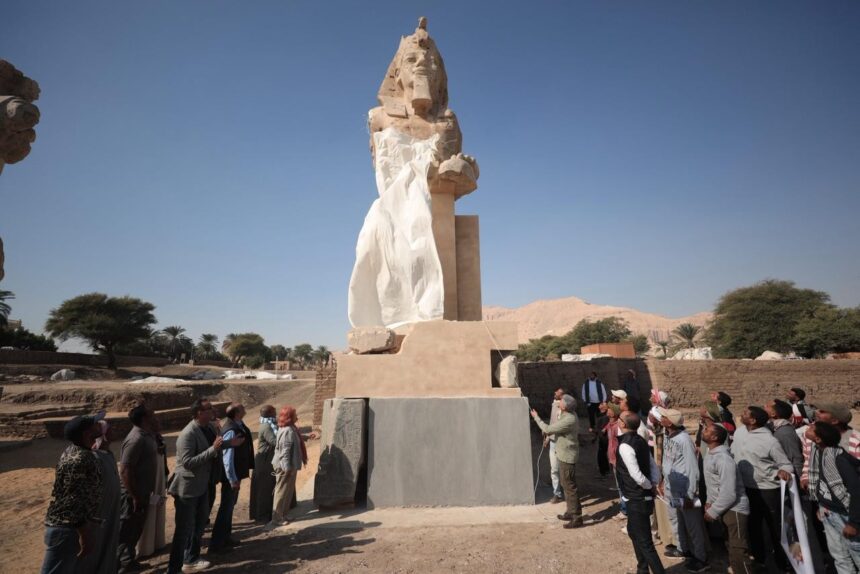
Egypt’s Minister of Tourism and Antiquities Sherif Fathy presided over the unveiling of two colossal alabaster statues of King Amenhotep III at his mortuary temple on Luxor’s West Bank, following an extensive restoration and reinstallation effort that returned the monuments to their original locations.
The ceremony underscores Egypt’s ongoing efforts to preserve and revitalise one of its most significant archaeological sites, enhancing both its historical integrity and visitor experience.
The restoration was carried out through a long-term collaboration between the Supreme Council of Antiquities (SCA) and the German Archaeological Institute in Cairo, which began in 1998 with support from the World Monuments Fund and Johannes Gutenberg University Mainz. The project focused on conserving the remaining architectural elements of the temple, restoring the statues, and safeguarding the site against environmental threats.
The statues, measuring between 13.6 and 14.5 metres in height, depict the king seated with his hands resting on his thighs. He is shown wearing the traditional nemes headdress, the double crown, a ceremonial beard, and the bull’s tail, and is accompanied by smaller figures representing royal queens and princesses.
Mohamed Ismail Khaled, Secretary-General of the SCA, said the restoration followed the latest scientific techniques and international conservation standards. He noted that specialised materials compatible with the original stone were used to ensure long-term preservation, alongside the installation of an integrated water-management system to protect the site from rising groundwater linked to the Nile.
Dietrich Rau of the German Archaeological Institute highlighted the project’s collaborative nature, involving Egyptian and international specialists, and noted the contribution of the U.S. Research Center in Egypt in efforts to lower groundwater levels around the temple.
Beyond the two statues, the project included the recovery, documentation, and reinstallation of numerous architectural and sculptural elements, including more than 280 statues and fragments of the goddess Sekhmet, as well as limestone sphinxes. These efforts form part of a broader plan to rehabilitate Luxor’s West Bank and preserve its outstanding archaeological value.
The mortuary temple of Amenhotep III, constructed during the first half of the 14th century BCE over the king’s 39-year reign, was once among the largest and most richly decorated funerary temples in ancient Egypt. Much of the complex was destroyed by an earthquake around 1200 BCE, with later damage caused by flooding, sedimentation, and stone quarrying. The newly restored statues—widely known as the Colossi of Memnon—are among the few surviving elements returned to their original setting.
The project has also played a key role in training Egyptian conservators and architects, helping to build national expertise in heritage preservation. Minister Fathy expressed hope that the achievement would encourage further international cooperation in protecting and showcasing Egypt’s cultural heritage.