

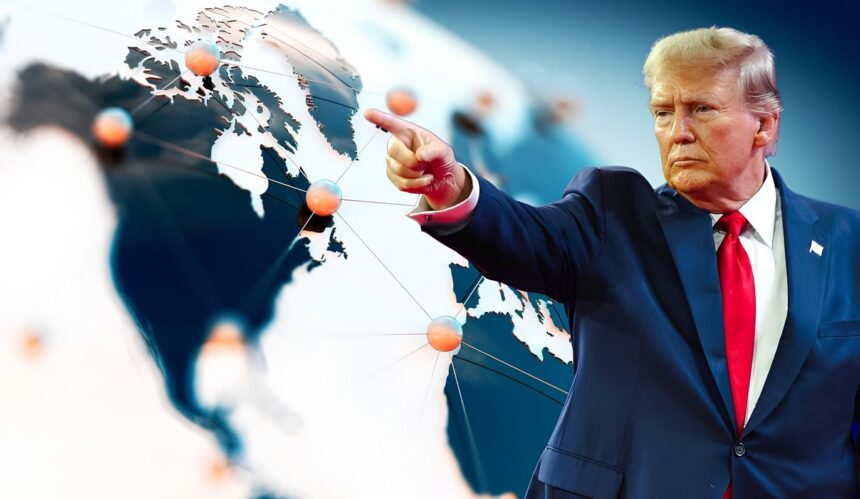
US President Donald Trump has unveiled a comprehensive strategic document aimed at reshaping Washington’s global role, particularly in the Western Hemisphere, and redefining its relationship with China, which has become America’s most formidable challenger.
The strategy, published by The Atlantic and Foreign Affairs, revives the Monroe Doctrine, which views the Western Hemisphere as an exclusive sphere of American influence and considers any encroachment in that region a direct threat to US national security. This marks, according to the document, a logical and forceful restoration of American power and its strategic priorities.
According to the document, Trump intends to maintain a more robust US military presence in the Western Hemisphere to counter irregular migration, narcotics flows, and the rise of hostile powers in the region. The 33-page strategy explicitly states that “American predominance in the Western Hemisphere is a prerequisite for its security and prosperity.” It further stresses that the terms of US alliances, and of any form of assistance, must be conditioned on reducing malign external influence, from controlling military installations, ports, and critical infrastructure to limiting the acquisition of broadly defined strategic assets.
The document describes these plans as part of a “Trump Doctrine” version of the Monroe Doctrine. First articulated in 1823 by President James Monroe, the doctrine warned that the United States would not tolerate hostile foreign interference in the Western Hemisphere. The strategy asserts that it is in Washington’s vital interest to negotiate a rapid cessation of hostilities in Ukraine and to reduce the risk of Russian confrontation with other European states. Notably, the document offers only mild criticism of Moscow. Instead, it directs some of its most pointed remarks at America’s European allies, implicitly criticizing European efforts to curb far-right parties and characterizing such measures as political censorship.
The Trump administration, the document suggests, is increasingly at odds with European officials who hold unrealistic expectations about the war in Ukraine while operating within unstable minority governments that often undermine democratic norms to suppress opposition. The strategy also warns that migration could radically alter Europe’s identity in ways that may harm US alliances. In the long run, it argues, the majority of NATO members are likely to be non-European within a few decades.
The new National Security Strategy acknowledges that the United States faces difficult choices in the scientific arena after years in which American foreign-policy elites convinced themselves that US dominance was permanent. Reality, however, has demonstrated that several states once supported by Washington, most notably China, have become formidable competitors.
The strategy identifies China’s growing assertiveness as the most serious long-term threat to American global power. Yet despite its tough tone, the strategy avoids inflammatory rhetoric. It pledges to rebalance the US–China economic relationship by prioritizing reciprocity and fairness in order to restore American economic sovereignty.
The document also calls for strengthening ties with Latin American governments, including cooperation on identifying strategic resources, an unmistakable reference to rare-earth minerals. It declares that the United States will deepen its partnerships with the private sector to advance “strategic acquisition and investment opportunities for American companies across the region.” These commercial commitments, though broadly framed, are likely to appeal to Latin American governments long frustrated with Washington’s limited engagement. Still, the compatibility of these promises with Trump’s insistence on imposing tariffs on key trade partners remains uncertain.
Ultimately, the strategy is the latest, and clearest, expression of Trump’s intent to overhaul the post–World War II international order built on alliances and multilateral institutions, replacing it with an “America First” framework.
But the central question for us is the place of the Middle East in this strategy. Strikingly, the document makes only rare mention of the “Middle East,” while Israel appears explicitly six times, with repeated assertions that its security is a top priority. Washington now views its primary interest in the region as avoiding costly “forever wars.”
Iran is labeled “the principal destabilizing force,” though the document emphasizes that US and Israeli strikes since October 7, 2023, including the “Midnight Hammer” operation in June 2025, have significantly degraded Iran’s nuclear program and its proxies in Yemen, Lebanon, and Syria.
The document acknowledges that the Israeli–Palestinian conflict remains the most intractable issue, yet argues that the ceasefire and the release of hostages have produced momentum toward a more durable peace and have weakened or constrained Hamas’s backers.
The core of the new American calculus is clear: the Middle East has effectively fallen out of the grand strategic equation. It is no longer a central arena of global conflict nor a geostrategic chessboard. Oil has lost its strategic significance—America is self-sufficient, Europe is shifting toward renewables, and the world is actively diversifying energy sources. Even Europe now views the region largely through the lens of preventing refugee flows. And the region’s “strategic corridors” have begun to lose relevance as alternative shipping routes and technologies emerge—a trend highlighted by the aftermath of the October 7 conflict.
The document is far from perfect, and its success will depend more on implementation than drafting. Yet it clearly reflects the contours of a new geopolitical reality. The only serious variable lies in Trump’s unpredictable personality, which could jeopardize adherence to the strategy, or a sudden global crisis could upend priorities altogether. Even so, the strategy aligns closely with the administration’s actions during Trump’s second term and with the views of many of his advisers.
Prof. Hatem Sadek, Helwan University

