

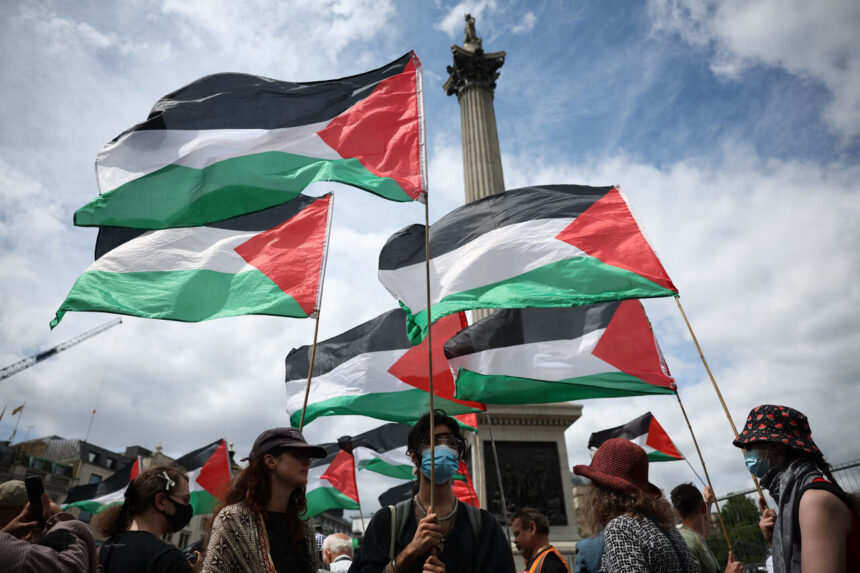
The recognition of the State of Palestine on 21 September 2025 by Britain, Canada, and Australia represents one of the most significant diplomatic ruptures in the trajectory of the Arab–Israeli conflict. What took place was not simply a symbolic gesture but a structural reconfiguration of Western policy, whereby international law and the principle of self-determination were restored as normative anchors in the discourse on Palestine.
For Britain, the decision resonates with historical depth. Since the Balfour Declaration, London’s name has been linked to the very origins of the Palestinian question, and successive governments oscillated between acknowledging a historical responsibility and aligning with Western strategic imperatives. The act of recognition today cannot be divorced from this long genealogy. It is an attempt, at least rhetorically, to redress a moral imbalance and reposition Britain as a credible interlocutor in the Middle East. In the post-Brexit era, such a move also signals a recalibration of British diplomacy, which increasingly relies on visible commitments to human rights and justice in order to consolidate its global standing.
Canada’s recognition carries a different but equally decisive weight. Unlike Britain, Canada does not bear a colonial burden in the Middle East. Instead, Ottawa’s foreign policy identity has long been tied to multilateralism, mediation, and respect for international institutions. By recognizing Palestine, Canada transformed from a mediator to a norm-setter, offering a moral precedent that may embolden European and Latin American states to follow. More importantly, Canada’s recognition reflects an internally coherent trajectory: a state that frames its foreign policy around legality and rights could not indefinitely postpone acknowledgment of Palestinian statehood. In this sense, Canada’s position may well mark the clearest articulation of a value-based foreign policy in the Western sphere.

Australia’s decision, meanwhile, stems from a geopolitical rather than historical imperative. Long aligned with U.S. strategic visions, Canberra often hesitated to take positions that could disturb the Western consensus. Yet its recognition of Palestine reflects an awareness that the perpetuation of the conflict has destabilizing effects on the Asia-Pacific region and undermines the very international order on which Australia depends. Thus, the recognition is both a moral stance and an investment in regional stability, signalling that the Palestinian question has ceased to be a peripheral Middle Eastern matter and has become embedded in broader global security concerns.
The Israeli response, delivered by Prime Minister Benjamin Netanyahu, was predictably uncompromising. He described the recognition as a “reward for terrorism” and a “threat to peace.” From an academic perspective, this reaction reveals a deeper structural crisis. Israel’s diplomatic strategy has long relied on an assumption of unwavering Western backing, which allowed it to frame Palestinian resistance as illegitimate while expanding settlement policies with impunity. The tripartite recognition disrupts this discursive monopoly. Netanyahu’s rhetoric is thus symptomatic of Israel’s declining ability to dominate international narratives; it reflects not strength but vulnerability. Scholars of international relations interpret this as a paradigmatic shift: Israel is no longer the uncontested beneficiary of Western consensus but increasingly a state under normative scrutiny.
The broader implications of this moment are profound. First, within Europe, the precedent set by London, Ottawa, and Canberra will likely energise debates in France, Germany, and Scandinavia, where public opinion has become progressively sympathetic to Palestinian rights. Second, in the Arab world, particularly the Gulf states that normalised relations with Israel, this recognition may prompt a recalibration of their positions. They can no longer rely on the shield of Western consensus to justify normalisation without addressing the core Palestinian issue. Third, within international institutions, recognition will strengthen Palestinian claims to membership in bodies where Israel has long attempted to block them.
This development should not, however, be over-romanticised. Recognition alone does not alter the facts on the ground, where occupation, settlement expansion, and military asymmetry persist. Its transformative potential lies in whether these recognitions are accompanied by concrete policy measures—such as conditioning military aid, protecting Palestinian sovereignty in international fora, or supporting reconstruction in Gaza and the West Bank. Without such follow-through, recognition risks remaining symbolic, albeit significant.
Nonetheless, 21 September 2025 marks a watershed. It reflects a Western reorientation from complicity in the maintenance of occupation to an acknowledgment—at least discursively—of Palestinian statehood as a legal and moral imperative. Britain’s historical responsibility, Canada’s principled diplomacy, and Australia’s geopolitical recalibration converge in a rare alignment that has already altered the discourse. For Israel, this constitutes not only a diplomatic setback but a structural challenge: the erosion of its hegemonic position in the Western narrative. For Palestinians, it is not the end of the struggle but the reopening of international legitimacy as a tangible resource.
In academic terms, the recognition is best understood as a transition from a system of historical complicity—where great powers justified occupation through silence or selective legality—to a system in which international law regains normative primacy. The durability of this transition will depend on whether Western capitals move beyond discourse to implement measures that anchor recognition in political reality.
Dr. Marwa El-Shinawy – Academic and Writer

