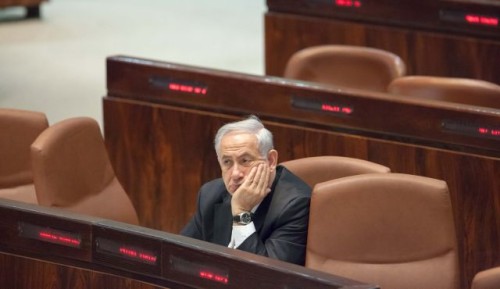
Israeli Prime Minister Benjamin Netanyahu is facing escalating political challenges and widespread public exhaustion ahead of October elections, as multi-front wars against Iran, Hamas, and Hezbollah fail to secure decisive victories, according to the Associated Press.
The lack of definitive outcomes after more than two years of conflict has spurred political consolidation against the country’s longest-serving prime minister. Opposition leader Yair Lapid and former Prime Minister Naftali Bennett announced on Sunday their intention to run together in the upcoming elections, with former military chief Gadi Eisenkot expected to join them.
“After 925 days of fighting since October 7, Israel has failed to achieve a decisive victory on any front,” military affairs commentator Yoav Limor wrote, summarising the national mood. “At the end of another war, it is perceived as a state whose decisions are not made in Jerusalem, but in Washington.”
When the US-Israeli campaign against Iran launched in late February, Netanyahu stated the objectives were to weaken the Iranian military, eliminate its nuclear and ballistic missile programmes, and create conditions to topple the regime. However, despite sustaining significant damage, the Iranian military remains a threat to neighbouring countries and navigation in the Strait of Hormuz, and the government in Tehran remains in power following a ceasefire earlier this month.
Netanyahu has nonetheless framed the campaign against Iran as a “success” and a preemptive strike against an existential threat. “We crushed the Iranian regime’s destruction machine in advance,” he stated recently.
Similarly, Israel’s recent war in Lebanon halted before fully achieving its stated objectives. Netanyahu said he agreed to the truce at the request of US President Donald Trump, emphasising that Israel is “not done yet” with the Iran-backed Hezbollah group, while Israeli forces continue to occupy a 10-kilometre strip in southern Lebanon. In the Gaza Strip, after more than two years of war and pressure from Trump to reduce military operations, Hamas remains intact, albeit “weak,” according to the AP.
These inconclusive outcomes have triggered a significant decline in public trust, which initially plummeted following the October 7, 2023, Hamas attack. While an Israel Democracy Institute (IDI) poll showed 64% of respondents trusted Netanyahu’s management during the first week of the Iran war, a subsequent survey following the 8 April ceasefire revealed that the public’s overall assessment of the government’s handling of the conflict had turned negative. Prior to the US-brokered truce extension in Lebanon, a majority of Israelis believed fighting against Hezbollah should continue.
“People felt disappointed because they (the wars) did not achieve the goals,” Tel Aviv-based political analyst Dalia Scheindlin said.
The Lebanon ceasefire has also sparked deep disappointment and protests in Israeli border towns, with much of the anger directed at Netanyahu, the AP reported. Nadav Eyal, a writer for the Yedioth Ahronoth newspaper, noted that Netanyahu faces a “big problem” if he cannot convince the public that the conflicts achieved lasting security. “With fragile ceasefire agreements that could collapse at any moment, voters will not be satisfied with that,” Eyal said.
The political vulnerability is compounded by potential divergences between Israeli interests and those of President Trump. The IDI poll indicated most Israelis believe the likelihood of a US-Iran agreement adequately considering Israel’s security is “somewhat low” or “very low”. Moreover, an invitation for Trump to officially receive the “Israel Prize”—making him the first foreign leader to do so—in Jerusalem on 22 April for the 78th anniversary of Israel’s Independence Day passed without a visit.
Despite these concerns, Trump continues to publicly praise Israel. He recently posted on his Truth Social platform that “whether people like Israel or not, it has proven to be a great ally to the United States.”
Trump also announced he would host Netanyahu and Lebanese President Joseph Aoun at the White House “in the near future” for truce talks, describing the opportunity as an “honour.” While Netanyahu’s office declined to comment on the relationship, an anonymous Israeli official stated that “Trump and Netanyahu still speak daily.”