

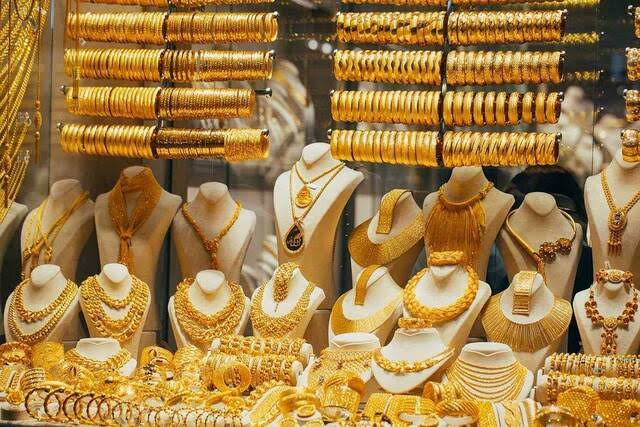
Gold prices in the local market rose by EGP 215, or 3.2%, last week, reflecting a similar increase in the global gold price, which rose by $65, or 1.3%. This surge was driven by escalating geopolitical tensions and renewed demand for the precious metal as a safe-haven asset, according to a report from the iSagha platform.
Saeed Embaby, CEO of iSagha, noted that the 21-karat gold gram opened the week at EGP 6,710 and closed at EGP 6,925. The 24-karat gram reached around EGP 7,914, while the 18-karat gram hit approximately EGP 5,936. The price of the gold coin also climbed to about EGP 55,400.
Globally, the price of gold per ounce rose from $5,043 at the start of the week to $5,108 by the close. The rally in gold prices came after data indicated a slowdown in U.S. economic growth, with the core Personal Consumption Expenditures (PCE) index exceeding 3%, the Federal Reserve’s preferred inflation gauge.
However, the U.S. Supreme Court’s ruling on tariffs, which declared those imposed under the National Emergencies Act unlawful, sparked a boost in risk appetite. This, in turn, led U.S. equities to recover from earlier losses.
Gold prices also regained the $5,000-per-ounce level as concerns over rising geopolitical risks escalated, particularly with the possibility of a military confrontation between the U.S. and Iran. U.S. President Donald Trump’s deployment of significant military reinforcements to the region, including aircraft carriers and fighter jets, renewed concerns about Middle East stability and potential disruptions in energy markets, as well as global inflation.
Despite gold reclaiming this key threshold, its weekly gains were relatively modest, suggesting a wait-and-see approach among investors. U.S. GDP data revealed a slowdown in growth, dipping to 1.4% year-on-year, compared to 4.4% in the previous period. Additionally, the University of Michigan’s consumer sentiment index dropped slightly, from 57.3 to 56.6 points, amid ongoing inflationary pressures.
At the same time, inflation expectations for the coming year fell to 3.4%, while longer-term expectations remained steady at 3.3%. Markets are anticipating two interest rate cuts of 25 basis points each this year, as speculation over U.S. monetary policy continues to build.
Despite some market volatility, gold prices have held firm above $5,000 per ounce, supported by geopolitical risks, a slowing U.S. economy, and central banks’ ongoing efforts to diversify their reserves. Many financial institutions remain bullish on gold, with UBS predicting prices could reach $6,200 by mid-2026, and Bank of Montreal projecting a potential rise to $6,500 in a strong bullish scenario.
ANZ forecasts that gold could reach $5,800 per ounce in the second quarter, while Goldman Sachs sees a potential rise to $5,400 by the end of 2026, driven by renewed institutional demand.
However, JPMorgan analysts caution that a slowdown in central bank purchases could put downward pressure on prices. They also note that gold’s relatively low share in reserves in emerging markets (19%) compared to advanced economies (47%) suggests strong medium-term demand.
Official data indicated that the Russian central bank reduced its gold holdings by 300,000 ounces in January, taking advantage of the recent high prices above $5,600 per ounce. Despite this sale, the value of Russia’s gold reserves increased by 23%, reaching $402.7bn, buoyed by higher global gold prices.
In conclusion, gold remains well-supported by a mix of geopolitical risks, a slowing U.S. economy, and central banks’ ongoing diversification efforts. As global uncertainty persists, movements in the dollar and bond yields will play a key role in shaping gold’s price trajectory in the near future.
