

Iran warned on Friday it would treat any military strike as “total war” and has placed its armed forces on high alert as a US carrier strike group and thousands of troops approach the region.
A senior Iranian official told Reuters that while Tehran hopes the military build-up does not lead to a physical confrontation, the military is prepared for the “worst-case scenario.”
“This time we will deal with any attack, whether limited or comprehensive, a precision strike or direct military targeting… as a total war against us,” the official said. “We will respond in the strongest possible way to settle this matter.”
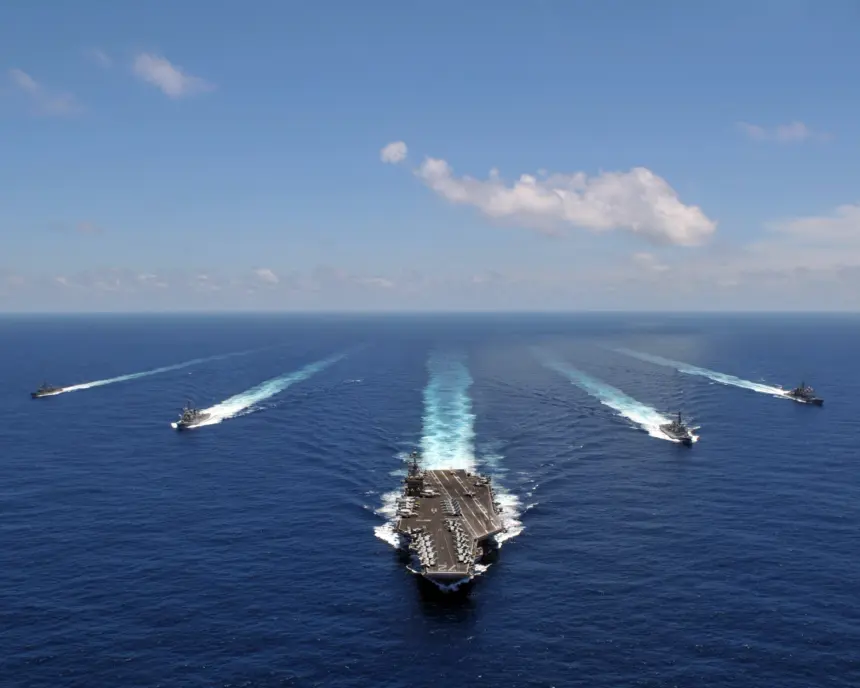
The nuclear-powered USS Abraham Lincoln carrier strike group, carrying an air wing of approximately 80 aircraft, was in the Indian Ocean on Friday after crossing the Strait of Malacca earlier this week. The deployment includes three Arleigh Burke-class guided-missile destroyers capable of carrying Tomahawk missiles and F-35C fighter jets.
US President Donald Trump said on Thursday that a “fleet” was heading toward Iran, though he expressed hope that its use would not be necessary. Trump reiterated warnings to Tehran against the killing of protesters or the resumption of its nuclear programme.
The arrival of the carrier group adds approximately 5,700 personnel to the US regional footprint. These assets will join three coastal combat ships in Bahrain and two destroyers already patrolling the Arabian Gulf. Additionally, US Central Command confirmed that F-15E Strike Eagle jets are now positioned in the Middle East, while the British Ministry of Defence announced the “defensive” deployment of Typhoon fighters to Qatar.
Risk consultancy Eurasia Group estimated the probability of US or Israeli strikes on Iran before April 30 at 65%, citing the potential failure of diplomatic efforts. Rapidan Energy Group placed the likelihood of a strike within the coming weeks at 70%.
The military activity has caused widespread disruption to international aviation. Air France, KLM, and Lufthansa have suspended or restricted flights to cities including Dubai and Tel Aviv, while avoiding Iranian and Iraqi airspace. US-based United Airlines and Air Canada also cancelled flights to Tel Aviv scheduled for Friday and Saturday. British Airways previously suspended flights to Bahrain, the base of the US Navy’s 5th Fleet.
The current tension follows US strikes on Iranian nuclear facilities in June 2025, which were met with an Iranian volley of 12 missiles against Al-Udeid air base in Qatar. Analysts suggest the current build-up may be intended to protect US and allied assets from more severe retaliation should the Iranian government perceive an existential threat.
Domestically, Iran has faced widespread protests since late December triggered by economic conditions. While Tehran reports more than 3,000 deaths in the unrest, other reports suggest the figure exceeds 5,000.
Mignon Houston, US State Department deputy spokesperson, said on Friday that Trump is monitoring the situation “very closely.” She stated that while the administration’s priority is regional peace, the US remains committed to ensuring Iran is without nuclear weapons or ballistic missile programmes, which Washington views as a national security threat.
